




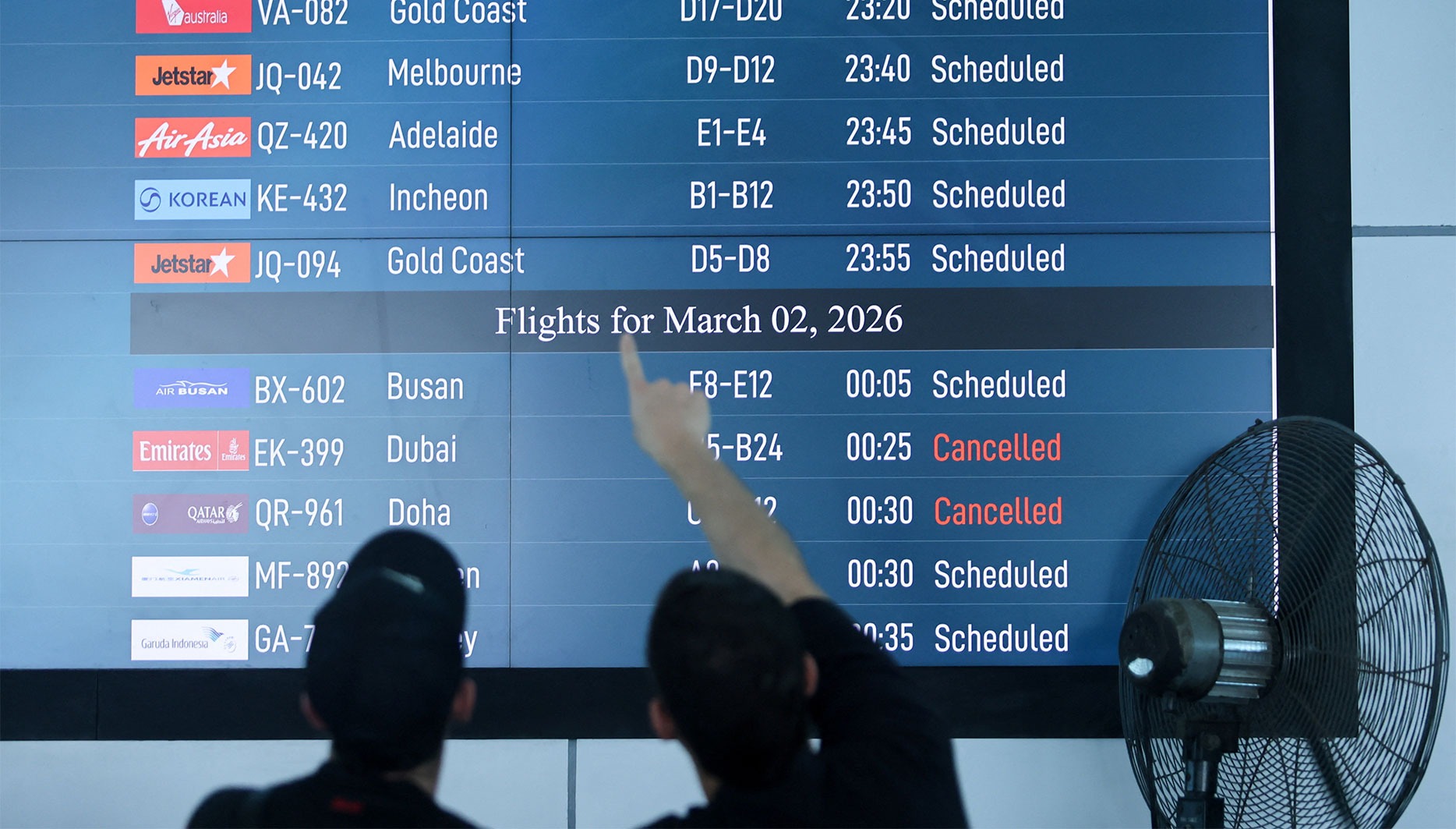
 Passengers look at the departure board at I Gusti Ngurah Rai International Airport in Bali, Indonesia, on 1 March after some flights to Dubai and Doha were cancelled following the US and Israeli strikes on Iran. (Photo Johannes Christo / Reuters)
What’s the background here?
Israel and the United States (US) launched an attack on Iran on Saturday, 28 February, killing the nation’s supreme leader, Ayatollah Ali Khamenei, and plunging the Middle East into renewed conflict.
At least 201 people have been killed in the attacks on Iran, including 148 people at an elementary girls’ school in Minab, southern Iran, reported Al Jazeera.
/file/attachments/orphans/13790435_153250.jpg "Smoke rises in central Tehran after an Israeli attack on 28 February (Photo: Abedin Taherkenareh / EPA)")
Iran has since responded with retaliatory missile attacks targeting US and Israeli assets in the neighbouring Gulf states. By Sunday evening, three US troops had been killed in action, nine people had been killed in Israel, and at least four people had been killed in Iran’s retaliatory attacks across the United Arab Emirates, Kuwait, Qatar, Bahrain and Oman.
Read more: Three more strikes aimed at Iran after US, Israeli assault kills supreme leader
The joint US-Israeli attack on Saturday came eight months after both countries waged a 12-day war against Iran and followed weeks of mounting threats from US President Donald Trump that the US would strike again if Iran pressed ahead with its nuclear and ballistic missile programmes.
How are flights affected?
As tensions escalate, airlines across the Middle East have suspended flights, disrupting global air travel. Major airports, including Dubai International Airport in the UAE and Ben Gurion in Israel, have also been closed.
According to a Reuters report, Dubai International Airport sustained some damage from Iran’s retaliatory airstrikes, while airports in Abu Dhabi and Kuwait were also hit.
Emirates, the region’s largest airline, has paused all flights to and from Dubai until Monday. Qatar has also suspended flights until the Qatari airspace is safely reopened.
Read more: Airlines cancel flights across Middle East after US and Israel launch strikes on Iran
/file/attachments/orphans/RC2LVJAWE7DB_783146.jpg "Stranded passengers wait near the Emirates Airways customer service office at I Gusti Ngurah Rai International Airport in Bali, Indonesia, on 1 March after flights to Doha, Dubai and Abu Dhabi were cancelled following the US and Israeli strikes on Iran. (Photo: Johannes Christo / Reuters)")
In a statement on Sunday, 1 March, Airports Company South Africa (Acsa) confirmed that the continued closure of the UAE airspace was affecting Emirates and Qatar Airways flights at various South African airports.
According to Acsa, the flight disruptions were as follows:
- Eight cancellations at OR Tambo International Airport (seven outbound and one inbound);
- Four cancellations at Cape Town International Airport (outbound); and
- Two cancellations at King Shaka International Airport (outbound).
“Passengers scheduled to depart from South African airports to destinations in the Middle East and the UAE are strongly advised not to proceed to airport precincts until they have confirmed the status of their flights directly with their respective airline,” said Acsa.
For rebooking and assistance, customers can contact:
- Emirates: www.emirates.com or +971 600 555 555
- Qatar Airways: www.qatarairways.com or +974 4144 5555 / +44 3309 127 416
South African Tourism has also encouraged travellers to contact their airlines, travel agents, or relevant airports directly to check the latest flight information before proceeding with their travel arrangements.
Are South Africans in the region affected by the attacks?
Department of International Relations and Cooperation (Dirco) spokesperson Chrispin Phiri confirmed that as of 2pm on Sunday, all South African diplomats and citizens in the region who were known to the department were safe.
“We do not have any distress calls,” he said.
Dirco’s head of public diplomacy, Clayson Monyela, said the department was in touch with South Africans in the region.
With the closure of various airspaces, Monyela, in a post on X, said, “It’s impossible to move in or out of those countries. We are in touch with South Africans using various [communications] platforms. Our systems do work. Every country’s diplomatic mission [has] evacuation plans. Various interventions and options are being explored.”
Airspaces are closed Mam. It's impossible to move in or out of those countries. We are in touch with South Africans using various comms platforms. Our systems do work. Every country's diplomatic mission have evacuations plans. Various interventions & options are being explored. https://t.co/72ZrfdWvEb
— Clayson Monyela (@ClaysonMonyela) March 1, 2026
South Africa’s consulate general in Dubai on Sunday issued an advisory to South African citizens residing in the UAE, urging them to “exercise heightened vigilance in light of the evolving situation in the region”.
The consulate general called on all South Africans residing in the UAE to take precautionary measures to ensure their safety, including registering immediately with the South African mission, limiting non-essential movement and avoiding large gatherings.
According to Monyela, about 18,000 South Africans are registered with the mission, reported JacarandaFM.
In a post on X, Dirco listed the contact information for South African embassies and consulates in several Gulf states. One can also visit Dirco’s website for further details.
ALERT | Important information for South African citizens currently in the Middle East region.
— DIRCO South Africa (@DIRCO_ZA) March 1, 2026
In the event that you find yourself in distress, please contact the SA Embassy/Consulate in the country of your residence. Visit https://t.co/jLfq4M13kS #MiddleEast#ConsularService pic.twitter.com/xlVEbb1xqR
What else might be affected?
According to a report from The Guardian, the conflict in the Middle East has also threatened the flow of oil, which could affect the price of petrol and other fuels. The publication reported that Iranian officials had warned tankers in the Strait of Hormuz, one of the most crucial oil routes in the world, that no ship would be allowed to pass.
While Iran has not formally confirmed a blockade on the waterway, ships appeared to be avoiding the strait after an attack on a ship off the coast of Oman. If the pause continues, it could block up to 15 million barrels a day of crude oil from reaching their destinations, reported the publication.
How has the South African government responded?
President Cyril Ramaphosa has expressed “deep concern” over the escalating tensions in the Middle East, and called on all parties to exercise restraint and abide by international law, international humanitarian law and the principles of the United Nations (UN) Charter.
“These developments pose a serious threat to regional and international peace and security, with far-reaching humanitarian, diplomatic and economic consequences,” he said in a statement on Saturday.
/file/attachments/orphans/13794013_793893.jpg "Emergency services personnel at the scene of a building that was struck by an Iranian missile in Tel Aviv, Israel, on 1 March. (Photo: Abir Sultan / EPA)")
“Article 51 of the UN Charter provides for self-defence only when a state has been subjected to an armed invasion. Anticipatory self-defence is not permitted under international law, and self-defence cannot be based on assumption or anticipation,” he continued.
Ramaphosa said that there could be “no military solution to fundamentally political problems” that should be resolved diplomatically.
“Military confrontation has never delivered sustainable peace, nor has it addressed the legitimate grievances that underlie conflict. Long-term peace and stability can only be achieved through inclusive dialogue and a genuine commitment to justice and coexistence,” he said. DM
Comments
Scroll down to load comments...