



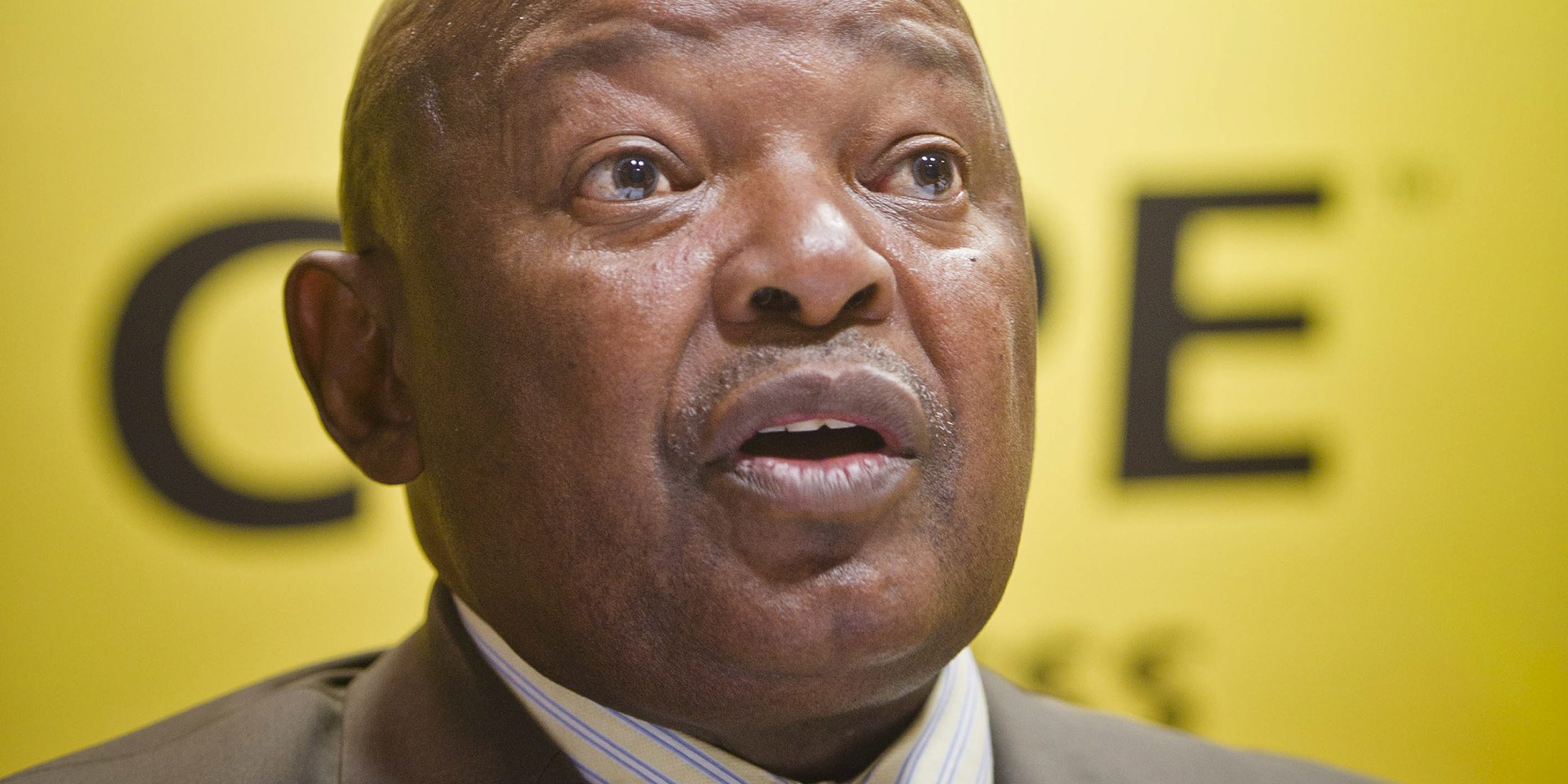
 Mosiuoa ’Terror’ Lekota on 18 October 2013. (Photo: Gallo Images / Foto24 / Nelius Rademan)
When confronting the cacophony that is our current politics, it is easy to forget that for a long period, it was not like this. In fact, during the early 2000s, it seemed that our politics could settle into an unhealthy pattern.
At the time, the political landscape was dominated by the ANC and the DA, a rivalry that — while a simplification — often reduced our national discourse to a matter of race. Black people voted for one party while white people voted for the other.
The third-biggest party was the IFP. While it attracted mostly black voters, it was also an identity party. It was then, and probably still is, primarily a party for people who spoke a particular language.
Back then, the signs of corruption were already becoming evident.
The Arms Deal had come and gone, leaving only Tony Yengeni as a convict. Schabir Shaik was being prosecuted, and in 2005 was found guilty of bribing Jacob Zuma.
Zuma was the deputy president at the time. And in a crucial moment, President Thabo Mbeki removed him from office.
/file/attachments/orphans/000074935_971657.jpg "At the 52nd ANC National Conference in Polokwane, ANC president Thabo Mbeki (centre) and national chairperson Mosiuoa Lekota share a light moment, while Jacob Zuma sits alongside. (Photo: Johnny Onverwacht)")
Things were so bad that by 2007, the then ANC secretary-general, Kgalema Motlanthe, told Carol Paton, “This rot is across the board. It’s not confined to any level or any area of the country. Almost every project is conceived because it offers opportunities for certain people to make money.”
Then, over 20 years ago, our political reporting was not the public interparty spectacle it is now. It was confined mainly to reporting on what was happening inside the ANC.
This was because there was no realistic prospect of another party having any impact on South Africa’s trajectory. It was almost as if South African politics were locked in a laager mentality.
So strong was the hold of this idea that when Zuma was elected leader of the ANC in the rain and mud of December 2007, it was hard to believe that anything could challenge him. Instead, most of the analysis focused on whether this would help the DA.
The start of competitive politics
As late as May 2008, just after the ANC recalled Mbeki, it was difficult to imagine anyone making a dent in the hold the ANC had on the vast majority of voters.
But not for Mosiuoa Lekota.
He and Mbhazima Shilowa decided they could no longer be a part of the ANC under Zuma.
Eventually, after a period of hints, suggestions and speculations, they went public. Lekota delivered his “divorce papers” during a press conference at Primedia Place in Sandton and said he was forming a new party.
This was beyond revolutionary at the time.
/file/dailymaverick/wp-content/uploads/2022/08/0000165959.jpg "Cope leader Mosiuoa Lekota speaks in Parliament on 30 May 2012. (Photo: Jaco Marais / Gallo Images / Foto24)")
The only previous example was the UDM, formed by Bantu Holomisa (and for a time, Roelf Meyer). It had some support, but was limited to Holomisa’s own support base.
No one would have wanted to follow their lead. It seemed a route to electoral oblivion.
Following a massive and well-funded conference at the University of the Free State in December 2008, Cope contested the 2009 elections.
Suddenly, the election was not just about the ANC and the DA, and, to an extent, the IFP. It was also about the ANC and Cope competing for the same constituency of voters.
The fact that Cope won more than 1.3 million votes had important consequences. First, it was Cope that prevented Zuma’s ANC from winning a two-thirds majority.
/file/attachments/orphans/0000200383_510229.jpg "Mosiuoa Lekota outside the Johannesburg Magistrates’ Court on October 18, 2013, after the court ruled that he was the rightful leader of Cope, ending a three-year legal battle. (Photo: Nelius Rademan / Gallo Images / Foto24)")
Knowing what we know now about Zuma’s personal agenda, one wonders what would have happened if the ANC, led by him, had won the power to unilaterally change the Constitution.
Second, it showed other leaders, some inside the ANC, that it was possible to win votes from outside the party.
Without Lekota’s leadership of Cope at the time, and his decision to form a new party, Julius Malema may never have formed the EFF.
There may even be a direct line from Lekota’s formation of Cope, and its initial success, to the proliferation of political parties in South Africa. It was this that made our politics competitive.
From race to policy
It was also important for another reason. Before Cope, parties were largely defined by racial or ethnic identities
Cope was not. It was, if it was anything, a party for people who used to vote for the ANC but did not like Zuma, which gave it a more urban flavour.
It replaced identity politics with a competition centred on policy and ideology — a shift that, in retrospect, proved to be a defining moment for the country.
In the hours after the 2021 local elections, at the elections centre, this journalist was lucky enough to spend a few hours with Lekota, waiting for votes to come in.
/file/dailymaverick/wp-content/uploads/2022/08/0000138481.jpg "Mosiuoa Lekota casts his vote in the municipal elections on 18 May 2011. (Photo: Charl Devenish / Gallo Images / Foto24)")
Ideology and identity were clearly still at the forefront of his mind when he hailed ActionSA’s performance as the election’s most critical result. He suggested that, for the first time, South Africans had transcended racial lines to rally around one individual and a common ideal.
ActionSA may well grow or decline in the local polls this year. But as Lekota inspired Malema and others to form their own parties, so Herman Mashaba has inspired others to also campaign for a new multiracial political identity.
/file/attachments/2989/20140509-_MG_2774_713226.jpg "Cope leader Mosiuoa Lekota stays true to his word and ‘eats’ his hat after the party received reduced support in the 2014 elections. (Photo: Greg Nicolson)")
Human first
For this writer, Lekota made one other important contribution, both as a politician and as a human.
In 2006, PW Botha died. As the defence minister, Lekota gave a press conference in Pretoria the following morning.
The reporter Ben Said (unfortunately, also late — and still deeply missed), asked Lekota’s spokesperson if the minister would say anything about Botha.
The answer to that request was, completely understandably, no. Botha’s henchmen had jailed Lekota — he had no reason to mourn the man.
Said, typically, then asked Lekota directly whether he had anything to say.
This was pre-YouTube, but this writer’s memory records it in this way: Lekota said, “I have nothing to say about him.”
There was a pause.
And then he said, “But I’m sorry for his family, and I send them my regards.”
In that single moment, Lekota offered a rare contribution to our politics — the reminder that no matter our differences, we are human first. It is a necessary truth in these troubled times, standing in stark contrast to a world where some leaders gleefully celebrate the loss of human life. DM
Comments
Scroll down to load comments...