





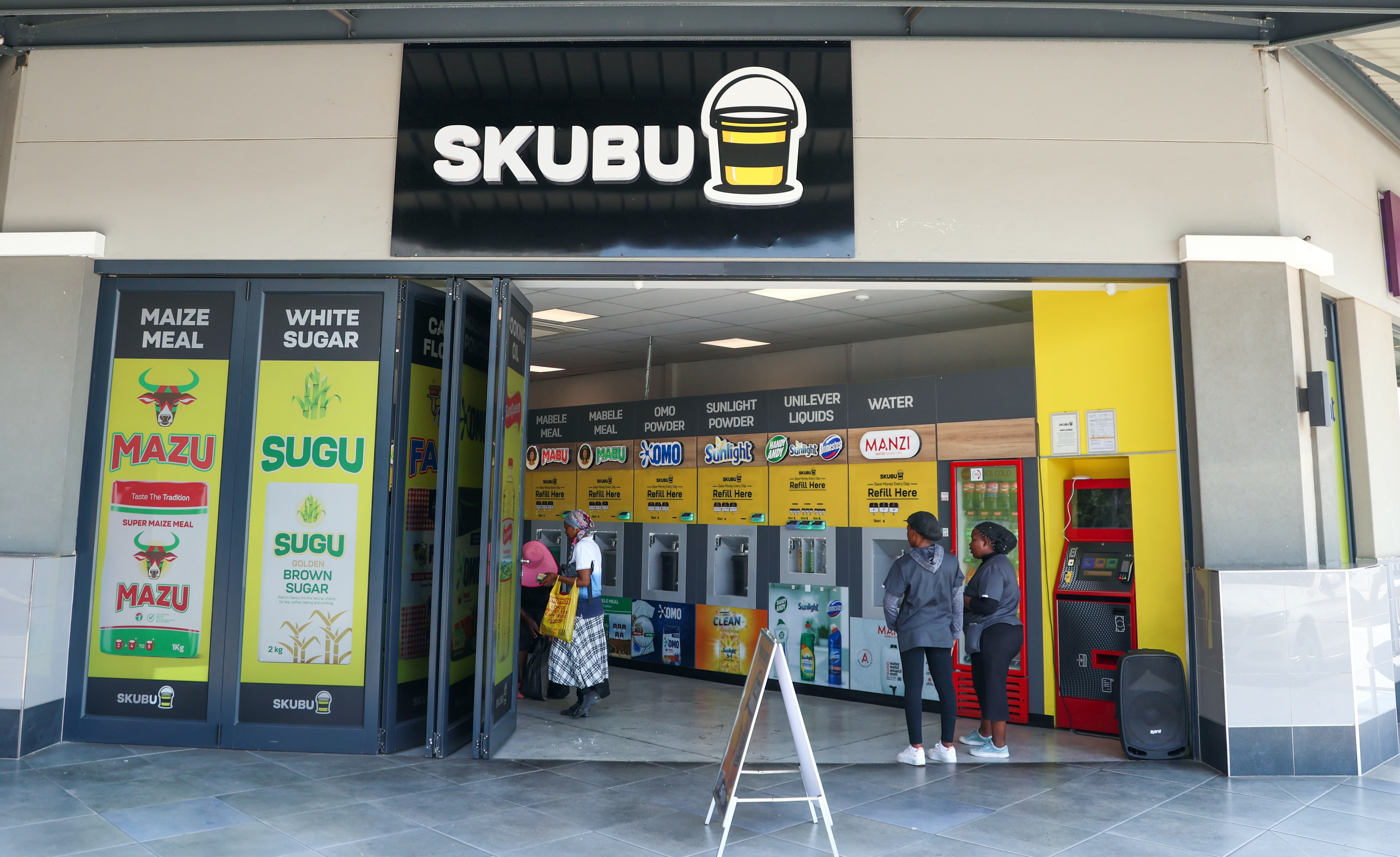
 The Skubu stor at the Diepsloot shopping centre in Johannesburg. Innovative refill stores like Skubu and Gcwalisa are tackling the rising cost of living by allowing consumers to buy only what they need, thus promoting fair pricing and sustainability. (Photo: Felix Dlangamandla)
 “I wouldn’t think about going to any other shop,” says a local businesswoman in Diepsloot, Johannesburg, who sells scones to passersby. “It is much cheaper and affordable to buy everything I need from them.”
By the time most of Diepsloot is waking up, she has already sold her scones. Armed with her containers and the morning’s earnings, she makes her way to the local Skubu refill store and buys exactly what she needs for the next batch, no more. Tomorrow, she will do the same thing.
It is a precise, self-sustaining routine, built on daily decisions. And it is made possible by a model that is quietly gaining ground in some of SA’s most under-served communities.
The Skubu model
Skubu, launched in Diepsloot, lets shoppers fill their own containers with essentials like maize meal, cooking oil, sugar, cleaning products, and pay only for what they take, at a standardised price per unit regardless of quantity.
The Council for Scientific and Industrial Research (CSIR), which supported the venture under the Department of Science, Technology and Innovation’s Circular Economy Demonstration Fund, found that the model can eliminate up to 100% of single-use plastic packaging and enable savings of up to 50%.
The idea came from its founder and managing director, Ebenezer de Jongh, during his time as a logistics manager at a large fast-moving consumer goods company. He noticed something that troubled him: the smallest pack sizes, designed to be affordable, carried the highest margins.
/file/attachments/orphans/6I1A3751_593719.jpg "A Skubu employee packs a customer’s maize meal at the Diepsloot store in Johannesburg. (Photo: Felix Dlangamandla)")
/file/attachments/orphans/6I1A3741_827056.jpg "Junior Mokhele (left) and Khayelihle Zulu, employees at Skubu at the Diepsloot store. (Photo: Felix Dlangamandla)")
/file/attachments/orphans/6I1A3757_566531.jpg "Skubu employee Amukelani Mdaka helps a customer load money onto her Skubu card in the refill store. (Photo: Felix Dlangamandla)")
“A 1kg bag of maize meal is sold for R20 or R22, but a 10kg [bag] is sold for like R90 or R100,” said De Jongh. “How does it make sense that you’re paying twice the price for the exact same thing just because you can’t afford the bigger pack size?”
With more revenue gained when people buy products in smaller pack sizes, more waste is generated, too, he told Daily Maverick.
“I just thought that was a problem that is worth solving, and that I had the ability to solve [it],” said De Jongh.
His grandmother’s stories of grocery shopping in Zimbabwe inspired the idea for the refill stores. “We are basically going back to the future,” he said. “We solve the cost and waste problem by using our tech and the old way of doing it.”
De Jongh left corporate life and sold his house to raise initial capital and to build something different. Sonke Retail (Pty) Ltd, the parent company, was founded in 2020. The Skubu stores currently operate in two locations, with De Jongh clear that the focus is on serving their current community well rather than rushing expansion.
“We just try to have a positive impact where we operate at the moment,” said De Jongh. “We are an impact company first and foremost; we’re here to solve social and environmental problems.”
For the woman who bakes scones each morning, the benefit is practical and immediate. She said the benefit wasn’t hers alone.
“Many of the community members all get a lot of benefit from having a store where they can buy what they need,” she said.
De Jongh also runs Sonke Sales Solutions, a separate venture that works to equip young entrepreneurs with the skills to start and grow their own businesses. The two businesses reflect the same underlying philosophy: that the existing system was not built with low-income communities in mind, and that closing that gap requires better access.
The weight of small purchases
The January 2026 Household Affordability Index, compiled by the Pietermaritzburg Economic Justice and Dignity Group, shows that the average cost of a household food basket across six major cities stands at R3,720.25 per month, for a family of four. The National Minimum Wage, at R4,836.72 per month, would leave a person unable to cover core household and family expenses, which include transport to get to work and back, prepaid electricity, and the cost of a basic basket of nutritional food. The current cost of living is forcing families to make tough choices between nutritious food and filling food.
It is in this context that a new kind of retailer has begun to emerge; one built on a deceptively simple idea: let people buy exactly what they need, at a fair price per unit, in their own containers.
The same principle, different hands
Just off the main road in Alexandra, outside Alex Mall, sits a container. It is not a conventional store – there are no aisles, no trolleys, no checkout queues. But on any given morning, there are people. A grandmother measuring out a few rands’ worth of sugar. A child stopping by on the way to school. Neighbours catching up while they wait. This is Gcwalisa, and for many residents of Alexandra, it has become as familiar and essential as any shop in the area.
/file/attachments/orphans/6I1A3803_314016.jpg "Josephine Katumba, head of operations at Gcwalisa, with some of the products available in store. (Photo: Felix Dlangamandla)")
/file/attachments/orphans/6I1A3801_519001.jpg "(Left) Zuzeka Silo, operations associate at Gcwalisa, and Lekau Makgamatua, a Gcwalisa employee and community leader in Alexandra, at the Gcwalisa store outside Alex Mall. (Photo: Felix Dlangamandla)")
Gcwalisa operates on the same weigh-and-pay model, but with a distinct community-embedded structure. Speaking to Daily Mavrick, Josephine Katumba, the head of operations at Gcwalisa, which currently runs six outlets in Alexandra, said: “For us, this is about democratising access to food and essential household items. Freedom should include the freedom to afford basic necessities with dignity.” It currently runs six outlets across Alexandra, all operating on the same principle: products dispensed from bulk containers, customers paying only for the exact amount they take, whether that is R2 worth of sugar or a single teabag.
According to Katumba, the model has revealed something that mainstream retail rarely accounts for – many township residents shop daily rather than monthly, because income is inconsistent.
“Gcwalisa’s system allows people to stretch their money without embarrassment,” she said. “It restores dignity by giving customers control over quantity and spending.”
Many community members did not have stable incomes, said Ntandoyenkosi Mlambo, finance associate at Gcwalisa. The store allowed them to use whatever they had on hand to still put food on the table.
“[The store] gives people dignity. Instead of having to borrow a cup of sugar or a cup of flour from a neighbour every day, they can come here and buy what they need and can afford,” she said.
Zuzeka Silo, operations associate at Gcwalisa, said that many children in the area left for school without breakfast. Some of them stopped at a Gcwalisa container on the way, where they could buy a portion of Weet-Bix for R2.
/file/attachments/orphans/6I1A3794_884419.jpg "The Gcwalisa store outside Alex Mall. (Photo: Felix Dlangamandla)")
/file/attachments/orphans/6I1A3783_475307.jpg "Lekau Makgamatua and Zingiswa Hlongwane at the Gcwalisa store outside Alex Mall. (Photo: Felix Dlangamandla)")
The stores have also created a sense of ownership among residents. When Gcwalisa opened its first container in Alexandra, a community member named Lekau Makgamatua, who lived on the same street, began cleaning in front of the store each morning, getting up at four o’clock to make sure the space was tidy before the day began. Nobody asked him to. He did it because he saw what the store meant for his neighbours and wanted to maintain it. When the company’s CEO learned what Makgamatua had been doing, he was eventually brought on in a part-time cleaning role. He is now a full-time employee and a recognised community leader.
Less packaging, cleaner communities
The benefits of the refill model extend beyond the till. A study on solid waste management in Alexandra township, the same community where Gcwalisa operates, in May 2024 found that solid waste is not reliably collected and transported in low-income communities in SA, with the main obstacles being the scarcity of resources and equipment necessary for waste treatment. When packaging waste has nowhere to go, it ends up in streets and in open spaces. Refill stores that eliminate single-use packaging at the point of purchase reduce the volume of waste entering communities where the infrastructure to manage it simply does not exist.
Weigh-and-pay — balancing the scales
The Pietermaritzburg Economic Justice and Dignity Group’s January 2026 data puts the challenge in sharp relief: the Child Support Grant of R560 is, according to the index, 41% below the average monthly cost of feeding a child a basic, nutritious diet. The same report shows that core staples for a nutritious diet alone make up 52% of the total food basket, meaning any price increases push core foods off the table.
Weigh-and-pay stores cannot fix that. But they dismantle one stubborn injustice – that the less you can buy, the more you pay per gram.
“Currently, the poorest of the poor pay more than everyone else because they can’t afford the bigger pack sizes,” says De Jongh.
These stores are reimagining the system one refill at a time. DM