




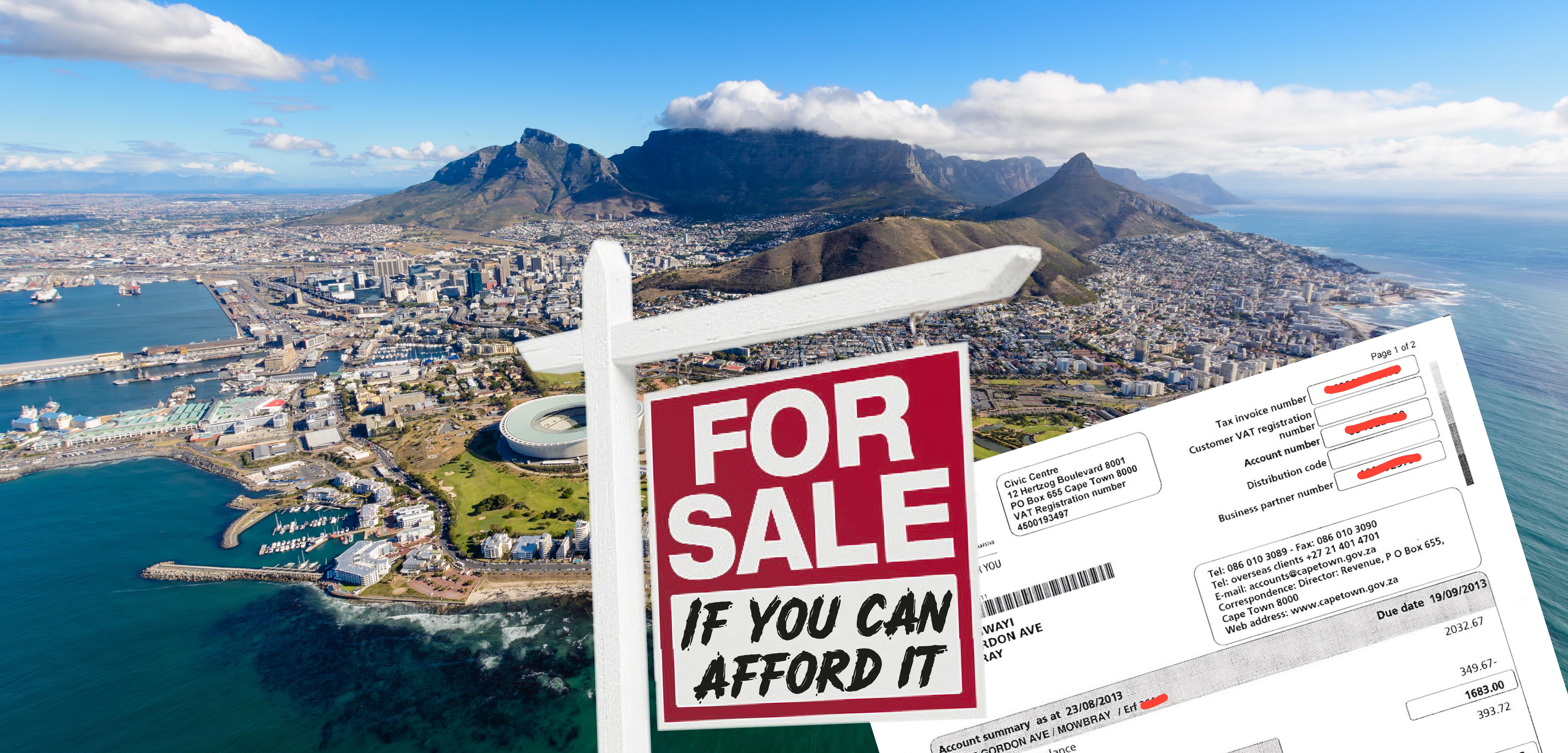
 Aerial view of Cape Town, South Africa on a sunny afternoon. Photo taken from a helicopter during air tour of Cape Town
The City of Cape Town has around R68-billion in accumulated surplus and R13-billion in cash. The City says it uses its cash surplus to “maintain lower tariffs and limit increases, by reducing the need to raise external loans, which would otherwise have a direct impact on tariff levels”.
Why, then, do so many middle-class Capetonians seem concerned about the perceived increases over time in their monthly municipal bills?
Wanting to find out if the anger matched the figures, Daily Maverick asked Capetonian readers to send in copies of municipal bills for the same property from 2015/2016 and 2025/2026.
An analysis of six sample bills from properties across six suburbs, ranging from a small Claremont flat to a modest Woodstock house to a large Constantia family home, shows that no suburb we looked at has been insulated from the increases.
The average property rates component alone has risen by approximately 170% across the sample, outstripping the average rise in property value (around 131%). But it is also the introduction of new charges — a city-wide cleaning levy, fixed basic water and sewerage charges, and an electricity home user and wires charge — that has pushed overall bills beyond what rates increases alone would explain.
Since the publication of this article in DM168, the City of Cape Town has argued that our calculations are misleading because these charges are not new, merely billed differently — though crucially, as will be seen, also calculated differently.
The City also contended that our comparisons do not take into account reductions in water, sanitation and electricity consumption charges. We chose not to include water and electricity charges in this analysis due to the complexity of comparisons over time because of the variability of consumption.
A spokesperson for the City said: “The percentages quoted are inflated and misleading”.
Concern about municipal bills is a hot-button topic in the city because the City of Cape Town released a new general valuation roll on Friday, with property owners across the city braced for revised valuations that will feed directly into their rates calculations and most fixed charges.
For a growing number of residents — particularly retirees on fixed incomes and long-term owners in gentrifying areas — the question is whether they can afford to stay.
On social media, a number of DA representatives — including Public Works Minister Dean Macpherson — have sought to frame the concerns over bills as a problem affecting only the super-wealthy, whose mansions have astronomical property valuations and monthly charges to match. But this is only part of the picture, as the experience of a Daily Maverick reader called Mary* illustrates.
Mary’s story
The value of Mary’s property, located in the sought-after coastal suburb of Kalk Bay, has exploded from just over R500,000 in 2006 to over R7-million in 2026. Though the area is affluent, Mary describes her property as a “historic but run-down old cottage”.
“I inherited this property from my mother in 2005. My husband and I have worked in the NGO world for most of our lives, earning modest salaries. He has a small pension. I don’t have one, but I do have a few inherited investments. None of this is sufficient to cover our current monthly municipal costs, so we have divided the house and have let half of it. I don’t fall into the ‘indigent’ bracket because our combined income is above the threshold,” Mary told Daily Maverick.
/file/attachments/2988/04BillKalkbay_102702.jpg "Sample bill Kalk Bay")
“I don’t object to paying for the privilege of living here — it really is a privilege — but there may come a time when we can no longer afford to stay in our family home of over 50 years, because newly built or massively renovated houses around us are being valued at between R15- and R25-million and are pushing up all the property values.”
/file/attachments/2988/04000052251_632732.jpg "Kalk Bay, where property prices have shot up over the years. (Photo: Supplied)")
Our analysis did not take into account water or electricity consumption rates, due to their variability, in order to focus on fixed monthly charges.
Although Cape Town’s increasing property values are often used as a justification for higher bills, our analysis of the fixed portion of Mary’s bill showed that the rates and fixed municipal charges increased by 208% over 10 years, while the property value increased by 131.27% over the same period.
Other than the spike in Mary’s property rates (183% over 10 years), the biggest hike was in her Improvement District levy (up 186% over 10 years).
The City says that our comparison should not include the increase in the Improvement District levy, since the City does not set these levies and “does not receive this as income, but merely administers it on behalf of the CIDs [City Improvement Districts]”.
CIDs are, however, normally initiated by a community because they feel the level of municipal services being provided to the area — particularly in terms of security and cleaning — is inadequate. Although the City does not receive the levies as income, the levies are calculated based on the municipal valuation of each property. The levies have to be approved annually by the Cape Town City Council.
The introduction of a fixed basic charge for sewerage and a new city-wide cleaning levy has also seen Mary’s monthly bill balloon.
“It must be emphasised that fixed charges are coupled with a reduction to the consumption portion of the tariffs. The consumption portion [of the bill] would be a lot higher if there were no fixed charges,” a City spokesperson said in response.
The City also disputed the framing of the city-wide cleaning levy as new.
“Residents have always contributed to these services, inter alia, via a cost embedded in electricity purchases. City-wide cleaning has now simply been removed from electricity, lowering prices, and displayed separately on the monthly bill,” said the City.
The City did not address the fact that these fixed monthly charges have only recently been linked to property value.
We asked how much the City’s revenue from rates and services had grown between 2016 and 2026.
“This data is still being sourced. It must be noted there are many variables and external input costs that would be reflected, much of which would not be within the City’s control," a spokesperson responded.
Greg’s story
The most extreme discrepancy we found between the increase in property value and the increase in municipal charges applied to a small Claremont flat owned by Greg*.
Over 10 years, the property value increased by 206%, while the rates combined with fixed portions of the municipal bill shot up by 494%.
/file/attachments/2988/04Billclaremont_219186.jpg "Sample bill Claremont house")
The municipal property valuation, carried out every four years, is the source of anxiety for many Capetonians because these figures are not just used to calculate property rates, but also the charges for the fixed water and sanitation fees and the cleaning and improvement district levies.
This was not always the case. When the fixed water levy was introduced in July 2018, it was calculated based on the size of the water meter connection to the property. It was only from the start of the 2025/2026 financial year that it was linked to property value.
This change, the City explains, was because “Cape Town cannot sustainably fund infrastructure with lower-income and affluent households making equal contributions”.
A spokesperson said that since the change to calculating this charge based on property value was implemented, 290,000 Cape Town households living in properties worth under R2.5-million are “now paying less for their fixed water charges than they would have on the meter-size system”.
The City also claimed: “The only alternative to fixed charges linked to property value is for everyone to pay a flat charge regardless of whether they are low-income or affluent.”
This is not quite accurate. An alternative metric for calculating fixed water charges, which is used by some other metros, is to base it on property size rather than value — on the grounds that larger properties have greater consumption potential and pose a greater infrastructure burden.
/file/attachments/2988/04BillSeapoint_464235.jpg "Sample bill Sea Point Flat")
The City of Cape Town said its data suggest that “consumption generally rises with property value” — a sentence in which “generally” seems to be doing some heavy lifting, given that a one-occupant flat in Sea Point can be valued similarly these days to a sprawling erf in a less affluent suburb like Milnerton.
The argument also does not account for people like Mary, whose property value has skyrocketed over time but whose water consumption has not materially changed over the same period.
“Cape Town would not have a working electricity or water service to speak of if the City only charged people for consumption, and not for a contribution to the costs of building and maintaining the network of infrastructure that make those services possible,” said the City.
“I feel I’m in a better position than many other owners in the area,” Greg told us.
“Many are retirees who are on a fixed income. With the City now using the municipal valuation of properties as a basis for the fixed water and sewage charges, they are actively contributing to making the City unaffordable for many, young and old. It’s a concern I’ve seen expressed again this week on neighbourhood WhatsApp groups because the new property valuations are coming out this week.”
The salaries that can’t keep pace
In the City of Cape Town’s April 2025 budget communications, it stated that the City “offers the lowest monthly municipal bill of South Africa’s ‘big five’ metros” — for properties under R5-million — for a much higher quality of monthly services.
Our analysis at least partly backs this up: over the 2025/2026 financial year, the City of Cape Town’s rate-in-the-rand calculation of property rates was the lowest of all five major metros, with eThekwini, at the highest end, charging its residents almost double this.
/file/attachments/2988/04Billwoodstock_904653.jpg "Sample bill Woodstock house")
After we sent questions to the City about municipal charges, the City also announced a new 10.2% rate-in-the-rand decrease, which it says will ensure that 60% of residential properties will experience either a rates decrease or no rates increase, even though their property value has risen.
Tracked over a 10-year period, however, what seems to be exacerbating Cape Town residents’ sense of an affordability crisis is the pace at which municipal increases have outstripped both average salary increases and inflation.
Between 2016 and 2026, a Capetonian may have seen his or her salary rise by around 55% (if lucky). During this same period, they are likely to have experienced their municipal bills rising four or five times faster than their salaries.
In Johannesburg over the same period, our analysis suggested that homeowners would also have experienced their municipal bills climbing at a rate not matched by either inflation or salary increases, but at a slightly lower margin of potentially two or three times salary growth.
The City of Cape Town has disputed our comparison with Johannesburg’s fixed charges, saying that the analysis “at face value does not look correct”.
Because Johannesburg property values have risen by significantly less than Cape Town’s over the past decade as the general state of the city and its services declined, salary growth may have more or less kept pace. This is not the case for Cape Town, where property values in many areas have grown twice as fast as salaries and inflation over the last 10 years: posing obvious problems for aspirant homeowners or those hoping to scale up.
/file/dailymaverick/wp-content/uploads/2025/03/ED_435857.jpg "The general state of Johannesburg and its services have declined over the past decade. (Photo: Luba Lesolle / Gallo Images)")
Martin*, another Capetonian, told Daily Maverick: “Nobody’s salary has kept pace with such increases, and those who claim it’s justified by rising property values miss the point entirely. Property value doesn’t translate to income or cash flow.”
For someone whose income does not grow at all, meanwhile, bills rising at 250% over a decade represent a direct and widening gap between income and outgoings that no amount of belt-tightening can fully close.
If the pattern of the past 10 years continues — bills rising at multiples of both inflation and salary growth, with fixed charges growing alongside property values — the question of who can afford to remain in Cape Town will become harder to avoid. DM
*Names changed on request to protect anonymity.
Correction: An earlier version of this article said the value of Mary’s property had increased from just over R500,000 in 2006 to over R7-million in 2016. The increase occurred between 2006 and 2026. (Updated: 23 Feb 2026)
Comments
Scroll down to load comments...