




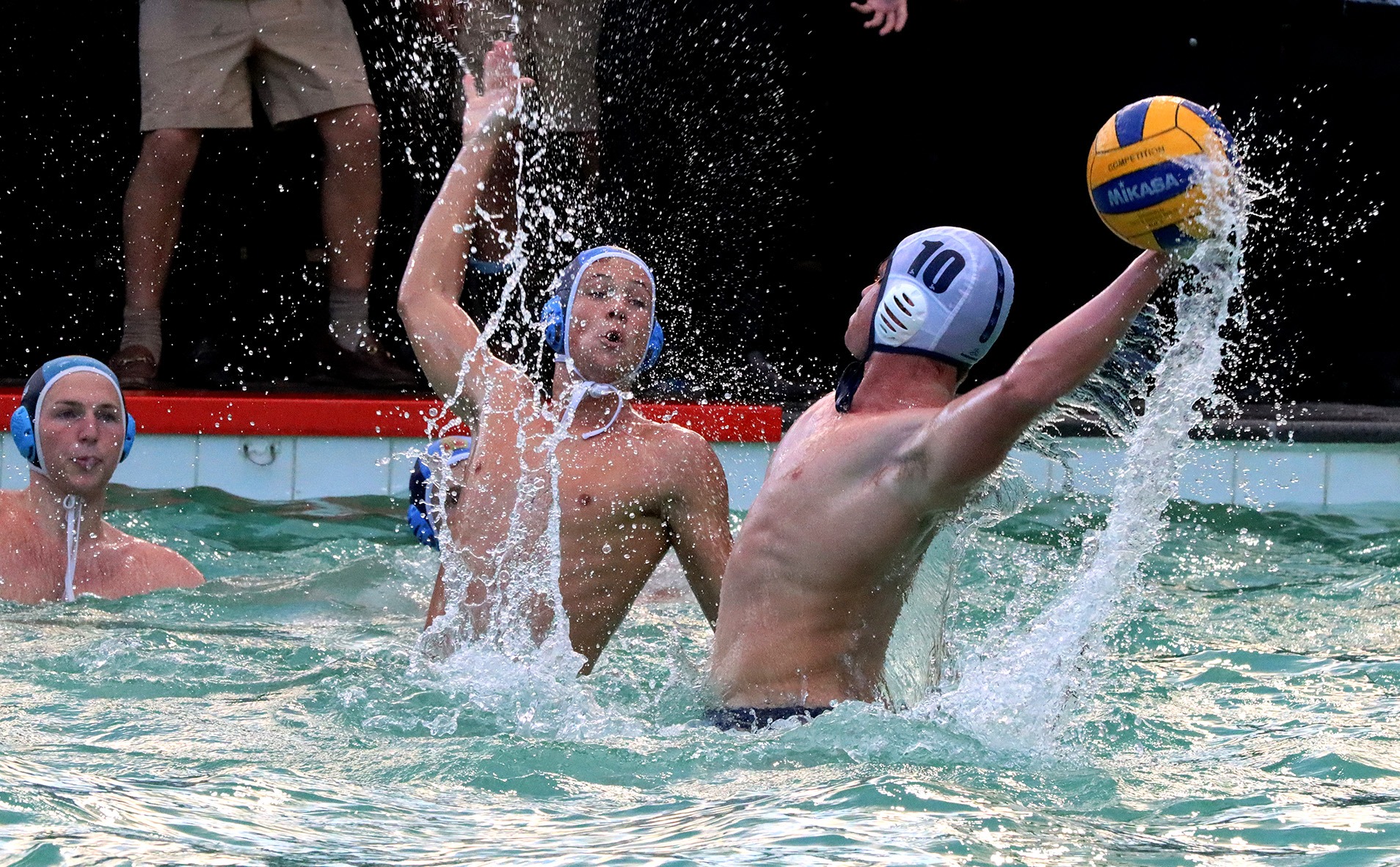
 James Hugo of Bishops blocks a pass from a Rondebosch Boys’ High School player during the final of the Sacs Nite Series. Behind him is Matt Fenn, who reached the milestone of 125 first-team appearances for Bishops in January at the St Andrew’s College Shield. (Photo: Bishops website)
 In 2024, Bishops Diocesan College made history when they claimed their first-ever title at the South African College High School (Sacs) Water Polo Tournament, a competition they had not won since the tournament’s inception in 1984.
For a programme long considered among the country’s top-tier water polo schools, the victory signalled a shift.
What followed was a sustained run of dominance for the past two seasons. Since that triumph in 2024, Bishops have won every major schoolboy water polo tournament that they have participated in at least once.
This includes their maiden victory in 2024, the St Stithians Water Polo Invitational in 2025, the St Andrew’s College (SAC) Shield in 2026 and back-to-back titles in the King Edward VII School tournament. This is alongside regional dominance in the Mazinter Cup and the Sacs Nite Series, which they have won three years in a row.
As a result, Bishops have continuously held the number one ranking on SA School Sports from October 2024 until the present.
Bishops have always been among the contenders, consistently in the conversation but seldom this far ahead of it. They have now established themselves as the defining team of the current schoolboy water polo era.
/file/attachments/orphans/55124048002_bc9529b2ca_o_243972.jpg "Schoolboy water polo is fiercely competitive in South Africa, drawing large crowds even at regional tournaments as spectators are drawn to the spectacle. (Photo: Bishops website)")
It comes in waves
South African schoolboy water polo has historically been shaped by a handful of dominant programmes, among them Sacs, St John’s College and Rondebosch Boys’ High School.
Sacs head coach and former Olympian Devon Card told Daily Maverick that dominance within water polo “goes in waves”.
When consulting the historical record of Sacs, the school has long been regarded as the benchmark for consistency and longevity in the sport.
Since 2017, the Sacs first team has finished on the podium in 32 of 41 tournaments, claiming 16 gold and 15 silver medals – a formidable 78% medal rate over eight years.
When Card was in high school playing for Sacs, St Johns College under the tutelage of Vladimir Trninic held that dominant position.
However, while Sacs have maintained longevity, the current Bishops team have achieved a concentration of victories that exceeds the Sacs historical average for a single two-year cycle.
“If I look at Bishops now, they’ve been doing a lot of the right things for a long period of time,” said Card. “They have a great coaching structure, and when Jabs [Sibiya] came in he had a massive impact at Bishops from a cultural point of view and from a training ethos.
“I saw the change in Bishops when he went there. They focused on the fundamentals and getting it right at a junior age group level, not just exclusive focus on the first team. And they’re getting the results.”
/file/attachments/orphans/54913832801_5b77714f5b_o_297905.jpg "Bishops keeper Michael Mafunda on defence against Sacs. Over two seasons, Bishops have secured gold at least once in every major national and regional competition they have participated in since 2024. (Photo: Bishops website)<br>")
Cultural and tactical evolutions
When Sibiya departed Sacs and joined Bishops as head coach in 2022, there were two things that he and the coaching staff looked to reshape, and that was the culture and style of play.
“We spent our first year, our first probably two years, really getting the culture right, making sure that we have an environment that the kids and the athletes want to be a part of,” Sibiya told Daily Maverick.
“I think we had a successful 2022 and a building year in 2023, but before the results, we were really looking at making sure we were winning fair play awards at tournaments, that we were doing the small things right, like thanking officials regardless of who was winning or losing.”
Alongside the cultural reset came a tactical shift. Prior to Sibiya’s arrival, Bishops’ styles of play leaned toward a more physical, “Eastern European” style. It was an approach that suited a player base with a strong rugby crossover, said Sibiya.
“What we did is we just made it a lot more representative of the rules of the game currently in the modern age, which is super-fast, super-fit, super-mobile, super-versatile and unpredictable in terms of how we attack,” he said.
A key component of that evolution has been building squad depth.
Drawing inspiration from Springbok head coach Rassie Erasmus, Bishops have focused on aligning their junior and senior systems. Former Olympian Lwazi Madi has played a central role in that process, said Sibiya.
“[Madi] spent his first year really getting the coach’s selection right, in the junior age groups … making sure that the standard that we are setting, the way of playing that we set at the top, is filtering through.”
The impact has been evident with the Bishops’ second team also consistently competing for, and winning, select tournaments.
Like many top schools, Bishops have further strengthened their programme through club partnerships. The team regularly trains with University of Cape Town (UCT), where Sibiya also serves as head coach, exposing players to a higher level of competition.
Similar structures exist within Paul Roos Gymnasium, for example, who train with Stellenbosch University, Sacs with their Old Boys and Rondebosch with the Rondebosch Meerkats.
This underscores that many schools operate with comparable systems, including Bishops.
So where do we pinpoint the reason for their success?
Well, Rowan Belchers, the founder of leadership consultancy Lockstep and who has been with Bishops since 2025, noted that it was more nuanced than pinpointing it on singular concrete factors.
/file/attachments/orphans/55124046212_a8006d6d7f_o_490102.jpg "Jack Grout from Bishops searches for a teammate in the final of the Sacs Nite Series on 24 February. Bishops defeated Rondebosch Boys’ High School 14-9 to claim their third consecutive Nite Series title. (Photo: Bishops website)")
Mind over matter
Rather, it was an alignment of all these elements of culture, depth, conditioning and tactical clarity, combined with an incredibly strong playing group with star players such as Tim Young and Matt Fenn.
“It performs because the whole system comes into alignment together,” Belchers told Daily Maverick.
Since joining two seasons ago, Belchers has been assisting the side with yet another key element that comes into any high-performance sport, and that is mental strength and preparedness. Conquering the mind is what separates those who can handle pressure, maintain focus and resilience – especially in those losing moments.
/file/attachments/2989/BishopsTrophies_719055.png)
“If I had to explain how Bishops has gone from podium to dominant winners, it’s because the missing piece was the glue that brought everything together [mental preparedness],” said Belchers.
Before he came into the mix in 2025, Bishops “were not winning the big moments”, according to Belchers. “The team was a little short on intensity and ruthlessness,” he said. “Bishops water polo needed an increase in hunger from the players and a very clear, unwavering goal to aim at. So, from a mental standpoint, that’s what I put in. I put in the concept of hunger.”
While historical giants such as Sacs possess a greater long-term medal count, the intensity and exclusivity of the Bishops victory streak set it apart.
The pressure is on, said Sibiya, but Bishops welcomes the challenge. DM
/file/attachments/2989/BishopsComparison_572287.png)
This article was updated on 18 March, to clarify that Bishops has won each major tournament at least once in the two year period under review.
This article was updated at 9.30am on 18 March 2026 to include graphics for Bishops’ past achievements.