
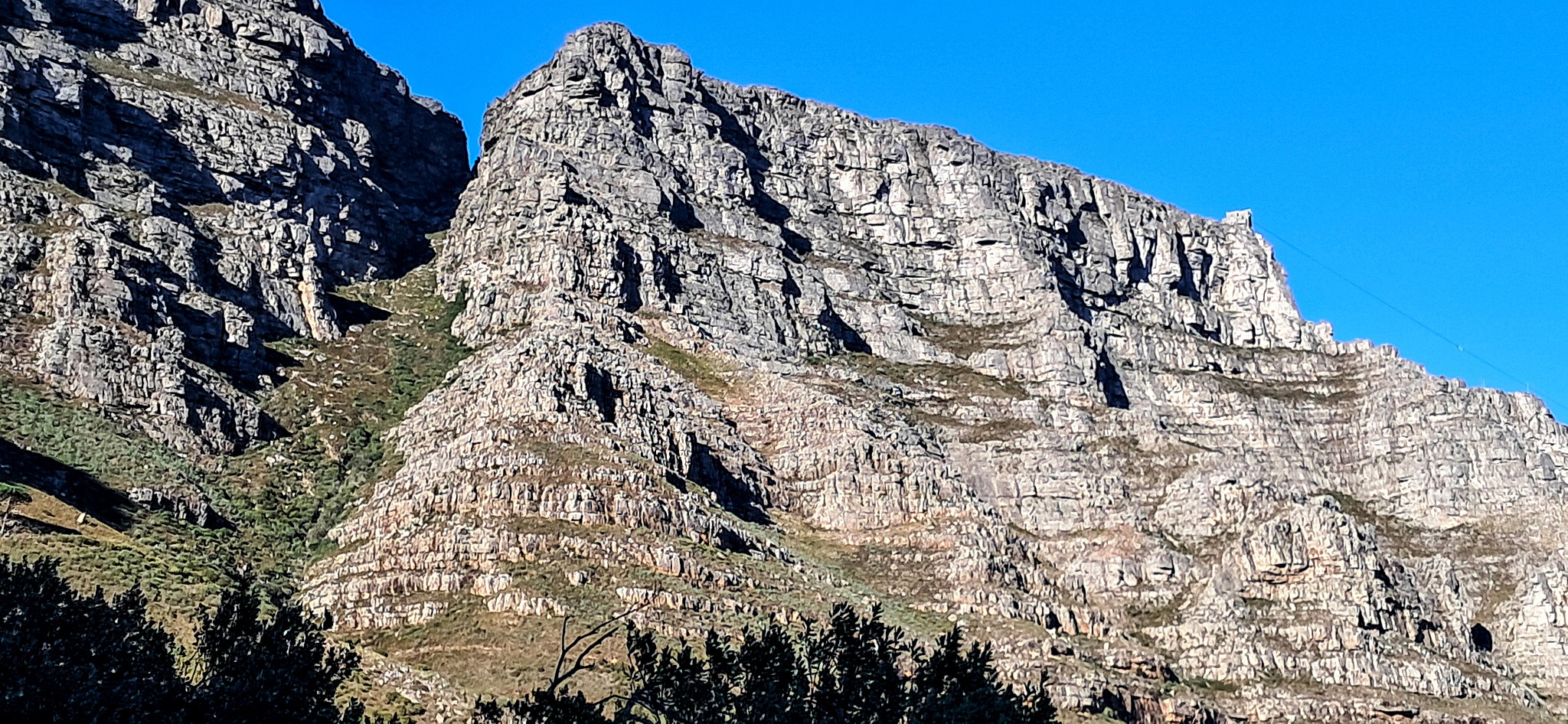
 Where we see a mountain, Parks scientists see an evolving system. (Photo: Don Pinnock)
 /file/attachments/orphans/storiedmountainlogo_692149.png)
As you read this, Table Mountain National Park will probably be a bit hotter and a little drier than it was a year ago.
It sounds dramatic, but that’s the reality written into hundreds of climate models, all pointing in the same direction: the iconic park encircled by Cape Town is steadily warming and losing moisture. Not a single model suggests the opposite. Not one offers relief.
For most parks, climate forecasts arrive wrapped in uncertainty: hotter maybe, wetter perhaps, stormier possibly. But Table Mountain National Park is unusual. Its future is startlingly clear. It will be hotter. It will be drier. And this certainty has become a strange gift.
“Because the direction is so clear, we can actually plan,” says Professor Wendy Foden, SANParks’ specialist scientist for climate change. “This is one of the few parks where the projections are completely aligned: hotter and drier, without exception.”
That clarity has energised researchers, managers and volunteers. Instead of waiting for disaster – or arguing about model uncertainty – they’re rolling up their sleeves and trying things. Practical things. Unusual things. In some cases, experimental things that look so odd from the roadside that people have asked whether the park is building alien landing pads.
If you’ve ever hiked past the lower slopes and spotted a series of neat, fenced squares – perfect, geometric, baffling – know that you’re looking at an ambitious climate-adaptation experiment.
“People had no idea what they were,” Foden laughs. “Soccer fields? Yoga platforms? UFO zones?”
The truth is far better.
/file/attachments/orphans/Don-researchplotsonTableMountain_964309.jpg "Geometric and baffling to many who come across them, they’re a Renosterveld climate-adaptation experiment. (Photo: Don Pinnock)")
Those squares are part of a restoration and research project in Renosterveld, one of the Western Cape’s most critically endangered vegetation types. Growing on shale-rich clay soils, Renosterveld once carpeted the flats but was almost obliterated by agriculture. Only about 3% remains and the little that is left had been hedged in by decades of wheat and canola farming.
Then the 2021 UCT fire burned through, clearing the site in one brutal sweep. It was a disaster – but also an opportunity. With funding from the French Development Agency and in partnership with colleagues on Réunion Island, the park seized a once-in-a-generation moment to try to bring the veld back.
Teams from FynbosLIFE collected thousands of seeds and cuttings from the only other remnant of this ecosystem inside the park – Signal Hill. They raised roughly 8,000 young plants and prepared kilograms of cleaned seed. Once the site was ploughed and cleared, volunteers and staff descended on the mountain for a giant planting day to sink the seedlings into fresh earth.
/file/attachments/orphans/Don-researchplotsonTableMountain-3_412571.jpg "Geometric and baffling to many who come across them, they’re a Renosterveld climate-adaptation experiment. (Photo: Don Pinnock)")
Each fenced square now contains a full micro-community of Renosterveld species – about 25 types – planted in careful patterns so they can be monitored. Some plots received seeds, some seedlings, some both. Together they form a living laboratory stretched across gradients of elevation, temperature and orientation.
Already, early surveys show a 90% survival rate in the first plot – a remarkable success. But the real test will be this summer. These experimental islands will reveal which species cope with extreme heat and dryness, which falter and which might need human help to move upslope in future.
“These squares are both a restoration project and a climate experiment,” Foden explains. As global temperatures rise, species move to cooler spaces. In Table Mountain’s case it means uphill. “The plots will help us understand at what elevation species can best survive – and how to help them adapt.”
This is climate adaptation made visible: fenced, tidy, hopeful and slightly eccentric.
Planning for heat
The restoration squares are only the beginning. Across the park, climate adaptation is threading its way into every corner of conservation planning.
The hotter, drier future means more frequent extreme fire weather, like the day the UCT fire flared under unusually high temperatures, low humidity and strong winds. Fire prevention and fire management are now being scaled up. Teams are also clearing invasive plants – fuel that turns ordinary fires into infernos.
But while ecosystems can recover from fire, some species cannot simply move away from heat. Table Mountain’s steep slopes limit where plants and animals can shift. Species needing cooler, wetter climates can only climb so far.
/file/attachments/orphans/Don-Mountainviews-2_487586.jpg "Caring for a mountain in the middle of a city takes an awful lot of planning. (Photo: Don Pinnock)")
Some, like the Table Mountain ghost frog, already live at the mountaintop edge of possibility. Any further drying or warming could push them beyond their limits. That’s why the park has completed a full climate vulnerability assessment of all plant species – an extraordinary effort now guiding which species may require assisted movement, ex-situ conservation or ongoing monitoring.
Climate change is reshaping everything from flood prevention to water security, from biodiversity planning to tourism models. “It’s not just an ecological issue,” Foden notes. “It affects infrastructure, finance, tourism, everything.”
Air-conditioned nests
Strangely, some of the most innovative adaptation work is happening not on the mountain but at its feet.
At Boulders Beach, African penguins face a new danger: heatwaves. When temperatures spike during nesting, adults abandon their chicks to cool off in the water. If they’re moulting, they can’t enter the water at all – and chicks die of heat stress.
/file/attachments/orphans/Don-Africanpenguins-theirsurvivalisparamount_304841.jpg "When African penguins overheat, rescue is on its way. (Photo: SANParks)")
In response, SANParks teamed up with the Dallas Zoo’s engineers to design special ceramic nest boxes – cooler and better ventilated and shaped for penguin preferences. Temperature sensors installed inside the nests allow real-time monitoring through a weather station just outside the ranger offices.
When conditions reach lethal thresholds, the bird rescue NGO Sanccob can rescue vulnerable chicks before they perish. It’s conservation meets engineering – a South African innovation now watched internationally.
Survival interventions
Across the SANParks network, similar micro-adaptations are rolling out:
Shaded waterholes for birds that overheat before they can drink.
Nest boxes for heat-sensitive tree-breeding species.
Refugia structures that allow animals to thermoregulate during extreme events.
Individually they’re simple. Collectively they represent a philosophical shift: conservation is no longer just about protecting landscapes – it’s about actively helping species survive conditions their evolutionary history never prepared them for. And Table Mountain National Park is one of the first places in the country doing this in a systematic way.
People who care
Despite tight budgets, high public expectations and the challenge of managing a world-famous park embedded in a major city, morale inside SANParks is surprisingly strong. Many staff have been with the organisation for decades. Turnover is low. And the overwhelming sentiment? Love for the place.
Scientists, managers and interns work as an unusually cohesive climate team. The marine scientists, freshwater experts, botanists and biodiversity officers collaborate across disciplines. Everyone, it seems, is pulling in the same direction.
Foden herself brings global experience in climate conservation through her leadership in international conservation networks – yet she’s animated, hands-on and excited about local solutions.
“We’re actually doing things,” she says. “Not just talking about climate change – doing something about it.”
/file/attachments/orphans/Don-Mountainviews_447794.jpg "Path building on the mountain is part of luring people into its beauty. (Photo: Don Pinnock)")
A new kind of conservation story
Perhaps the most hopeful thing about Table Mountain National Park’s climate programme is that it feels alive. Experimental. Curious. Eager. It doesn’t hide from the seriousness of the future, but it refuses to be paralysed by it.
Every fenced plot of Renosterveld, every ceramic penguin nest, every shaded waterhole and seedling represents the same idea: we can act.
The mountain is changing. But the park is changing too – faster, smarter and with a kind of upbeat determination that feels uniquely South African.
With climate change already reshaping ecosystems around the world, Table Mountain National Park is becoming something a blueprint for conservation in a heating world. A place where science, improvisation, optimism and practical action all come together where adaptation isn’t a buzzword. It’s a daily practice, built by people who love the mountain and are determined to help it thrive. DM