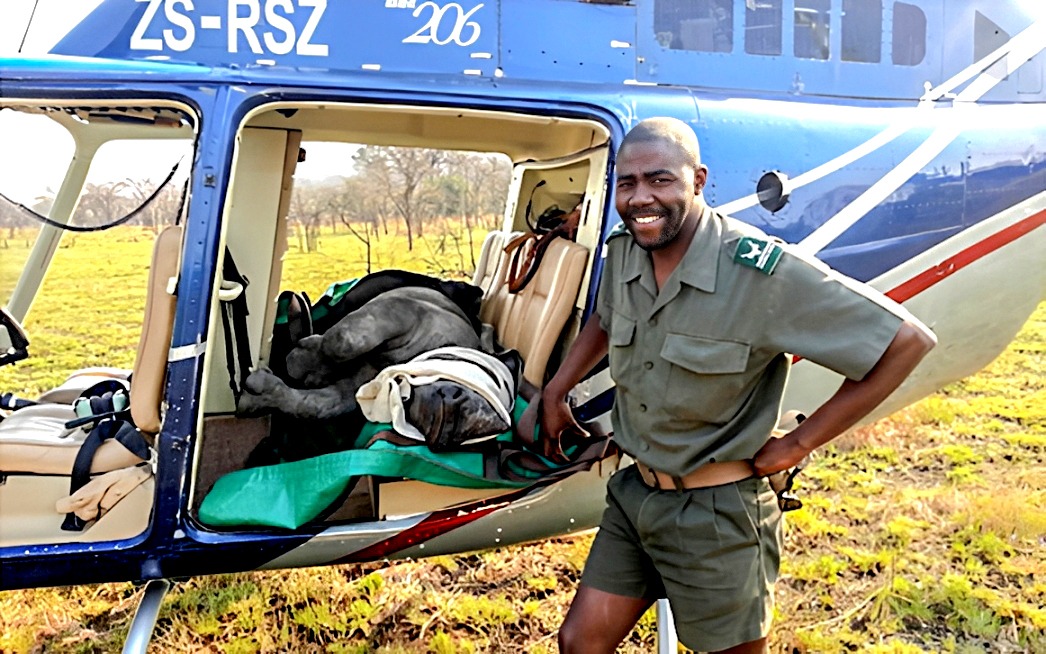
 Rodney Landela previously worked on Kruger National Park programmes to reintroduce rhinos to other reserves. He is now in the dock for killing a rhino in the park. He faces up to 10 years in prison if convicted. (Photo: Supplied / KNP)
 /file/dailymaverick/wp-content/uploads/2025/10/label-Op-Ed.jpg)
Accused rhino poacher and former regional ranger Rodney Landela – once heralded as the “Crown Prince of the Kruger” – insists he was framed.
The former Kruger regional ranger, tipped for a top post at the national park before his arrest, has testified that a wildlife observation mission went disastrously wrong in the Kingfisherspruit section of the Kruger National Park on 27 July 2016.
Landela, alongside former state veterinary technician Kenneth Muchocho are accused of killing a white rhino early that morning. Landela also faces a charge of possession of a firearm with intent to commit a serious criminal offence.
The marathon trial has tested the State’s resolve to confront alleged criminal activity within conservation ranks, and has unfolded against the backdrop of the Madlanga Commission of Inquiry into corruption at the highest levels of South Africa’s law enforcement and criminal justice system.
Capabilities
Kruger regional rangers such as Landela are typically responsible for about 20 operational sections, each comprising roughly 10 field rangers.
During bail proceedings, the State argued that Landela’s senior position, control over patrol deployments and access to key wildlife areas gave him capabilities valuable to poaching syndicates.
The State submitted that Landela had “all the knowledge of the veld, all the knowledge of firearms and the exact workings of the Kruger National Park”. Furthermore, he sat in planning sessions where ranger deployments were decided.
The State also introduced bank records and a Financial Intelligence Centre report into Landela’s financial affairs. These reflected unexplained inflows totalling about R1-million between 2013 and 2016, including a cash deposit of R85,000 in a single day.
The prosecution relied on this material as the possible proceeds of crime and as evidence of motive, arguing that Landela lived beyond his means. As a regional ranger, he earned about R19,000 a month after deductions.
Similarly, Muchocho, who earned about R9,000 a month and whose bank account was frequently in overdraft, nevertheless accumulated property, cattle and vehicles valued at more than R1.5-million.
Landela and Muchocho, who were granted bail in November 2017, have denied any involvement in poaching syndicates. Landela has now finally testified in court, and said he played no role in the rhino killing of 27 July 2016.
The State’s case against Landela rests on two legs: witness testimony and forensic evidence that places him at the scene, links his state-issued firearm to spent cartridges found at a nearby “stash site” and confirms that blood found on his clothing matched the DNA of the freshly slain rhino. Vehicle-tracking data tracing the movement of Muchocho’s white Toyota Hilux bakkie, fitted with a canopy, was also used to support the State’s version of events.
The photo exhibits before court unfold like a storyboard. They document the kill scene, the pursuit, vehicle tracks and footprints, the discovery of the weapon, spent cartridges, a bloodied axe and freshly cut rhino horn, along with other forensic material presented in evidence.
/file/attachments/orphans/RodneyLandelaincourt_575619.jpeg "Rodney Landela flips through photo exhibits entered into the court record. (Photo: Fred Kockott)")
Landela’s story
Landela testified that at about 5am that day, he had accompanied Muchocho to scout for wild dogs suspected of suffering from canine distemper – a disease that can be fatal to wild dogs and spread to other carnivores.
He told the Skukuza Regional Court that they stopped from time to time to photograph impala, zebra and other animals and to record their positions using a CyberTracker system.
Landela said he had left his state-issued firearm – a .375 H&H Magnum CZ Model 550 bolt-action rifle – in a safe in his office. With it were his backpack, live ammunition and spent cartridges, an axe, panga and a knife. The panga, axe and knife, he said, were used to cut back branches of trees on patrols.
He testified that he and Muchocho never left the vehicle while scouting for wild dogs and he was “still surprised to this day” that his firearm and other items from his safe were later discovered at a stash site in the bush near the crime scene, alongside the freshly chopped-off rhino horn.
/file/attachments/orphans/AdvLotMgiba_497515.jpeg "Prosecutor, Advocate Lot Mgiba. (Photo: Fred Kockott)")
Poaching realities
Under cross-examination, prosecutor Lot Mgiba argued that it would have been foolhardy for Landela not to have carried his firearm that day, particularly given a recent spike in armed poacher incursions and ranger confrontations. At the time, poaching in the Kruger was peaking, with more than 600 rhino killings recorded that year.
Mgiba asked what Landela would have done had he encountered armed poachers. Landela replied that he would have retreated and radioed for armed back-up.
The court heard that a rhino-poaching incident had occurred in Block 37 of Kingfisherspruit the previous month. This prompted Corporal Lucky Ndlovu, then acting as sectional ranger, to include Block 37 in patrols that day – a decision taken after the patrol roster had already been sent to Landela the previous day. Mgiba said this meant Landela was unaware that rangers would be patrolling the area where he and Muchocho went that morning.
Gunshots
The high-stakes drama unfolded from about 7am when reports crackled over the park’s radio network that gunshots had been heard in Block 37, followed by the sighting of two men fleeing towards a white bakkie, which then sped off. Two rangers, Selby Magopane and Dennis Nzima, gave chase.
Having just dropped off Magopane and Nzima, ranger Hanyi Samuel Ndlovu was driving away when he heard the report about gunshots and received an instruction to block the road. He did so at a four-way crossing at the Majekejeni firebreak, a few hundred metres from where the shots had been heard, and took cover behind a tree with his firearm ready.
Landela testified that when their vehicle was stopped, Ndlovu ordered them out at gunpoint. He said he had told Ndlovu that he had also overheard reports of gunshots from Block 37 and that he and Muchocho were attempting to find a cellphone signal to alert the area mission manager, Mbongeni Tukela. He testified that Tukela supervised all joint operations in the park.
While arguing over the need to search for a signal – Ndlovu told Landela that he had a clear cellphone signal – Landela instructed Muchocho to drive off to try to contact Tukela.
Radio dispute
Landela then told Ndlovu that he also needed to contact Tukela privately on his cellphone, rather than over the radio, which was an open communication channel. This was to advise him to mount a back-up operation, including deployment of a helicopter and field rangers from Skukuza to assist with the search.
Ndlovu complied. Landela denied he had switched off the radio in Ndlovu’s vehicle while operations were under way, testifying instead that the radio volume had been too high for them to communicate and that he had turned it down.
He said they continued driving away from the site of the gunshots until reaching a junction, where he attempted to phone Tukela while standing on a concrete road sign.
“I could not get through, but left a message,” he told the court.
Landela denied that his hands were shaking to the extent that he dropped his cellphone, disputing testimony given by Ndlovu.
Carcass discovery
Several kilometres from the initial interception point, Muchocho was re-intercepted on the S106 road by Corporal Lucky Ndlovu, who had gone in pursuit after learning that Muchocho had driven off alone in the Toyota Hilux. Ndlovu testified that during the pursuit he saw Muchocho’s vehicle begin to make a U-turn, allowing him to catch up.
Landela and Muchocho were escorted back to the area where the white bakkie had originally been parked when the gunshots were first reported.
Other response teams, including trackers and senior investigators, arrived. It had rained the night before and drizzled that morning, and footprints around where the vehicle had been parked were clearly visible. Tracks led to a dead rhino about 300m away.
The animal was described by Detective Matuludi Selatole and senior investigator Kenneth Maggs as “freshly killed” and “still fresh and bleeding”. Its large front horn had been removed, while the smaller rear horn remained intact. Rangers observed that the rhino’s stomach cavity had been cut open.
Bits of blood
In his testimony, Landela said he had lifted a flap of skin on the rhino’s shoulder where meat had been removed, explaining that this was often done by poachers to insert poison intended to kill scavenging vultures, whose presence can alert rangers to fresh kills.
“I can’t deny that bits of blood from the rhino touched me,” Landela said. He testified that there was blood on the ground leading to the carcass, as well as on grass and tree branches which his clothing may have brushed against.
Rangers and investigators Selatole and Maggs, however, testified that Landela and Muchocho – who were already being treated as suspects at that stage – were not permitted near the carcass.
During a field postmortem examination, a spent bullet believed to be of .375 calibre was recovered from the rhino’s intestines. Laboratory analysis later revealed that DNA from the dead rhino was present on Landela’s boots and jumpsuit.
Stash site
After the discovery of the carcass, Corporal Ndlovu accompanied Maggs, Selatole and dog master Captain Ivan Swart to the area where he had earlier observed Muchocho attempting a U-turn. There they noted visible wheelspin marks and shoe imprints leading into the bush.
Following these tracks, rangers found Landela’s .375 firearm and a backpack containing a freshly chopped-off rhino horn wrapped in black plastic, three .375 spent cartridges, a bloodied axe, a panga, a knife and a notebook.
Under cross-examination, Landela said these items, including the spent cartridges ballistically linked to his firearm, must have been planted to implicate him. Asked who might have framed him, Landela said he had no idea.
“During my time at Kruger, no one had a grudge against me,” he testified.
Several rangers corroborated this, telling the court that before his arrest Landela had been held in high esteem as a dedicated ranger committed to combating poaching. Among them was Dr Xolani Funda, SANParks’ general manager for area integrity management, who testified that he had hoped Landela would one day become chief ranger of the Kruger National Park.
The sense of betrayal runs deep. In his testimony, Corporal Ndlovu broke down in tears as he recounted how close he had become to Landela, coming to view him as a father figure, despite Landela being younger.
/file/attachments/orphans/SkukuzaPoliceStation_489809.jpeg "Skukuza Police Station. (Photo: Fred Kockott)")
/file/attachments/orphans/AdvMswaziMakhubela_704194.jpeg "Advocate Mswazi Makhubela. (Photo: Fred Kockott)")
Credibility challenged
Towards the end of his cross-examination, Mgiba raised a conflicting statement made by Landela regarding an alleged attempt to escape from custody while he was detained outside Skukuza Police Station.
Although the escape charge was withdrawn before Landela testified, his defence advocate, Mazwi Makhubela, nonetheless reintroduced the allegation.
Landela told the court he had been left unattended outside the police station and, when the call of nature came, had gone inside the precinct to use a toilet. In a sworn statement filed during his bail application, however, he stated that he had gone to urinate behind a tree in nearby bush.
Mgiba said this discrepancy was another indication that Landela was not a reliable witness.
In closing, Mgiba said that if Landela’s version of events was to be believed, it meant whoever was framing him had shot the rhino, dehorned it, taken Landela’s firearm and other items from his safe the night before, and then placed all these items at a spot in the bush in the very same area where he and Muchocho had gone dog scouting.
“Mr Landela, I am going to argue that you and accused No 2 shot, killed and dehorned the rhino. When rangers stopped you, you asked Muchocho to drive away and hide the firearm and the rhino horn,” said Mgiba.
The case was postponed till 28 May when Muchocho is likely to testify in his defence.
The State’s case against Muchocho includes separate forensic evidence recovered from his bakkie. Investigators found darting equipment and controlled anaesthetic drugs which forensic analysis later confirmed to be Zoletil — a Schedule 6 tranquiliser used to immobilise large wildlife, including rhino, as well as wild dogs. DM/Roving Reporters
This story forms part of an in-depth Roving Reporters case study on the State vs Rodney Landela and Kenneth Muchocho trial, developed with support from the Yazi Centre for Science and Society and the Resilience Fund run by the Global Initiative Against Transnational Organised Crime.