




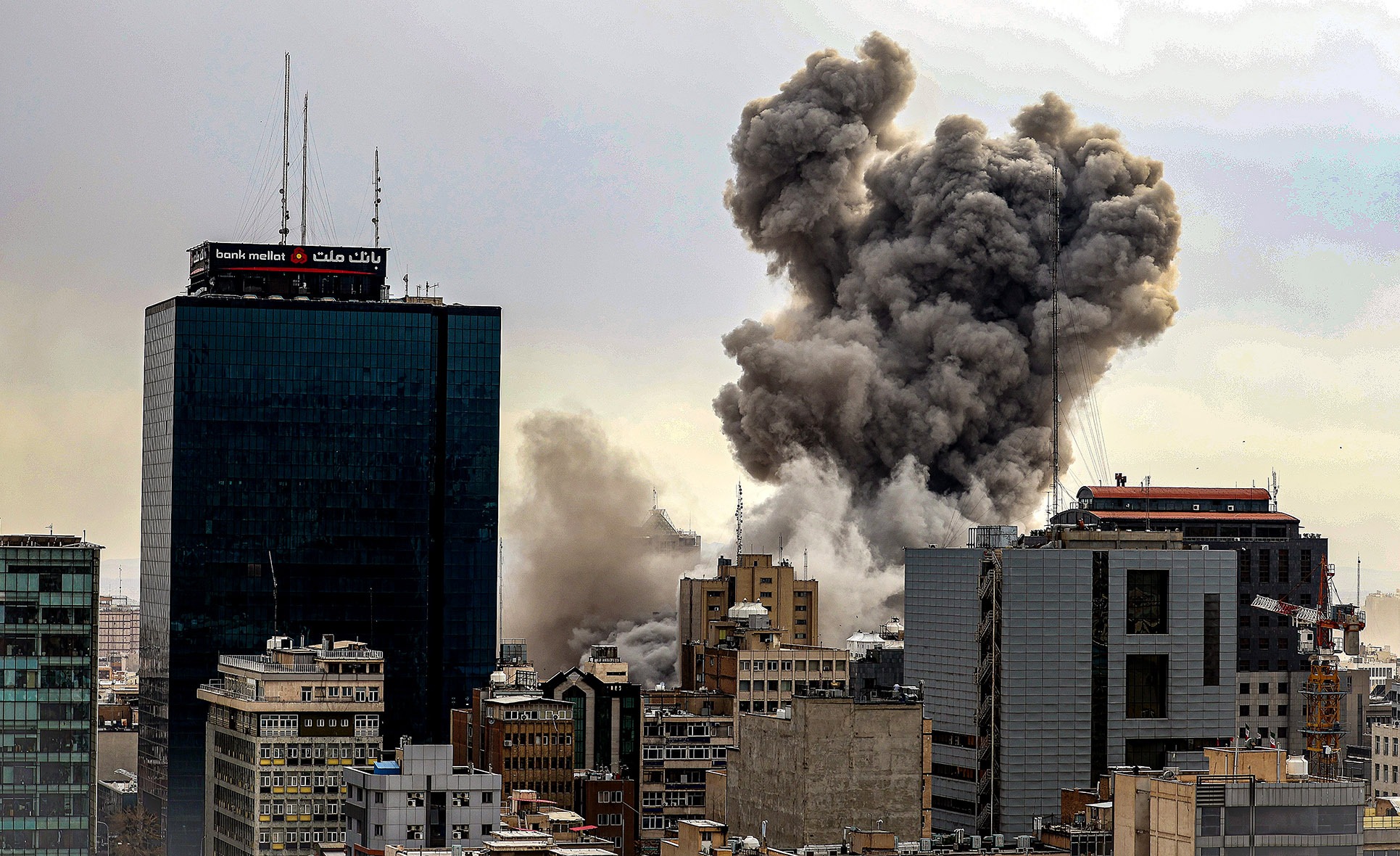
 A missile strike in Tehran on 2 March 2026. Major sporting events are under threat because of the conflict in the region. (Photo: Contributor / Getty Images)
 Last week, on 3 March, a tennis tournament in the United Arab Emirates (UAE) came to a screeching halt when falling debris from the interception of a drone caused a fire at an oilfield about 13km away from the courts.
This occurred during the match between Japan’s Hayato Matsuoka and Belarusian Daniil Ostapenkov in the Fujairah Open, a second-tier event on the ATP Challenger Tour.
Social media posts showed the players scrambling for shelter and the tournament was subsequently cancelled.
Following coordinated aerial strikes against Iran on 28 February by the US and Israel, a flurry of sporting events have been affected by the ensuing conflict.
/file/attachments/2989/UP1EL4D1AE295_400006.jpg "McLaren’s Oscar Piastri takes the chequered flag to win the 2025 Bahrain Grand Prix. (Photo: Reuters / Andrej Isakovic)")
Iran launched retaliatory strikes on US military bases and infrastructure across the Middle East, including Bahrain, Qatar and the UAE.
As a result, airspace across large parts of the Middle East remains shut or heavily restricted, causing significant disruption to one of the world’s busiest aviation corridors.
About 92.3 million passengers travelled through Dubai in 2024. The airport sees about 1,250 flights per day, Ian Petchenik, head of communications for Flightradar24, told Sky News. That number dropped to 161 by Thursday, 5 March, almost a week after the first US-Israeli strike.
With a range of sporting events already postponed or cancelled, uncertainty still looms over what might be disrupted next.
Formula One undecided
With motorsport events increasingly being hosted in the Middle East, alarm has been raised over the sport’s status amid the escalating conflict.
On the day the tennis tournament was stopped, the FIA, the governing body for motorsport, announced that the first race of the year for the World Endurance Championship, set to take place on 27 March in Qatar, had been postponed indefinitely.
In Formula One, four races take place in the Gulf states that have been targeted in retaliatory strikes by Iran, two of which take place in April.
On 2 March, FIA president Ben Sulayem said about the conflict: “We are in close contact with our Member Clubs, championship promoters, teams and colleagues on the ground as we monitor developments carefully and responsibly.
/file/attachments/orphans/13812288_358039.jpg "Smoke rises from Shahran Oil Refinery following the previous night’s air strike in Tehran, Iran, on 8 March 2026. (Photo: EPA / Abedin Taherkenareh)")
“Safety and wellbeing will guide our decisions as we assess the forthcoming events scheduled there for the FIA World Endurance Championship and the FIA Formula One World Championship.”
Then, on 7 March, during the Australian Grand Prix weekend, Stefano Domenicali, chief executive of F1, was set to meet the teams to discuss the feasibility of the Bahrain and Saudi Arabia Grands Prix, which are set to take place on 12 and 19 April respectively.
“What we said is, first of all, it’s still a month to go,” Racing Bulls chief executive Peter Bayer told the media after the meeting. “Secondly, it’s also difficult to talk about it because I’m really sorry for the people and the situation [in the Middle East].
“But I also have to say that we are so focused on here, which is, for us now, really what matters at the moment. And I know Stefano [Domenicali] and the FIA, they’re monitoring the situation. And I trust they make the right decision for us as a team.”
Given the freight logistics between races, F1 has at least another week before a decision is required, an announcement that likely to come after next week’s Chinese Grand Prix.
While Sports Minister Gayton McKenzie hinted this month at the possibility of South Africa stepping in to host a replacement race, it is highly unlikely that it would be hosted here at such short notice.
If it is cancelled, it is more likely that the race calendar would be reduced from 24 races to 22 with a five-week gap between Japan at the end of March and Miami at the beginning of May.
Silent protests
In football, five members of the Iranian women’s national team have been granted humanitarian asylum in Australia, following their exit from the 2026 AFC Women’s Asian Cup hosted in the Gold Coast.
This follows the team’s silent protest during the national anthem on 2 March, which fell parallel to the military conflict, leading Iranian state media to brand them “wartime traitors”.
/file/attachments/orphans/2265377530_119048.jpg "Iran’s women’s soccer team at the AFC Women’s Asian Cup before a clash against the Philippines at Australia’s Gold Coast Stadium. (Photo: Albert Perez / Getty Images)")
US President Donald Trump and various human rights groups encouraged the Australian government to intervene, citing fears that the athletes would face severe consequences if they returned.
While captain Zahra Ghanbari and four teammates are now in a safe location under federal protection, the rest of the squad and coaching staff have reportedly begun the journey back to Iran despite local protests.
“Assistance remains available for the other members of the team, but it, of course, is a decision for them. If they make a decision to ask for support, they will receive it,” Australian Prime Minister Anthony Albanese told the media on 9 March.
Stoppages for football
In addition, the Qatar Football Association decided to postpone all matches in the country indefinitely.
This has sparked doubt about the Finalissima clash between Argentina and Spain this month. The much-anticipated match between the Copa América holders and European Champions was scheduled for 27 March at Lusail Stadium in Doha.
The Asian Football Confederation (AFC) also announced last week that the first and second legs of the round of 16 in the AFC Champions League Elite, originally scheduled for the first two weeks of March, have been postponed.
This week’s quarterfinals in the Asian Champions League Two and the Asian Challenge League have also been postponed.
“The AFC’s priority remains the safety and security of all stakeholders including players, teams, officials, partners and fans, and we are steadfast in our commitment to ensuring a secure environment for all,” it said.
/file/attachments/2989/2258496608_855575.jpg "Dunith Wellalage of Sri Lanka plays a shot during the third one-day international against England at R Premadasa Stadium in Colombo. Sri Lanka have cancelled their matches against Afghanistan in thbe UAE. (Photo: Sameera Peiris / Getty Images)")
What next?
In cricket, a six-match white-ball series between Sri Lanka and Afghanistan, which was due to begin this week in the UAE, has been postponed indefinitely, an official told AFP.
The teams were set to play three T20 internationals in Sharjah between 13 and 17 March and three one-day internationals in Dubai between 20 and 25 March.
Depending on how long the strikes continue, athletics might also be affected. The opening Diamond League meeting is set to take place in Qatar on 8 May, but the uncertainty surrounding travel and security in the region means the elite competition could face disruption.
While airlines remain cautious, with some routes disrupted, life on the ground in parts of the region has reportedly “continued largely as normal”, a flight attendant for Etihad Airways who lives in Abu Dhabi told Daily Maverick.
For now, much remains uncertain and the coming weeks will determine whether global sport can continue to operate uninterrupted. DM