



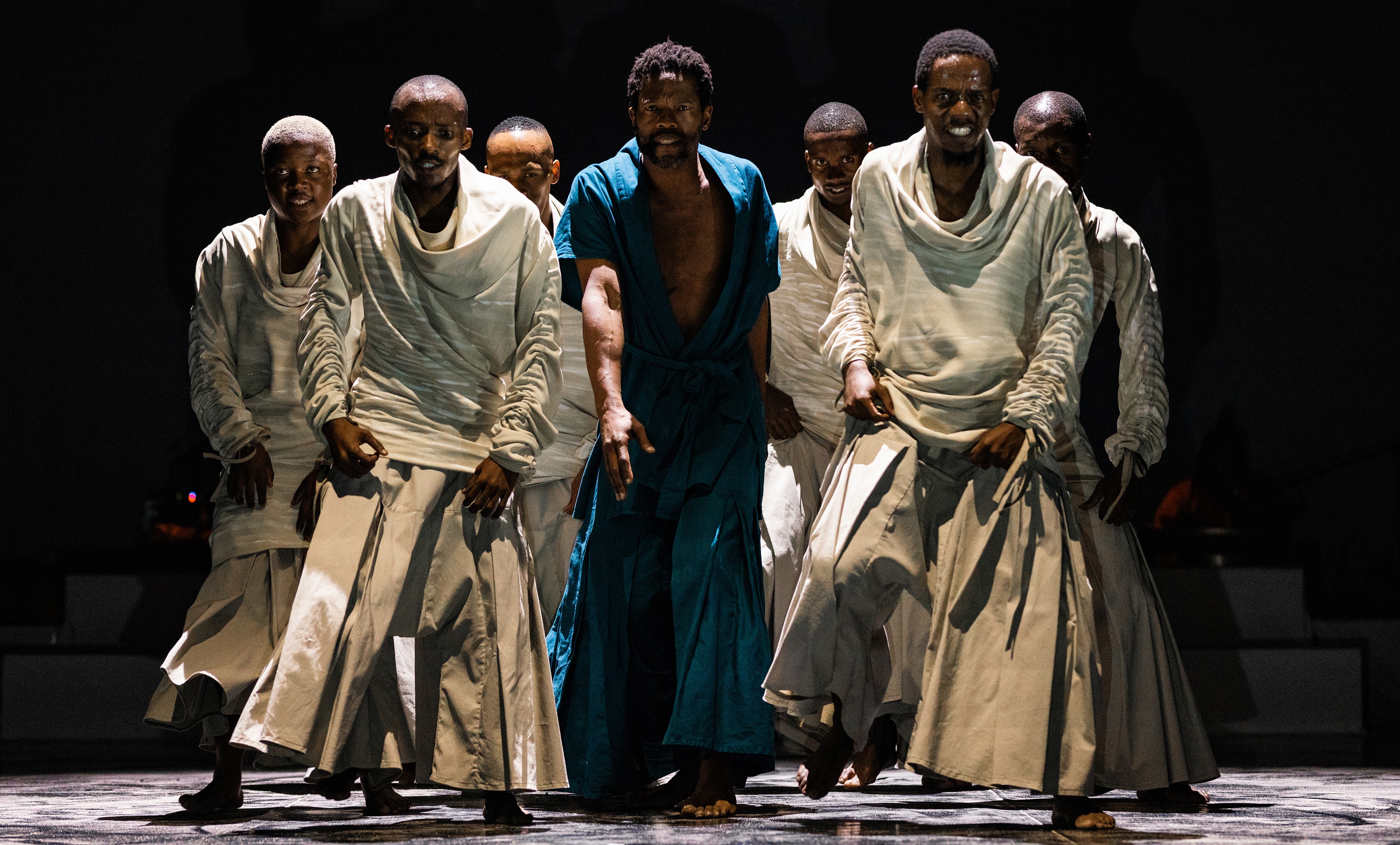
 Genesis is a groundbreaking, multivalent dance opera. (Photo: Arthur Dlamini)
 In an interview towards the end of 2024, shortly before the great South African dancer Gregory Maqoma’s retirement from performing, he told me that as a choreographer he places a high premium on collaboration, that in the rehearsal room everyone has something to offer.
He also said that the audience, although not present in the rehearsal studio, is perhaps the most significant collaborator of all.
“The most important thing for me, and something that I always think about when making work or choreographing a piece, is the audience,” he said. “Because ultimately, it is about them. The work is telling a story that needs to be relatable to an audience. It is relating stories that the audience needs to be inspired by. In any work I create, the audience is among my collaborators. They are there with me in the space.”
Genesis: The Beginning and End of Time is Maqoma’s newest work, fresh from the rehearsal room for a brief run at The Baxter in Cape Town. It’s a kind of groundbreaking, multivalent dance opera that fuses movement and intense physicality with haunting voices, scintillating music and a fascinating libretto (by the French-Indian poet Karthika Naïr) that draws on an agglomeration of diverse texts.
What was most evident – and instructive – about the show’s opening performance on Wednesday night, was its impact on the audience.
There were loud, proud, prolonged ululations, shouts of recognition and calls of agreement from people watching that made the entire auditorium feel alive, as though it had been summoned into action by a jolt of creative energy. The atmosphere in that space was electric.
It was incredibly moving, too.
/file/attachments/orphans/ThechoreographyincorporateselementsfromcolloquialandtraditionaldanceformsdistilledfromavarietyofAfricancultures_ArthurDlamini_900507.jpg "The choreography incorporates elements from colloquial and traditional dance forms distilled from a variety of African cultures. (Photo: Arthur Dlamini)")
/file/attachments/orphans/Thetextisablendofsungariasgutturalemanationsmonologuesandrecitationsofspeeches_ArthurDlamini_902297.jpg "The text is a blend of sung arias, guttural emanations, monologues and recitations of speeches. (Photo: Arthur Dlamini)")
The interactive charge between performers and audience touched me almost as much as what was happening on stage. It became a shared spiritual experience, an immersive summoning of forces beyond the physical realm that made me feel somehow cleansed, rejuvenated, buoyed.
Unfolding on stage was a gutsy, hard-hitting, incredibly visceral performance, something terribly earthy and strongly connected to the ground beneath our feet – suggestive of a central theme, which is land and its ownership, and its problematic treatment in a colonised environment.
And yet something in the spirit of the performance was not bound to the earth at all.
It was, as if in counterpoint to the feet stomping against the stage and the bodies occasionally tumbling to the floor each time the dancers enacted attempts to architecturally build a new society, also incredibly light, as if the true substrate of the production was centred in a more ethereal place.
We were witnessing, I felt, a ritual of acknowledgement, of stating out loud the sources of so much social ill, of uttering the names of those forces which have conspired to subjugate and oppress: slavery, colonialism, racialised segregation, apartheid and the crushing demands of greedy capitalism. Some of this is strongly literalised: we see Steve Biko, having been slain, raised from the dead, rendered alive again so that he can speak his thoughts and beliefs, reminding us of the values he taught while he walked among us.
The text – a blend of sung arias, guttural emanations, monologues and recitations of speeches – seems designed to make us listen intently as much as we’re there to absorb the energy of the furious and sometimes delicate dancing. It drifts between languages, and the writings of Biko exist side by side with the words of Nhlanhla Mahlangu (who is also the show’s musical director), Nina Simone and such postcolonial thinkers as Aimé Césaire, the father of Negritude, and Frantz Fanon, the revolutionary humanist and radical psychiatrist. There are mythical references and biblical psalms, too.
/file/attachments/orphans/Whattranspiresonstageworkstodrawtheaudienceintoacommunionwithanotherrealm_ArthurDlamini_770785.jpg "The text is a blend of sung arias, guttural emanations, monologues and recitations of speeches. (Photo: Arthur Dlamini)")
The format is a kind of layering, like a living breathing palimpsest, words layered on one another, just as there are bodies upon bodies, voices upon voices, and sounds upon sounds. What you feel, though, are the multitudes of spirits, the voices of ancestors, metaphorically raised from the dead here to speak frankly and directly to a contemporary audience.
Maqoma’s interest in experimenting with and exploring a variety of mediums is evident in the way different components of the production come together, sometimes synthesising into something entirely new, while at the same time remaining deeply rooted in ancient dance traditions.
It is impossible to watch this show and not recognise its Africanness. The choreography incorporates elements from colloquial and traditional dance forms distilled from a variety of African cultures; these are integrated into something new and contemplative, configured in ways that absolutely keep the audience in mind, hold us gripped as the rhythms meted out by the bodies become a kind of elegy of hope.
The show also taps into what Maqoma describes as “dance as a mechanism to open new doors”; what transpires on stage in a sense works to draw the audience into a communion with another realm, to shift us into an almost dreamlike, parallel space where the ideas being disseminated can affect us at a deeper, perhaps transcendent level.
Aside from the beauty of the dancing and the frankly transportive singing and ethereal music, the costumes by Black Coffee and Oliver Hauser’s sublime lighting design add to this sense of being on a journey beyond the physical.
/file/attachments/orphans/ThecostumesbyBlackcoffeeandOliverHauserssublimelightingdesignaddtothesenseofbeingonajourneybeyondthephysical_ArthurDlamini_964798.jpg "The costumes by Black Coffee and Oliver Hauser’s sublime lighting design add to the sense of being on a journey beyond the physical. (Photo: Arthur Dlamini)")
/file/attachments/orphans/Thebodiesonstagemakearadicalpleathatwefaceuptothetruth_ArthurDlamini_434675.jpg "The bodies on stage make a radical plea that we face up to the truth. (Photo: Arthur Dlamini)")
Maqoma wears his politics on his sleeve.
We hear Biko and other voices very explicitly stating the problem with colonialism, reminding us of the truths that lie buried in this land.
And yet, while the production is replete with its reminders of where we’ve come from, Maqoma’s real politics seem to be connected to his humanity, his regard for his fellow human beings, and his hope for the future. In perhaps the most awkward section of the opera, the entire cast joins hands in a gesture of unity that addresses the audience directly.
You feel the show turning, for several minutes, into something almost childlike, naïve in its willingness to state the obvious. It’s a strange shift in the rhythm of the show, a prolonged moment during which the energy subsides and all that there is on that stage is vulnerability. I doubt this is accidental: it’s a plea, it’s something from the heart, it’s unvarnished hope.
Maqoma has, since he first danced as a young boy in the 1980s, done so as a means of escape, a way of dealing with the trauma of what this country was.
Now, with Genesis, he has created a show that in many ways defies definition, and which does not presume to use dance purely as a means of escape or celebration. Rather, the bodies on stage make a radical plea: that we face up to the truth and, in so doing, heal ourselves. DM
Genesis: The Beginning and End of Time is showing at The Baxter in Cape Town until 21 February. It will also enjoy a run in Johannesburg in March.