




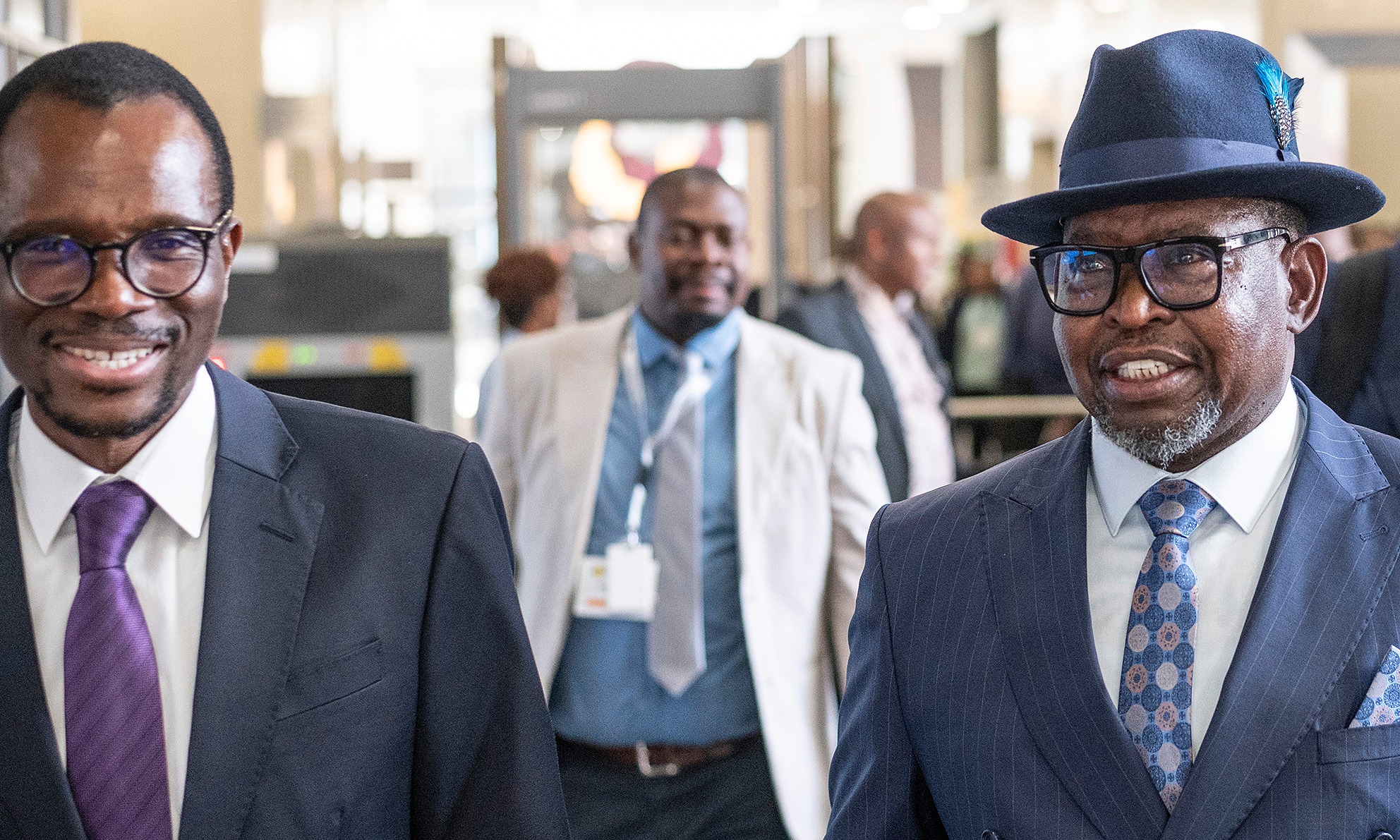
 Minister Enoch Godongwana at the media briefing held at the Imbizo Media Centre in Cape Town before his Budget speech on 25 February. (Photo: Gallo Images / Brenton Geach)
As is customary, the 2026 National Budget was delivered in a triplet flow. Minister of Finance Enoch Godongwana’s lyrical stylings look back one year, but forecast three – it’s what he means when he says “medium term”.
But internal rhymes between these lines point to a R893-billion investment in manufacturing, SMEs and public employment programmes to stimulate economic growth over the medium term. Welcome to Ramaphosa’s industrialist economy.
“We committed to a clear reform agenda and a disciplined fiscal strategy built on three principles: stabilise debt, invest in infrastructure and spend better,” says Godongwana of the 2026 Budget.
In 2023/24, the primary balance swung from deficit to surplus for the first time since the 2008 global financial crisis. It will grow to 2.3% of GDP in 2028/29. As a result, debt as a share of GDP will decline over the next three years and the cost of servicing that debt will reduce from 21.3% of revenue in 2025/26 to 20.2% in 2028/29. These developments reflect a determined approach to repair the public finances while creating a foundation for stronger and sustainable economic growth.
Let’s get down to business
Over the next three years, the government will spend R310-billion more (R2.58-trillion in 2025/26 to R2.89-trillion in 2028/29) per year to reduce the unemployed hordes. All this while generating R250-billion more in tax revenue over the same period (R2.13-trillion to R2.38-trillion).
“After two years with no inflationary relief, personal income tax brackets and medical tax credits will be fully adjusted for inflation,” Treasury explained in the 2026 Budget Review document.
It would seem that the age of austerity is largely behind us (there was even Ellis Brown coffee creamer in the media lock-up). This year’s budget is expected to spend R2.67-trillion – off of a projected tax income of R2.35-trillion; which brings down the deficit 50 points from 4.5% of GDP to about 4%.
Tax income is expected to remain steady at just under 30% (28.6% – it was 28.8% last year).
Growing the country
On the economic development front the next three years will see spending of R284-billion in 2026/27, R291-billion and R319-billion.
It’s now the sixth-biggest destination for government spending, and enjoys a 5.8% average annual growth – the government will increase its spending more to meet this end than any other.
Only spending on public sector pensions will grow quicker (6.3% average annual growth), with the government looking to send an additional 500 million randelas per year to support pensioners.
The Budget delegation, when doing their walkabout session, confirmed to Daily Maverick that this is not linked to the early retirement offers to help the reduction of the public wage fund and refresh the public sector.
The government also mirrors some Daily Maverick readers who responded to Business Maverick editor Neesa Moodley’s reader engagement on household expenditure – basic and post-school education and training together receive just over one of every five rands the government spends.
Easing local government pains
This is not the scorecard but the odds are very much in favour of fixing local government failure – it is, of course, also a local government elections year.
“The 2026 Budget also signals a fundamental shift in the effort to fix local government. For over a decade, intergovernmental flows have masked financial weaknesses in subnational government. With 63% (162) of municipalities in financial distress in 2023/24, and provinces struggling to balance compensation costs and service delivery, this approach has reached its limit.” – Budget Review 2026
Spending on municipalities is estimated at R567-million, at an average 3.1% annual growth across the medium term.
This does not sound like a lot, but there are other conditions and grant restructuring (school infrastructure backlog, for instance, has been folded into the education infrastructure grant) that explain away some of the issues.
There’s also the interplay between the provinces and municipalities to consider, but a major reform is an addition to the approach towards delinquent municipalities who are already under the debt relief programme. Those will be encouraged to enter into an arrangement with Eskom for the power utility to then take over the distribution network until accounts can be brought into good standing.
As an aside, Godongwana did confirm to the media that “national government will have to get closer to the City of Joburg” because, in his understated assessment, “there is a problem”.
Wrangling the Budget sheet
Perhaps the biggest impact on the Budget was the lowering of the inflation outlook and reducing the inflation target to 3% (and slightly higher real GDP growth).
That single move directly lowered short-term borrowing costs. On the bottom line this translates to principal and interest payments expected to be R21-billion lower than estimated in the Medium Term Budget Policy Statement.
The government could then borrow at a cheaper rate, with debt service costs also being revised down by R10.6-billion over the medium term on the back of better bond yields.
/file/attachments/2988/borrowingcost2_609554.png)
With increased spending on economic development and government stepping in to rehabilitate the failing municipalities, there needs to be borrowing to help get these projects over the line. And, for the first time in 16 years, we can get that working capital on favourable terms. DM
Comments
Scroll down to load comments...