



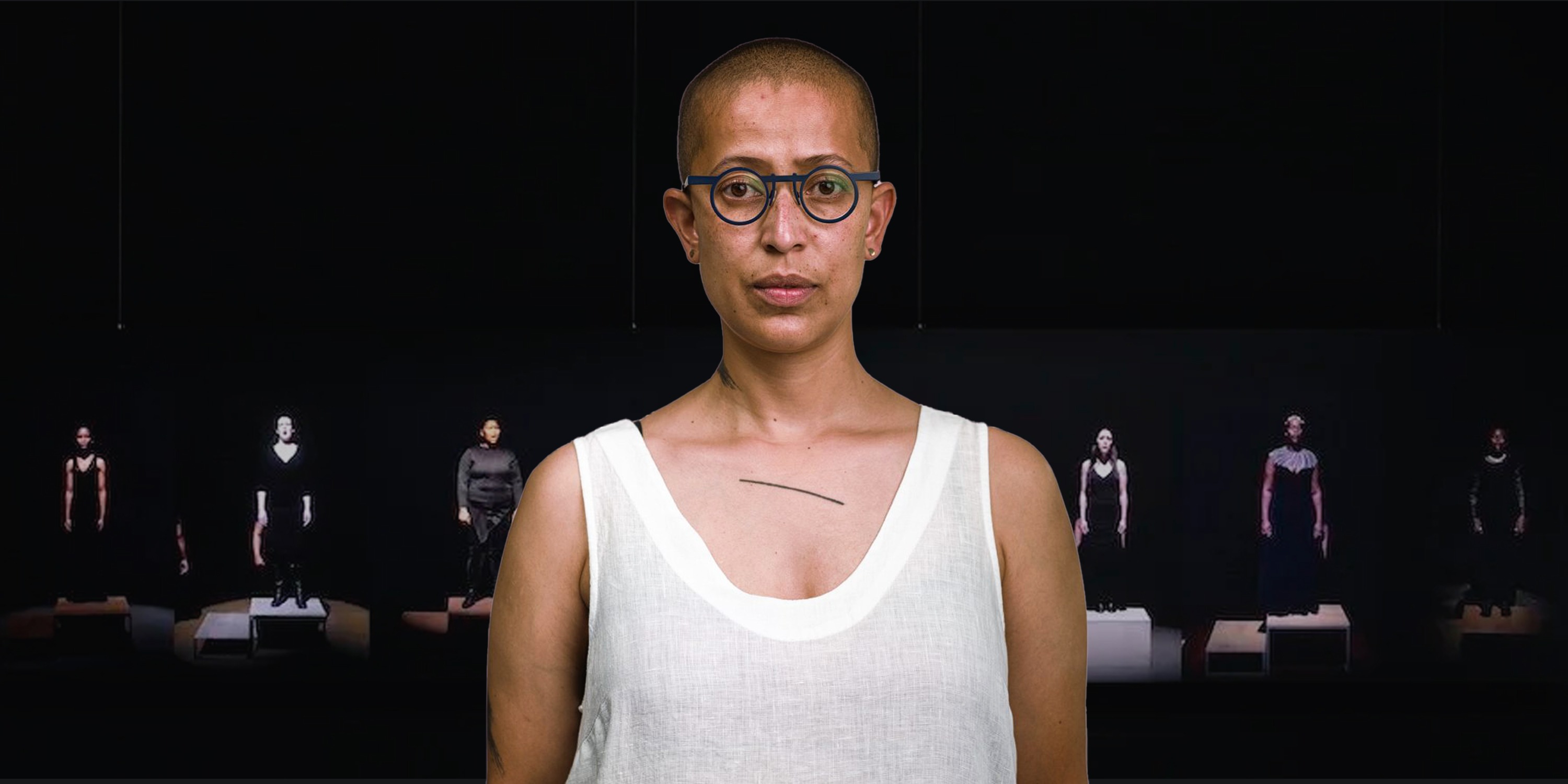
 Illustrative image | A series of 10 documented Elegy performances is shown in this immersive video and sound installation. (Photo: @gabriellegoliath) | Gabrielle Goliath. (Photo: @gabriellegoliath)
South Africa’s participation in the 2026 Venice Biennale may still happen, despite Arts and Culture Minister Gayton McKenzie’s apparently concerted machinations to cancel an artwork dealing with the killing of women and children in Gaza and femicide in South Africa.
South Africa’s ambassador to Italy, Nosipho Jezile, said McKenzie told her on 6 February at a briefing in Rome that a decision had been made not to exhibit any artwork at South Africa’s pavilion at the Biennale. The decision was apparently made so as “not to place South Africa in disrepute at an international platform”.
/file/attachments/orphans/nosiphojezile_406664.jpg "South Africa’s ambassador to Italy, Nosipho Jezile. (Photo: X)")
However, when this decision was relayed to the Biennale Foundation that day, its response appeared to allow a glimmer of hope for the artist McKenzie sought to cancel, Gabrielle Goliath, and her team, curator Ingrid Masondo and studio manager James Macdonald.
The Biennale’s Joern Brandmeyer wrote back to the embassy that “the catalogue constraints are currently being reviewed internally. In this context, we are pleased to confirm our availability to keep the pages reserved for the South Africa Pavilion and to extend the related deadlines until next week [this coming weekend].”
Daily Maverick understands that, at the time of publishing, the Department of Sport, Arts and Culture had not sent Jezile an official letter of communication withdrawing South Africa’s participation, as required by the Biennale’s rules. Such communication will be formalised this week, presumably after the hearing on Wednesday, 11 February at the Gauteng High Court in Pretoria of an urgent application to prevent McKenzie from cancelling Goliath’s work.
Read more: Artist Gabrielle Goliath sues Gayton McKenzie over cancellation of work for Venice Biennale
Department is ‘adamant’
Arts and culture spokesperson Stacey-Lee Khojane said the department was adamant that it was “not planning any exhibition in Venice this year”.
Daily Maverick understands that Goliath’s lawyers have written to the Biennale to ask whether her work can still be exhibited at the event if the court finds in her favour.
This is the latest twist in a tale that started when McKenzie sought to interfere with, and then cancel, Goliath’s video-based artwork Elegy after an independent selection committee chose it to represent South Africa at its national pavilion in Venice.
Initially, McKenzie had taken issue with Elegy because part of the “work of mourning” engaged with the Israel Defense Forces’ killing of women and children in Gaza. McKenzie also publicly claimed, spuriously, that it was funded by the Qatari government — an allegation that was debunked by Daily Maverick.
The latest “sho’t right” by the minister raises questions about whether McKenzie intentionally dragged his feet in taking more than 2½ weeks to finally respond to the urgent legal application by Goliath’s lawyers to interdict him from interfering with the Biennale process.
During that time, both court and important Venice Biennale deadlines whizzed by.
McKenzie and his department also appeared to be making surreptitious moves to replace Goliath’s Elegy as South Africa’s selection for this year’s Venice Biennale while letting the clock run down on related deadlines.
Read more: Goodman Gallery drops artist Gabrielle Goliath after her Venice Biennale selection
Court papers
These apparent behind-the-scenes machinations — while McKenzie remained silent to the news media and the general public about what was to happen at South Africa’s Pavilion at the Biennale — are evidenced in email correspondence attached to McKenzie’s replying affidavits filed on 9 February.
McKenzie missed the initial deadline to file his response by a full 11 days, citing being out of the country and the state attorney’s procurement process as reasons for the delay. Meanwhile, South Africa missed Biennale-related deadlines, which may render Goliath’s application moot — something that McKenzie argued in his affidavit.
It is unclear whether this was part of McKenzie’s strategy. The department’s Stacey-Lee Khojane said the minister would not “engage in commentary, speculation or opinion on ongoing legal proceedings”.
Attached to McKenzie’s affidavit is correspondence that shows Jezile twice requesting — and obtaining — from the Biennale extensions of the deadline to submit details of SA’s exhibition at the Biennale.
On 23 January, Jezile requested an extension of the date to submit exhibition information for inclusion in the Biennale’s official catalogue and “reaffirm[ed] South Africa’s commitment to participating in the 61st International Art Exhibition of La Biennale di Venezia”.
An extension until 6 February was obtained on 28 January. Two days later, Jezile wrote to arts and culture officials, including McKenzie’s special adviser, Charles Cilliers, requesting a virtual meeting on 2 February and seeking “guidance on how best to proceed” to meet the deadline, which she described as “absolute”.
/file/attachments/orphans/471856120_1145661713843858_8779230088251932422_n_362592.jpg "Gayton McKenzie and his special adviser, Charles Cilliers. (Photo: Patriotic Alliance)")
Jezile said she had received two submissions for South Africa’s Biennale exhibition. One was from Studio Goliath, as per the transparent and independent selection process conducted by Art Periodic, the nonprofit appointed by McKenzie to run the Biennale process. The other, a project by Beyond the Frames, was “resubmitted” on 23 January. Jezile confirmed that she had received the submission directly from the Cape Town-based group of artists, who describe themselves on their Facebook page as a “social life-drawing collective”.
Read more: McKenzie’s ‘foreign power’ defence for cancelling Venice Biennale artwork falls flat
‘Forgettable’ submission
One of the independent selection committee members who chose Elegy told Daily Maverick, on condition of anonymity, that Beyond the Frames had submitted a proposal for their consideration, but that it was so “forgettable” that it did not make the selection committee’s cut for the second round.
/file/attachments/orphans/IMG_8092_993157.png "Beyond the Frames describes itself as a ‘social life-drawing collective’. (Photo: @beyondtheframevollective)")
By 23 January, with Beyond the Frames having submitted their proposal to the ambassador, McKenzie and his advisers still appeared to have an appetite to present something at the Venice Biennale. Jezile said that, during a meeting with McKenzie’s advisers on that day, she was told that the department would “abide by” any court ruling and was asked “to explore further requests for extensions with the Biennale” — which she duly did, obtaining an extension until 6 February.
But time was running out. On 30 January, Jezile again wrote to the Department of Sport, Arts and Culture, requesting their “priority attention” regarding the Biennale’s “absolute deadline” for the submission of information about the artwork to be included in its official catalogue.
Jezile confirmed that at the 2 February meeting with arts and culture officials, the “guidance” she sought “explored the option not to proceed with the Pavilion showcasing in 2026”.
On 4 February, she sought another extension from the Biennale. Then, two days later, McKenzie appears to have, embarrassingly, canned the whole thing.
But the emails McKenzie filed in the court papers appear to confirm that the government did attempt to replace Goliath’s selection after she sought to interdict the minister when her lawyers filed an urgent application on 22 January.
Whether all this was a wilful delaying tactic has not been established, but in a 1 February email that McKenzie’s special adviser, Cilliers, sent to Bennedict Mokubedi, the department’s acting director of legal services, he noted the possibility that Goliath’s court application would become academic.
Cilliers forwarded the email thread, including Jezile’s messages regarding the 6 February deadline, and wrote: “This would suggest that the date the applicants gave of 18 February is too late and the case will be moot by 6 February.”
In his affidavit, McKenzie claimed that Goliath and her team had no legal standing to make the application and, “fatally”, they did not cite Art Periodic in their papers.
The Department of Sport, Arts and Culture announced a public-private partnership in November last year that tasked Art Periodic with organising South Africa’s pavilion at the Biennale. The non-profit’s directors, according to its website, are Ann Roberts and Liesl Potgieter. The agreement was terminated by McKenzie on 2 January this year.
McKenzie argued in his court papers that this was done because Art Periodic had “never shared” information related to Elegy’s selection with his department, even after he had requested this in a letter dated 22 December.
He also claimed that the agreement with Art Periodic did not require a selection process to be held, nor was this a function of the department, “either under legislation or the Constitution”. This, McKenzie argued, means that his decision to cancel Goliath’s selection for Venice “does not amount to administrative action”. The Promotion of Administrative Justice Act requires decisions and actions by the state to pass a rationality test.
‘Total surprise’
McKenzie, who leads the right-wing Patriotic Alliance and is a self-proclaimed Zionist, said it came as a “total surprise” when he was informed of Elegy’s selection on 22 December. He said he immediately wrote to Art Periodic, requesting more information.
He said the political content of Goliath’s work, which engages with themes of mourning, femicide and genocide in contemporary South Africa and Palestine, and in German-controlled South West Africa (now Namibia), caused “concerns … regarding whether the use of the [Venice pavilion] space in this manner aligned with the purpose for which access to the pavilion had been granted”.
He said that Elegy’s engagement “with issues of international conflict and foreign policy” concerned him because of “potential diplomatic and reputational implications”.
McKenzie was critical of Art Periodic’s “lack of candour” when he sought more information about Elegy in December, and accused them of not being forthcoming. He said he took action against Art Periodic and not Goliath and her team.
“I have no relationship with the applicants. I never took any decision against the applicants,” he stated.
The non-profit Campaign for Free Expression (CFE) has applied to the court to be admitted as amicus curiae. In her affidavit, CFE’s executive director, Nicole Fritz, claimed that McKenzie’s actions had a “manipulating effect on artistic freedom” and that he had violated his constitutional obligation as a government representative to be “truthful and transparent”.
/file/dailymaverick/wp-content/uploads/2024/03/Black-power-point-q.jpg "Nicole Fritz. (Photo: Supplied)")
Fritz said McKenzie had placed South African artists in an “invidious position” where they either “practise art that pleases the political head of the department and thus be rewarded for it, or produce whatever their creative conscience tells them to, and risk being alienated or punished by the department, as the present applicants have been”.
This, she said, was an assault on the constitutional right to freedom of artistic expression.
Read more: Gayton McKenzie’s abuse of power is not an aberration, it is a pattern
Fritz also accused McKenzie of relying on ever-changing post facto “falsehoods” to justify his cancellation of Goliath’s work.
She claimed several constitutional issues had been raised, including that McKenzie was bound to ensure that public administration is accountable and that transparency must be fostered by providing the public with timely, accessible and accurate information. DM