




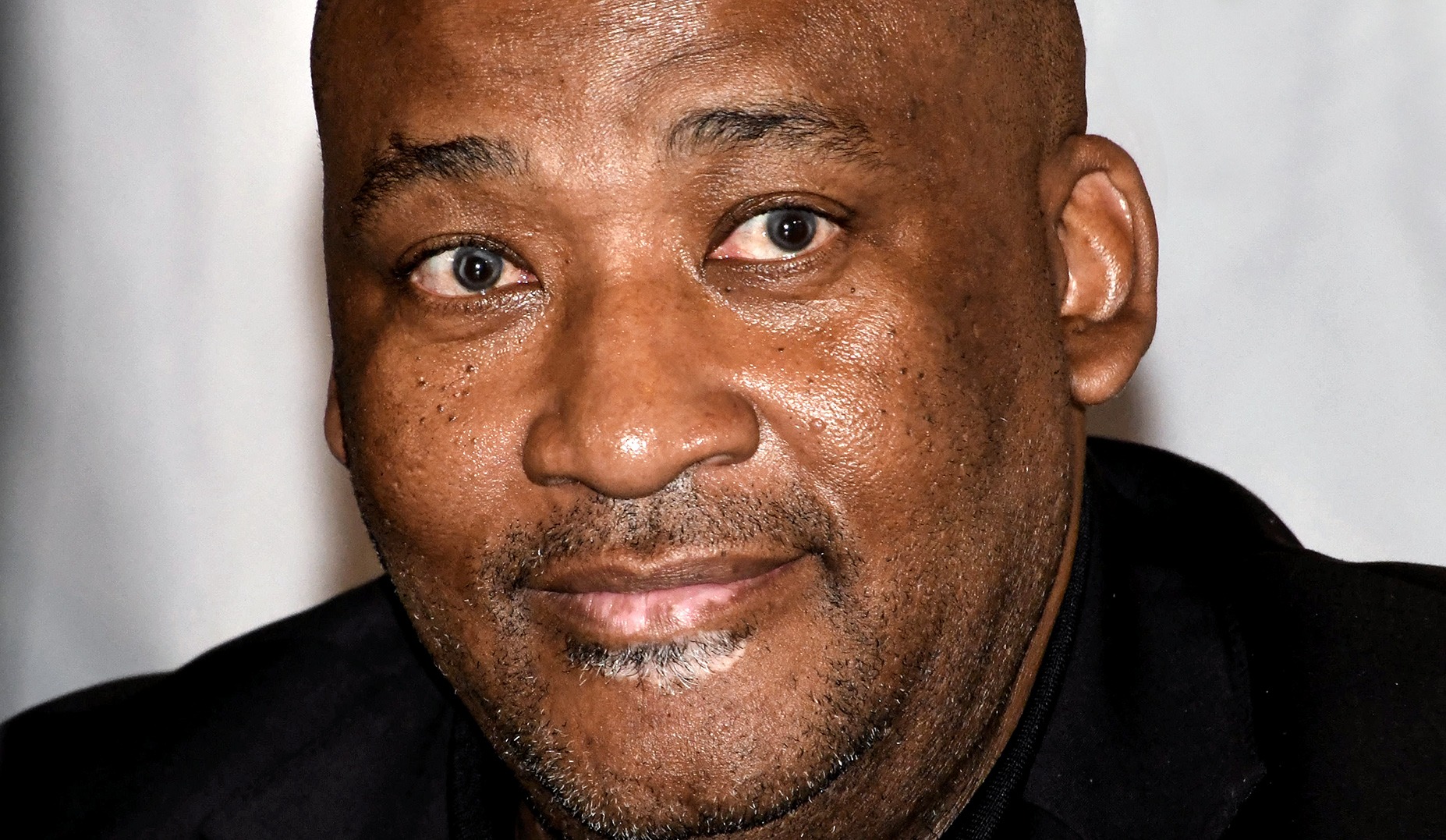
 Minister Gayton McKenzie’s cancellation of an artwork destined for the South African Pavilion at the 2026 Venice Biennale has been slammed as ‘an abuse of power’. (Photo: Gallo Images / Frennie Shivambu)
In an astonishing clampdown on freedom of expression — and a break with the South African government’s official foreign policy stance on the Israeli genocide of Palestinians — Arts and Culture Minister Gayton McKenzie has cancelled a South African artwork proposed for the 61st Venice Biennale later this year because of content related to the deaths of women and children in Gaza.
The decision, communicated by McKenzie on 2 January to the organising team preparing for the biennale, brings to an abrupt end a two-month-long open-call, selection and curatorial process, and places South Africa’s participation at the prestigious exhibition in Venice in jeopardy. Countries must submit their plans for the biennale by 10 January.
McKenzie took exception with Elegy, a work proposed by Gabrielle Goliath, who was unanimously selected as South Africa’s sole representative for the country’s pavilion. A 2019 Standard Bank Young Artist, Goliath is critically acclaimed both locally and internationally.
For the biennale, Goliath’s proposed version of Elegy draws on her similarly titled decade-long project centred on femicide and the killing of LGBTQI+ people in South Africa, women killed by German colonial forces in Namibia during the Ovaherero and Nama genocide in the early 1900s, and the deaths of tens of thousands of women and children killed in Gaza by the Israel Defense Forces (IDF) since October 2023. The third section includes a commemorative poem honouring the much-loved Palestinian poet Hiba Abu Nada, who was killed during the IDF bombardment of Gaza.
/file/attachments/orphans/Elegy-EuniceNtombifuthiDube_photo_CentrefortheLessGoodIdea1_625875.jpg "Gabrielle Goliath’s ‘Elegy — Eunice Ntombifuthi Dube’, 2018, Centre for the Less Good Idea, Johannesburg. (Photo: Stella Tate)")
According to letters McKenzie wrote to Art Periodic, the non-profit company tasked by the Department of Sport, Arts and Culture with organising and presenting the South African Pavilion at the 2026 edition of the biennale, it is the part of Elegy dealing with deaths in Gaza that the minister sought to censor.
On December 22, he fired off a letter to Art Periodic requesting a change in curatorial and artistic direction by Goliath, the highly respected project curator Ingrid Masondo and team member James Macdonald. The minister also threatened to terminate South Africa’s participation in the biennale or withdraw the ministry’s support for the exhibition if his wishes were not acceded to.
Without referring to the systematic killing of tens of thousands of Palestinians by IDF soldiers as a “genocide” — a term confirmed most recently by a United Nations independent international commission of inquiry in September 2025 — McKenzie described this subject matter as “highly divisive in nature and relates to an ongoing international conflict that is widely polarising”.
Goliath, Masondo and Macdonald responded to McKenzie in a letter dated 4 January, in which they described the minister’s prescriptions to the artwork and threats to terminate participation in the biennale and/or withdraw government support for it as “an abuse of power and due process, and a contravention of the right to freedom of expression”.
“We do not believe it is the right or duty of a Minister — especially a Minister for Sport, Arts and Culture — to prescribe or constrain what artists, sports communities and the public can or cannot reflect upon or respond to. Doing so would foreclose the possibility of the arts to facilitate meaningful engagement with urgent and challenging sociopolitical concerns,” they continued.
/file/attachments/orphans/unnamed_194202.jpg "Gabriellie Goliath was the Standard Bank Young Artist Winner for Visual Art in 2019. (Photo: Mark Wessels / National Arts Festival)")
They further rejected the minister’s claims that their work was “highly divisive” or “polarising”.
Describing Elegy as a “work of mourning and repair”, they stressed its invitation to audiences “to relate empathetically with those commemorated through the performances, across lines of racial, gendered, geographic, religious and political difference. Drawing significant connections between the national disaster of femicide in South Africa, the Ovaherero and Nama genocide in Namibia, and the unfolding crisis of displacement and death in Gaza, it asks us to consider and refuse conditions that render some lives grievable and others available to death and disavowal.”
But their call for sanity — and the constitutional right to freedom of expression to prevail — apparently arrived too late. McKenzie had, two days earlier, already sent a second missive to Art Periodic in which he terminated the department’s relationship with the non-profit organisation. He did not mince his words:
“For the sake of clarity, it would not be wise nor defensible for South Africa to support an art installation against a country currently accused of genocide [Israel] while we as South Africa are also fielding unjustified accusations of genocide. The Department of Sport, Arts and Culture cannot support such a highly divisive political narrative on what remains our platform as a country.”
‘Nonsense and disingenuous’
An official at the Department of International Relations and Cooperation (Dirco), who is familiar with South Africa’s International Court of Justice case to have Israel’s killings in Gaza declared a violation of the 1948 Genocide Convention, scoffed at what he described as McKenzie’s “false equivalence”.
“This is absolute nonsense and disingenuous. There is daily proof of a genocide by the Israelis in Gaza and broader Palestine. There is no proof of any genocide in South Africa. This is Minister McKenzie showing that he is heavily funded by the Zionists — which we all know,” said the official.
Read more: ‘The conclusion that Israel is committing genocide is unequivocal’ — Amnesty International
Daily Maverick understands that McKenzie’s actions have caused consternation within the Government of National Unity (GNU) and that the matter has been escalated to the Presidency and Dirco.
/file/dailymaverick/wp-content/uploads/2025/03/6T5A7818.jpg "Chrispin Phiri. (Photo: Shelley Christians)")
Chrispin Phiri, spokesperson for International Relations Minister Ronald Lamola, confirmed that, at the time of publishing, the matter was being discussed at a ministerial level.
The international relations official speaking to the Daily Maverick on condition of anonymity pointed out that mixed messaging from government ministers from different parties was an ongoing problem within the GNU, placing it in a “precarious” position.
“In this moment, McKenzie retains executive control of this situation [because it falls within the ambit of his ministry] irrespective of what we are saying as a government,” said the official.
Silencing dissent
Goliath was unbowed when she spoke to Daily Maverick this week. She bridled at McKenzie’s suggestion in his letters that artists were required to create nationalistic, myth-making art concerned with “social cohesion” and presenting “the best of South Africa to the world”.
The artistic team’s letter to McKenzie highlighted the problems with his understanding of the role of the arts: “To retrospectively dictate a reductive, politically-inscribed focus on the ‘best of South Africa’ feels disingenuous to us. We would also question the credibility of presenting a positivist ‘best-of’ narrative, at a time of public outcry and reckoning in which President [Cyril] Ramaphosa has declared femicide as a national disaster. It is our view that phrases such as ‘social cohesion’ and ‘nation-building’ are often weaponised to silence dissenting voices and to avoid robust dialogue.”
Read more: Gender-based violence and femicide declared national disaster, but with caveats
Goliath said, “As an artist, I am concerned with revealing and refusing conditions that make violence possible, permissible and terrifyingly ‘ordinary’. Whose lives are available to be displaced, raped, killed, disavowed?
“I have said it many times: my work is not about violence, but rather foregrounds practices of mourning, survival and repair, within and despite this normative disregard. At a moment in which sustaining hope is a political imperative, I think it is all the more crucial to emphasise my work as life-work rather than death-work, and as rooted in a decolonial black feminist project of care and radical love.”
McKenzie’s action has also raised concerns within the art fraternity about his predilection for censorship and the reduction of the arts to a simplistic tool for “social cohesion” and “nation-building” as expressed in his letters to Art Periodic — as opposed to artistic expression encompassing forms which challenge normative ideas and render complexity to how people understand their worlds.
‘Unequivocal support’
On Thursday, the selection committee released a statement giving their “unequivocal support for the artist, the curator, and their project in the face of political pressure and attempts to silence free expression and compromise artistic integrity”.
The committee described Goliath’s work as an “understated and powerful engagement with grief … that centres intimacy, care, and listening, creating space for reflection on loss and remembrance. The project centres ‘planetary concerns of loss and disregard’, with a central focus on the ‘urgent specifics of a national disaster of femicide in South Africa,’ but also including experiences in Namibia and Gaza.
“The proposed work recognises and mourns the tragic loss of innocent lives, including Palestinian women and children… [Elegy addresses] historical and ongoing forms of violence with sensitivity, responsibility, and emotional depth, representing South Africa with a courageous and challenging project.”
/file/attachments/orphans/GabrielleGoliath_Elegy-fortwoancestors_2024_performance_LaBiennalediVenezia_SaledArmi_Venice_photobyJMacdonald_6_150137.jpg "Gabrielle Goliath’s video and sound installation ‘Elegy — for two ancestors’ at the 2024 Venice Biennale. (Photo: James Macdonald / courtesy of the artist)")
The committee consists of several respected individuals from the arts sector, including the University of Cape Town’s professor of art history and visual culture, Nomusa Makhubu; Tumelo Mosaka, a former curator at New York’s Brooklyn Art Museum; arts editor and critic Sean O’Toole; Dr Greer Valley, the head of curatorial affairs at Zeitz Museum of Contemporary African Art; and Molemo Moiloa, the co-founder of Open Restitution Africa.
They described the termination of the project as “an abuse of executive authority and a serious violation of the principles enshrined in South Africa’s Constitution.
“The Bill of Rights guarantees freedom of conscience, thought, belief, opinion, and expression — rights that are foundational to a democratic society and essential to artistic practice. Against this constitutional framework, the cancellation of an independent and transparent curatorial process is deeply troubling, particularly in light of the Pavilion’s long history of non-transparency and mismanagement.
“We therefore reject, without reservation, any effort to coerce artists or curators into altering artistic statements to serve political narratives. We further reject all forms of censorship and intimidation that seek to curtail critical artistic practice or undermine the autonomy of cultural production. Such interference is unacceptable and stands in direct opposition to the values of democracy, accountability, and cultural freedom,” they stated.
When approached for comment, Art Periodic’s Ann Roberts referred Daily Maverick to the 6 January statement on their website that confirmed that the arts and culture department had terminated their partnership as of 2 January and that the company “no longer holds a mandate to proceed with the [Venice Biennale] project or to make any announcements in relation to it”.
/file/dailymaverick/wp-content/uploads/2025/09/TL_2253328-1.jpg "File photo: Gayton McKenzie. (Photo: Gordon Arons / Gallo Images)")
McKenzie’s response
Responding to Daily Maverick questions on behalf of McKenzie, the ministry furnished the following answers, published below.
Some of these responses require follow-up questions including the minister’s role in determining what constitutes art that “represents South Africa”; the chilling effect on independent-minded creativity that decisions like these would have on artists seeking state funding, state support or to be included in official national projects; why art needs to align with his personal vision of what constitutes the Department of Sports, Arts and Culture’s (DSAC’s) mandate and how the minister proposes to inhabit a stand at the Venice Biennale with almost no time available for a public call for submissions and a new selection and curatorial process.
Daily Maverick was unable to establish this and more because of time constraints, but will endeavour to do so in the following days:
1. McKenzie rejected suggestion of his drawing a false equivalence between claims of genocide against Israel and South Africa. The response from DSAC said his “concern relates solely” to South Africa “being falsely labelled a ‘genocidal state’”, and that the pavilion at Venice “should not be used to amplify similarly divisive global disputes that do not centre South Africa’s own story. If the Minister had discovered that the exhibition was going to be about telling Mickey Mouse’s life story, he would similarly have directed that a new avenue should be followed, and if the organisers had refused to promote our country on the DSAC’s platform, he would still have ended the partnership. We need to use our platforms to sell our country to the world.”
The response stated McKenzie was not making claims about the “validity or otherwise of international findings regarding Gaza” but stating his wish that official national arts platform did not become a “proxy arena for geopolitical conflicts” because he saw the department’s “statutory role” as “promoting cohesion and nation-building”.
2. McKenzie rejected the suggestion that his position contradicted South Africa’s foreign policy. Rather, his decision to terminate Goliath’s work at the Biennale was because Elegy did not conform with his belief that South Africa’s national pavilion “is meant to showcase South African artistic expression rooted in South African experience”. According to McKenzie Elegy’s “primary thematic focus… did not align” with “the intention and mandate under which DSAC participates in the Venice Biennale”.
3. McKenzie rejected allegations of censorship, claiming his decision “did not censor Goliath, or any other artist, from making, exhibiting, or distributing the work in question…. DSAC remains responsible for deciding what it endorses and presents internationally under the national banner.”
4. McKenzie rejected the allegations of prescribing artistic practise to artists. His “responsibility [was] to ensure that work shown under the South African name and supported by public resources is aligned with the mandate of the Department, the purpose of the platform, and established expectations for national representation. This is standard practice in all levels of state-supported cultural programming.”
McKenzie’s response contradicts the public-private partnership agreement between Art Periodic and DSAC that no state funding was to be used for the curating, creating, transport and installation of the selected art work.
5. McKenzie said he “supports freedom of expression and artistic freedom” and that his decision did not affect “the artist’s rights or her ability to present her work elsewhere”.
6. The ministry confirmed South Africa would have a presence at the Venice Biennale despite plans needing to be submitted to the biennale organisers on 10 January. Further details are to be announced in “due course” and the department “remains confident that we will present work that reflects the depth and dynamism of the country’s creative sector”, it said in response to DM’s questions.
7. McKenzie said his decisions had “no bearing on the Government of National Unity or Cabinet positions”. DM
Comments
Scroll down to load comments...