




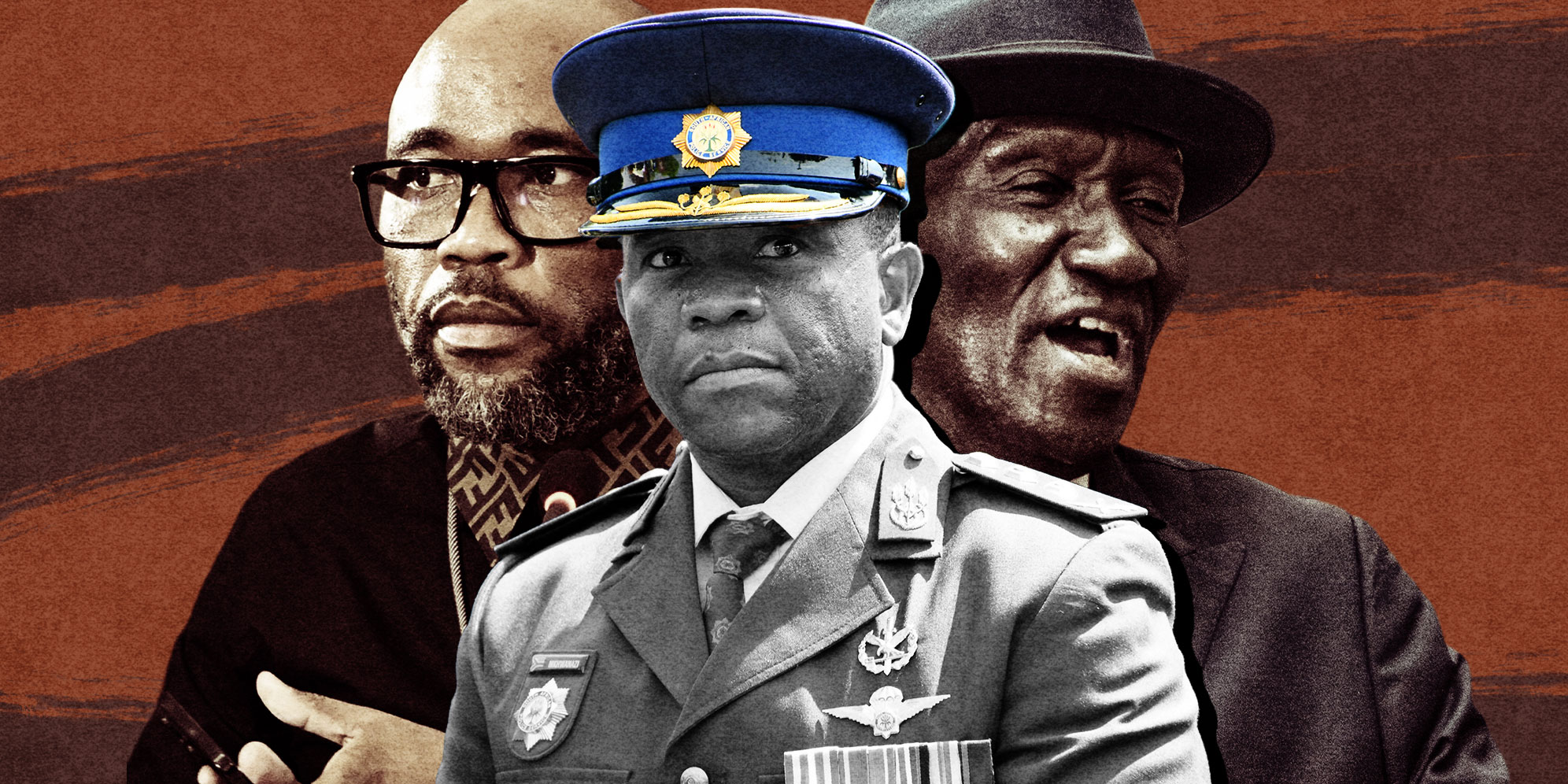
 Illustrative Image: Vusimuzi 'Cat' Matlala. (Photo: Gallo Images / Lefty Shivambu) | KwaZulu-Natal Police Commissioner Lieutenant General Nhlanhla Mkhwanazi. (Photo: Gallo Images / Frennie Shivambu) | Bheki Cele. (Photo: Gallo Images / Brenton Geach) | (By Daniella Lee Ming Yesca)
 /file/dailymaverick/wp-content/uploads/2025/10/label-analysis-2.jpg)
Startling revelations and allegations have emerged from two sets of proceedings focused on accusations that a drug cartel has infiltrated South Africa’s policing, politics and private security industry.
On the lighter side were some quirks, including that former police minister Bheki Cele never replies to messages on his cellphone.
He only deals with calls.
On the darker side were allegations, from a now-murdered witness, that a crime suspect was tortured to death in Brakpan in a 2022 cover-up involving metro police officers.
The two sets of hearings — the Madlanga Commission of Inquiry and Parliament’s ad hoc committee — were launched earlier this year to investigate allegations first publicised on 6 July.
That was when the KwaZulu-Natal police commissioner, Lieutenant General Nhlanhla Mkhwanazi, held a press conference and made a range of accusations, including about the drug cartel infiltration into South Africa's criminal justice system.
According to police officers, the cartel is known as the Big Five.
The Madlanga Commission commenced in September, while the ad hoc committee started hearing testimony the following month.
Both hearings have concluded for the year and will resume in 2026.
Parliament’s ad hoc proceedings have at times been heated, while the Madlanga Commission has been more austere.
What has emerged from the two hearings is that distrust and alleged criminality run through South Africa’s law-enforcement structures, from national offices down to the municipal level.
Below are some of the key overlapping issues and details that have emerged from, or are linked to, the hearings.
Murders and the Ekurhuleni metro police
Former Ekurhuleni metro police officer Marius van der Merwe was fatally shot in front of his family outside his Gauteng home on the evening of Friday, 5 December.
At the time, he was involved in private security and investigations into illegal mining.
Last month, he testified before the Madlanga Commission as Witness D, a pseudonym used as a security measure.
Van der Merwe told the commission about his role in a 2022 cover-up involving the torture and murder of a robbery suspect.
He said he had been tasked with disposing of the body.
The murdered man was Emmanuel Mbense, a father of five.
Among those he implicated was Julius Mkhwanazi, who was suspended as Ekurhuleni’s metro police chief last month and who testified at the commission days before Van der Merwe was killed.
Mkhwanazi spoke about his dealings with organised crime accused Vusimuzi “Cat” Matlala, a key figure in the overall law enforcement scandal who was allegedly a Big Five cartel member.
Mkhwanazi said he sometimes borrowed money from Matlala for petrol or food.
References to the Ekurhuleni metro police during the Madlanga Commission created the impression that corruption was widespread among its members, stunting crime-fighting.
Matlala and money matters
Matlala was repeatedly named at the Madlanga Commission and Parliament’s ad hoc hearing.
He testified before the ad hoc committee when it sat in Kgosi Mampuru Prison in Tshwane, where he is an awaiting-trial prisoner on charges including attempted murder.
Matlala, who acknowledged knowing several policing figures, appeared confident and wore designer clothing while addressing MPs.
During the proceedings, he confirmed that he loves money.
/file/attachments/orphans/ED_588221_522149.jpg "Vusimuzi ‘Cat’ Matlala testifies at the parliamentary ad hoc committee at the Kgosi Mampuru Correctional Facility on 27 November. (Photo: Frennie Shivambu / Gallo Images)")
He testified that he gave R300,000 to former police minister Bheki Cele in January as a “facilitation fee” after firearms that the police had seized from him were returned, and to stop the officers from harassing him.
He said he made a second payment of R200,000 to Cele at the Beverly Hills Hotel in Umhlanga in March.
“He asked for money … he actually wanted R1-million,” Matlala alleged, describing Cele as an “extortionist”.
Cele and freebies
Cele told Parliament’s ad hoc committee that he met Matlala in December 2024 at the Beverly Hills Hotel, a “high-end” location where he regularly ate breakfast.
The meeting was before Matlala was arrested on various criminal charges, but while he was experiencing issues with the police.
Cele confirmed that after they met, he stayed at Matlala’s penthouse in Pretoria on two occasions, at Matlala’s invitation.
Answering a question from an MP, Cele said he had no problem accepting hospitality.
Referring to his stays at Matlala’s penthouse, he explained: “It is because it was a freebie ... and I am not working. I am a pensioner. So here is a nice place, by the way.
“I’m not in government. I’m not going to declare. I guess if I were in government, I would have gone and declared. But now I sleep, I wake up, I go home.”
There were several lighter moments during his testimony before the ad hoc committee.
This included some focus on one of his quirks — that he never responded to typed messages on his cellphone.
Cele’s dealings with Matlala will be further scrutinised in 2026.
Sidelined and suspended
Other witnesses who testified before Parliament’s ad hoc committee included Senzo Mchunu, who was police minister when the accusations surfaced in July, and the deputy national commissioner of crime detection, Lieutenant General Shadrack Sibiya.
Mchunu was accused of being influenced to order the disbandment of KwaZulu-Natal’s Political Killings Task Team at the end of 2024 because certain crime suspects believed this would derail investigations against them.
Read more: Cele’s allegations — the murder and the Mchunu project for ANC presidency
He denied this and testified that he ordered its disbandment because of issues that included a tight police budget.
Other accusations relating to Mchunu, which he has denied, are political and link back to Cele and Matlala.
Cele alleged to the ad hoc committee that Matlala told him that he had been approached to fund a project involving Mchunu, who hoped to be the ANC’s president or deputy president.
As for Sibiya, he was accused of removing 121 dockets that the Political Killings Task Team was investigating.
These dockets ended up at the SA Police Service head office, where they remained for five months until earlier this year, when it was ordered that they be returned to the team.
Sibiya, who denied wrongdoing, was suspended in July.
/file/dailymaverick/wp-content/uploads/2025/10/WhatsApp-Image-2025-10-14-at-11.33.59_fff9618a.jpg "Lieutenant General Shadrack Sibiya testifies in Parliament on 14 October. (Photo: Zwelethemba Kostile / Parliament of RSA)")
Crime Intelligence and corruption
National Crime Intelligence boss Dumisani Khumalo told the Madlanga Commission how the Big Five cartel allegedly operates.
He said recruits registered private security companies that they owned, suggesting that aspects of this sector were furthering drug trafficking and other crimes.
Read more: Kidnapping and ‘body bags threat’ add sinister edge to SA’s clashing State Capture narratives
In June, a month before the law enforcement scandal erupted, the Investigating Directorate Against Corruption (Idac) arrested Khumalo and six of his colleagues over an allegedly irregular appointment.
The #AdHocCommittee probing allegations by @Saps KZN Head, Gen Nhlanhla #Mkhwanazi, is back in session this morning - now hearing evidence from IDAC Head, Adv Andrea Johnson #PKTT @ParliamentofRSA pic.twitter.com/mGUjw5lgKn
— Justice-and-security-Cluster (@JustSecuCluster) November 6, 2025
They denied wrongdoing, and during the Madlanga Commission and ad hoc committee proceedings, some police officers (Nhlanhla Mkhwanazi in particular) aired their views that Khumalo had been targeted to frustrate investigations into certain criminals.
Mkhwanazi alleged that Crime Intelligence members, through MP Fadiel Adams and Idac, got Khumalo and his colleagues detained.
Idac head Andrea Johnson testified before the ad hoc committee that there was “no truth to the allegation” that Idac was involved in a “witch-hunt” against police officers.
She also said she had received a death threat in relation to the Crime Intelligence arrests.
It said, in part: “Mrs IDAC… You going to wish you did not **** with us. Get body bags ready.”
/file/dailymaverick/wp-content/uploads/2025/11/ED_585362.jpg "Idac head Andrea Johnson. (Photo: Brenton Geach / Gallo Images)")
Where things stand
The Madlanga Commission and Parliament's ad hoc committee proceedings have emphasised the irrefutable — that South Africa’s law enforcement arena is fragmented.
These divisions were previously visible to the public when police officers made accusations against their colleagues.
The Madlanga Commission and the ad hoc proceedings, though, have zoomed in on the situation in an unprecedented manner, providing granular glimpses of what has sparked infighting.
Jobs and reputations, including that of Mchunu, Sibiya and Julius Mkhwanazi, are on the line.
/file/attachments/orphans/ED_589739_542305.jpg "Senzo Mchunu testifies at the Madlanga Commission at the Brigitte Mabandla Judicial College in Tshwane on 4 December. (Photo: Frennie Shivambu / Gallo Images)")
Given the security risks associated with the hearings, so too are lives.
More accusations and counterclaims about policing will emerge when the Madlanga Commission and ad hoc committee resume in 2026.
These hearings will make recommendations that have an impact on South Africa's policing and political arena.
State officials linked to law enforcement could even find themselves in a courtroom dock, where they are meant to be putting criminals. DM