




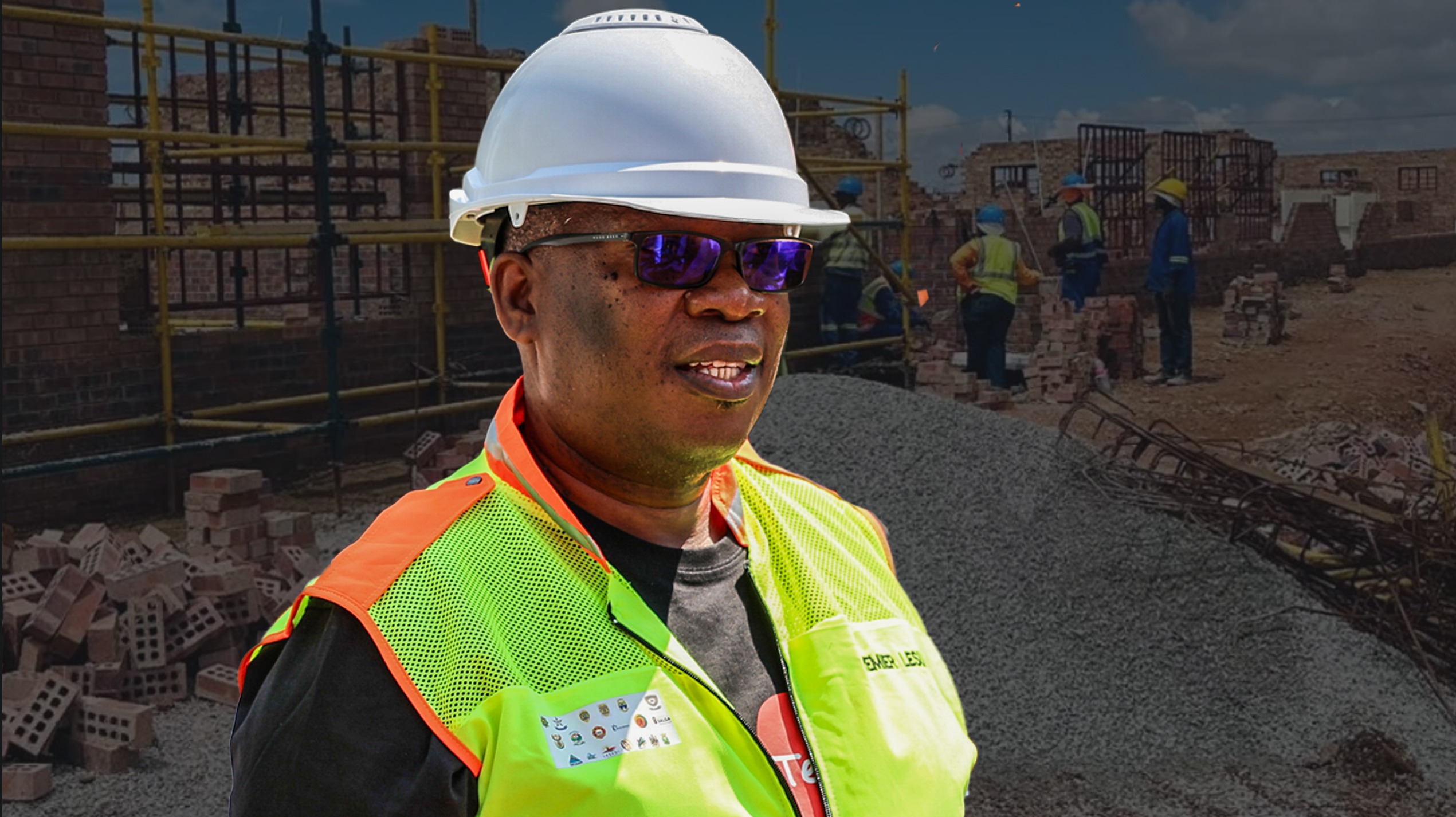
 Illustrative image | A Gauteng primary school under construction. (Photo: gp_infrastructure / instagram) | Gauteng Premier Panyaza Lesufi. (Photo: Gallo Images / Luba Lesolle)
 Although the academic year is well under way, it was only on 4 March 2026 that the Gauteng Department of Education (GDE) finally announced a "complete placement" of Grade 1 and Grade 8 learners. According to the department, as of the evening of 3 March, the final 484 students in the high-pressure zones of Tembisa and Kempton Park — had been placed at alternative schools within their respective areas.
DA Shadow MEC for Education, Sergio Isa Dos Santos explained that these learners were previously temporarily placed in a primary school facility, where they remained in limbo while waiting for mobile classrooms to be partitioned and dispatched.
“It is very disruptive,” Dos Santos explained. He noted that the delay and the makeshift setting hinder the learners' ability to integrate effectively. “By the second term, they've already lost valuable time making friends and adjusting. On top of that, I'm almost 100% certain they're missing out on the essential education they need in a real high school environment, complete with specialised subject matter and registered classes.”
The ‘school a week’ pledge
In an attempt to quell public frustration over this exact admissions backlog, Lesufi took to Facebook on January 14 with a bold pledge:
“We will open a new school every week until February because to us education is the future. Schools with smartboards, free wifi, laboratories, library and sporting facilities”.
In the weeks that followed, the province did manage to cut the ribbon on two educational sites.
The first was Rust-Ter-Vaal Secondary School in Vereeniging. For years, learners were taught in dangerous structures built from asbestos, a hazardous material banned in South Africa, and later in mobile ship containers, while the community repeatedly protested and begged for a safe brick-and-mortar school.
Billed as a state-of-the-art facility that complies with the Gauteng Department of Education's Smart School rollout, the new Rust-Ter-Vaal Secondary boasts the capacity to accommodate 1,000 learners. The school features 24 modern classrooms fitted with digital smartboards, alongside a specialised science block, computer laboratories, and a library. Beyond pure academics, the grounds also include a fully kitted home economics centre with the latest cooking hardware, a dedicated school nutrition hall, a guardhouse, and extensive sporting amenities.
/file/attachments/orphans/615773694_1427482858735874_2662019602857286544_n_173597.jpg "Gauteng Premier Panyaza Lesufi (right) and Gauteng Education MEC Matome Chiloane at the recently opened Rust-Ter-Vaal Secondary in Vereeniging. (Photo: Panyaza Lesufi / Facebook)")
However, while the school finally opened its doors to much fanfare in January 2026, the reality is that the local community had been fighting for this facility for roughly a decade.
Behind the scenes, the Gauteng Department of Infrastructure Development (GDID) struggled to get the project over the finish line. Construction was repeatedly delayed by a litany of operational failures, including poor contractor performance, severe cash flow mismanagement, late payments to local SMMEs and the subsequent community disruptions that followed.
According to Dos Santos, this is a systemic failure. While the Department of Education frequently spends 99% of its budget, the GDID’s expenditure can drop to between 60% and 70%.
“The Department of Education does what they are meant to do: provide the necessary budget. But the Department of Infrastructure Development, which is supposed to develop these schools, is really, really failing,” Dos Santos noted, questioning the lack of penalty clauses for contractors who delayed projects and failed to pay local SMMEs.
The second facility, Dr WK du Plessis LSEN School in Springs, was officially handed over on 22 January by Premier Lesufi, Education MEC Matome Chiloane, Infrastructure Development MEC Jacob Mamabolo and Ekurhuleni Mayor Nkosindiphile Xhakaza.
/file/attachments/orphans/619202319_1433653494785477_1034784382948856065_n_769651.jpg "Gauteng Premier Panyaza Lesufi, flanked by MEC for Education Matome Chiloane (right) and MEC for Infrastructure Development, Cooperative Governance and Traditional Affairs Jacob Mamabolo (front left), at the opening of Dr WK du Plessis LSEN School in Springs. (Photo: Panyaza Lesufi / Facebook)")
For decades, the special needs school operated out of ageing, prefabricated buildings plagued by leaky roofs, cracking floors and burst pipes.
The rebuild has transformed the outdated site into a modern, inclusive educational hub capable of accommodating roughly 600 learners. The sweeping upgrades include specialised, larger classrooms equipped with smart technology and ICT infrastructure, alongside dedicated therapy rooms.
To provide holistic care, the campus now offers on-site nursing, licensed therapists and boarding facilities for up to 120 learners. The rebuild also introduced newly equipped cooking and life-skills centres — designed, as Lesufi noted in his speech, to ensure these learners can participate meaningfully in the mainstream economy.
This is not the first time Lesufi has leaned on rapid-fire construction promises. In September 2014, during his tenure as Gauteng’s Education MEC, he made an almost identical, ambitious pledge, publicly committing to open “a new school every week” until the end of that year, to deliver 17 new facilities.
However, the government’s own paper trail reveals that this accelerated timeline completely failed to materialise. According to the Gauteng Department of Education’s 2014/15 Annual Report, the department managed to complete only 13 schools across that entire financial year.
Sopa déjà vu
During his 2026 State of the Province Address on 24 February, Lesufi acknowledged the ongoing admissions crisis that continued to plague Gauteng.
Promising relief, he said the online school admission registration process would be “improved and strengthened to ease the pain and frustration of our parents”. His proposed solution to the severe classroom shortage was the construction of 18 additional new schools across the province to finally ensure education was accessible to all.
However, that announcement probably triggered a profound sense of political déjà vu because, since 2023, the promise of 18 new schools has become a staple of Lesufi’s annual addresses. In 2023, he announced a major boost of R1.5-billion from the National Treasury to rebuild 18 schools and eradicate asbestos structures. In 2024, he announced the same figure and school count.
During last year’s address, the Premier explicitly identified the lack of schools as a core component of what he dubbed the “Gauteng 13” a set of 13 challenges, plaguing the province. Vowing to aggressively tackle the infrastructure deficit and end the annual placement nightmare, Lesufi announced that the National Treasury and the provincial government had set aside R2.5-billion to build 18 new schools.
/file/attachments/orphans/Gautengschoolvisual_401250.jpg "A look at the persistent delivery gap in Gauteng’s school infrastructure from 2023 to 2025. (Source: NotebookLLM)")
“Premier Lesufi has been promising 18 new schools for the last four Sopas. We have submitted questions in terms of where the 18 schools are, where they are in the development stage, and when the turnaround time is for them to be delivered,” said Dos Santos.
He said discussions with the Head of Department for Infrastructure indicated the province realistically expected to open only between eight and 10 schools this year.
Mduduzi Nkosi, a budget researcher at SECTION27, has said that the pace at which schools are being built has not kept up with the demand for space in many parts of the country, yet billions are spent each year.
“To break the cycle of learners struggling to find placement in schools, we have to build more schools close to where they live. Addressing capacity constraints in schools requires going beyond the status quo and building new infrastructure at a rate far exceeding what we are doing now,” said Nkosi.
Detailed questions were sent to the Office of the Premier, the Gauteng Department of Education and the Department of Infrastructure Development. At the time of publication, no responses had been received.
This article will be updated should they provide comments. DM