




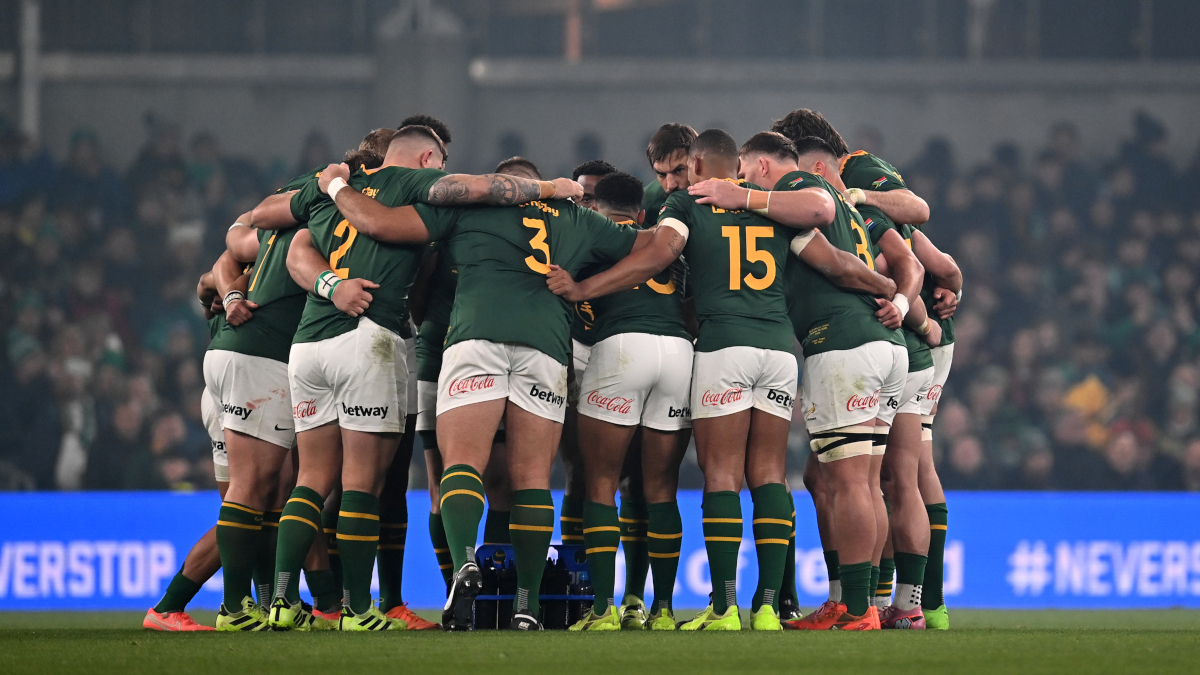
 The Boks huddle before their Quilter Nations Series match against Ireland at Aviva Stadium in Dublin on 22 November 2025. (Photo: Charles McQuillan / Getty Images)
 The Springboks are better placed than most to navigate one of the most demanding Test seasons in history – yet there is room for growth with a view to the Greatest Rivalry series against New Zealand as well as the 2027 Rugby World Cup.
The Six Nations kicks off on 5 February, and the biggest challenge facing the respective teams is the new schedule of five matches in six weeks. The well-stocked England and France teams are early favourites for the title, whereas more limited sides such as Ireland may struggle to maintain a high standard over the course of the tournament.
Meanwhile, the Springboks continue to plan for a season that may include as many as 13 Test matches – with seven Nations Championship fixtures and four Tests against New Zealand already confirmed, and one-off games against Australia and Argentina waiting for the green light. There may also be an extra warm-up match.
Although Rassie Erasmus has built a world-class squad over the past eight years, the 2026 schedule will test South Africa’s depth like never before.
Every Nations Championship match represents an opportunity for log points – and ultimately a place in the final of the inaugural inter-hemisphere tournament in London on 29 November.
The Greatest Rivalry series will pit the Boks against the All Blacks in four consecutive Tests staged across late August and early September, with the first three playing out in South Africa before a potential series decider in Baltimore in the US.
No team will emerge from the brutal 2026 schedule unscathed, and no coach will have the luxury of fielding the same match 23 on a regular basis. Fortunately for the Boks, Erasmus has been rotating his squad for some time, and the smart management of the group across the 2025 season may set SA up for another successful run in 2026.
Boks nailed 2025 dress rehearsal
In a sense, the 2025 season provided a taste of the challenges to come. Erasmus selected 36 players for the tour to Europe last November, in spite of a fixture list that included matches against Japan, France, Italy, Ireland and Wales in the space of five weeks.
The Boks went on to win all five matches, and the coaches received valuable answers regarding the challenge of playing consecutive Tests against world-class opposition.
Looking back, Erasmus and company made the most of those opportunities, and not just in terms of results. That data will serve them well as they prepare for four consecutive games against the All Blacks in 2026, and for the next World Cup, which will include a four-week playoff structure.
Speaking at an informal media gathering in Cape Town this week, Erasmus cited specific matches across the 2025 season where he rotated the team without compromising the quest for results.
Although 50 players were used over the course of the 14-game season, Erasmus limited his initial squad to 36 players for each block of fixtures – namely the mid-year Tests in SA, the Rugby Championship and the Autumn Nations Series in Europe.
A similar number of players (33) will travel to the next World Cup in Australia, although as seen at previous tournaments, injuries usually result in two or three others joining the group at a later date.
Clearly Erasmus has been limiting his squad numbers as much as possible in preparation for the global tournament in 2027. That said, he has confirmed that he may select as many as 40 players for the Greatest Rivalry series later this year.
The Boks will start the series as favourites, but both sets of coaches will need to box clever with their player-management strategies over the course of the rubber.
All Blacks coach Scott Robertson was axed in the wake of some underwhelming results across the 2024 and 2025 seasons, and big structural changes are expected in the coming months.
Locking in world-class alternatives
As the Bok coach pointed out this past week, there are areas of concern that require attention in the lead-up to the Greatest Rivalry series and ahead of the World Cup – specifically at lock.
Erasmus has developed a large group of younger players in recent seasons to ensure that the Boks travel to the next global tournament with the necessary balance between youth and experience. There is further work to be done, however, if the Boks are going to hit their targets over the next 18 months.
It’s encouraging to note that World Cup winners such as Eben Etzebeth, RG Snyman, Lood de Jager, Franco Mostert and Jean Kleyn are all available for the next global tournament.
At the same time, it’s worth considering that Etzebeth and Mostert will be 35 by the time the squad touches down in Australia. Older players will need to be managed carefully in the coming months.
Injuries are part of the game, and already there are one or two worries ahead of the 2026 Test season.
De Jager had hip surgery recently, and star flanker Pieter-Steph du Toit, who also covers lock, is in a race against time to recover from a serious shoulder ailment.
One of the biggest issues, as Erasmus pointed out, is the gap between the older and younger locks, in terms of Test caps.
Ruan Nortjé (27) has been one of the Boks’ best players over the past two seasons, and should add to his 18 caps in the coming months. But for reasons specified above, he can’t play every Test in 2026, and can’t be expected to start all four against the All Blacks.
Kleyn (32) has represented Ireland and South Africa, yet has relatively few Test caps to his name (seven for the Boks). Salmaan Moerat (27) has led the team in the absence of Siya Kolisi, but continues to struggle with various leg injuries, and was forced from the field with a foot ailment in the Stormers’ recent loss to the Sharks in Cape Town.
Will Erasmus look to his utility forwards to fill the void? Jean-Luc du Preez was lined up as a No 8 option last season, before injuries robbed him of the chance to add to his 14 caps. Du Preez has played lock for the Sale Sharks before, just as BJ Dixon (seven Test caps) has packed down in the second row for the Stormers. Sharks hardman Vincent Tshituka (two Bok appearances) is another utility who may get a run at lock, given his line-out expertise.
Alternatively, Erasmus could revisit a few options he’s used once or twice over the past eight years. Sharks lock Marvin Orie won the 2023 World Cup with the Boks, but hasn’t featured for the national side since. Another Sharks lock in Jason Jenkins (2018) as well as Bulls utility Nico Janse van Rensburg (2021) have played one Test apiece, and the Stormers second-rower JD Schickerling toured with the Boks in 2018.
It will be interesting to see who Erasmus backs if several veterans succumb to injuries over the course of the season. Experienced players will be essential when the Boks face off against leading set-piece teams like England, New Zealand, Ireland and France.
Several younger players could get an opportunity, albeit in less-challenging matches, such as the clash against 11th-ranked Wales this July.
Ruan Venter (23) and Cobus Wiese (28) have enjoyed brief opportunities with the Boks in recent years, and cover lock and blindside flank. Junior Boks star Bathobele Hlekani (20) is another utility worth considering, and trained with the senior side ahead of last year’s Rugby Championship.
Meanwhile, the Stormers’ Ruben van Heerden (28) and the Bulls duo of JF van Heerden (21) and Reinhardt Ludwig (23) were part of the national alignment camps in early 2025.
Erasmus should attempt to strike the right balance in the coming Tests, while keeping the next global tournament in mind.
Injuries may force his hand, but it wouldn’t come as a surprise if the squad selected for the four Tests against the All Blacks mirrored the group tasked with winning a third consecutive World Cup title in 2027. DM
This story first appeared in our weekly DM168 newspaper, available countrywide for R35.
/file/attachments/2987/DM-30012026-001_766143.jpg)