




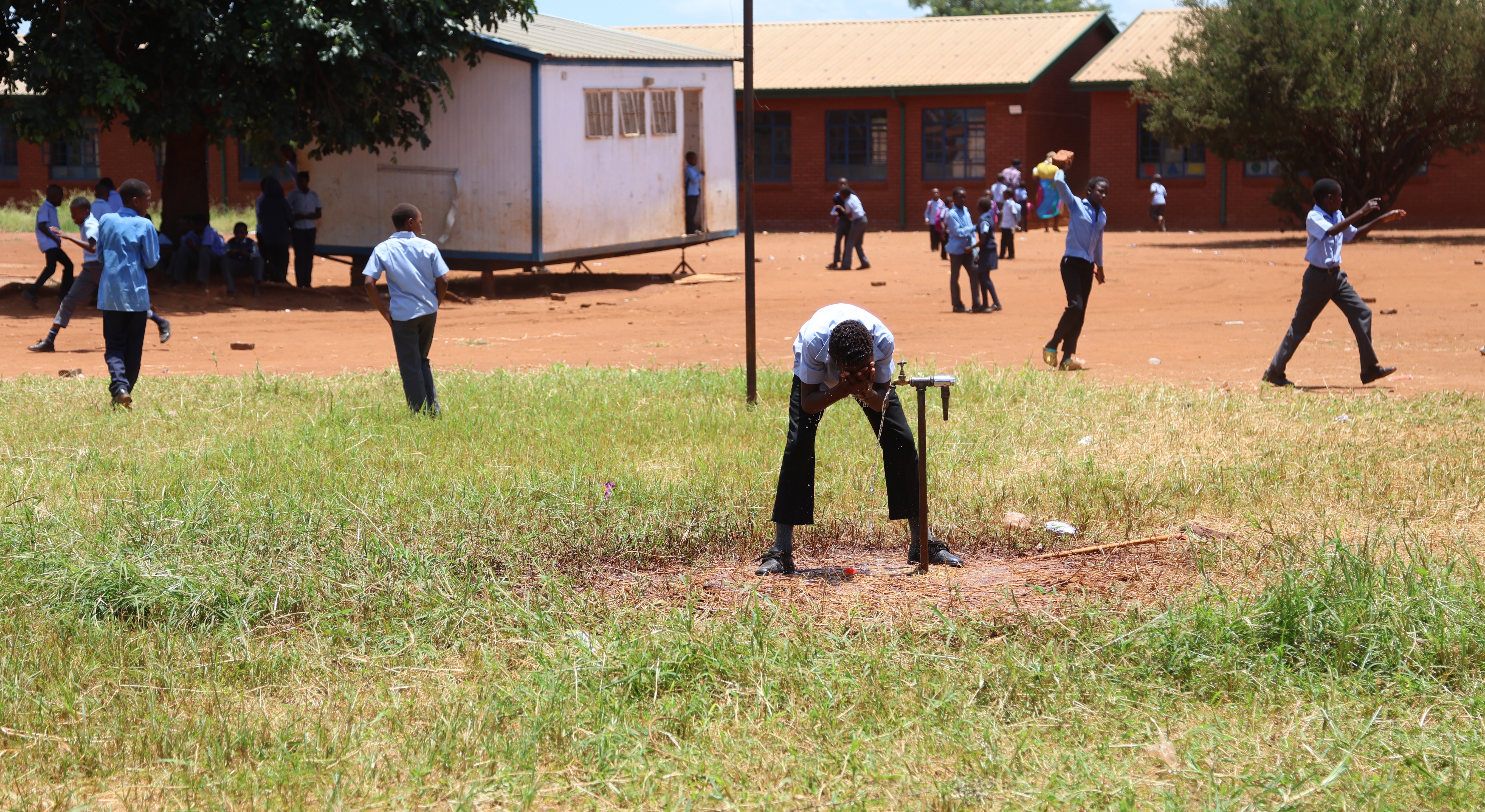
 With temperatures soaring after recent rains, a learner cools off during break at Rhida Primary School in Mapayeni. (Photo: Felix Dlangamandla)
 The road from the town of Giyani to Mapayeni village in Limpopo ends abruptly in a stretch of water just outside a local early childhood development centre. The area has been waterlogged since extreme flooding hit the region in mid-January, but locals say the road had been in poor condition for far longer than that.
To reach Mapayeni, or travel onwards towards the neighbouring village of Vuhehli, travellers must use surrounding dirt roads, some of which are hazardous for anyone without a 4x4.
Despite the challenges, most children have returned to schools in the area and the local clinic is operating as usual.
/file/attachments/orphans/Road1copy_130817.jpg "Floodwater remains on the main road in Mapayeni following heavy rains. (Photo: Felix Dlangamandla)")
During the floods that struck Limpopo in mid-January, Mapayeni Clinic was surrounded by water. It not only covered the road, but reached the doors of the clinic.
“It was difficult for us to come inside the clinic together with our clients. They were struggling a lot because they had to take off their shoes, and then they got inside without their shoes… We were able to get inside using our vehicles,” said Nkuna Rhulani, matron at Mapayeni Clinic, when Daily Maverick visited the area on Monday, 2 February 2026.
The clinic did not close, however, as the staff didn’t receive a directive from the Limpopo Department of Health to suspend operations.
“We’re not supposed to close the clinic until we get the directive from above – so we didn’t. We never closed. And then those clients, those who were struggling to get inside, they found us here. We assisted them, but there were few clients, because most of them were not able to reach the facility because the bridges were cut off,” said Rhulani.
/file/attachments/orphans/6I1A3177_525693.jpg "Health workers provide essential services to residents at Mapayeni Clinic following heavy floods that disrupted healthcare in the area. (Photo: Felix Dlangamandla)")
Restoring health infrastructure
Mapayeni Clinic serves six villages that fall within its catchment area. The flooded roads made it difficult for community members from neighbouring villages to reach the health facility.
The electricity and water supply at the clinic was also affected, limiting healthcare workers’ ability to assist clients. The local department of health had to install a pipe at the entrance gate to drain the water in the area.
Reflecting on the experience of staff members during the floods, Rhulani said: “We motivated each other because if there is an unexpected disaster, you cannot run away. Because the clients were still coming, so we motivated each other to stay strong and work with the support of our managers.
“Our local area managers were supporting us a lot. Even the department, they supported us because they came and they did the assessment around the clinic, and then they promised that they were going to assist us, and indeed they did.”
One outstanding issue at the clinic is a large sinkhole on the property. Many years ago, the spot was used to discard placentas after childbirth, before being abandoned and covered up. The recent floods have caused it to sink.
Rhulani said that security had demarcated the area and was keeping visiting clients from going near it until the department had a chance to close it.
/file/attachments/orphans/6I1A3175_673768.jpg "Malaria control services at Mapayeni Clinic as health workers conduct testing and prevention activities. (Photo: Felix Dlangamandla)")
The clinic staff have not picked up any increased health risks in the aftermath of the floods. However, Rhulani said they were closely monitoring their clients for cases of malaria.
“We’ve got enough screening tests to screen our clients [for malaria], because… we were in a malaria-risk area even before the floods. For now… we haven’t experienced diarrhoeal disease.”
While in Mapayeni, Daily Maverick saw members of the Limpopo Department of Health’s malaria control services visiting the clinic and other locations in the area.
Daily Maverick reached out to the department about damage to health infrastructure in the wake of the floods, but had not received a response by the time of publication.
Read more: Limpopo’s villages are a site of wreckage and resilience as floodwaters subside
Read more: Hero community health worker in Mbaula, Limpopo, delivers baby during flood disaster
Challenges for local centre
Tipfuxeni Mapayeni Community Creche is an Early Childhood Development (ECD) centre that cares for 56 children, and is only a two-minute walk from Mapayeni Clinic. While the clinic stayed open during the floods, the crèche was forced to close down for a week due to the downpour.
The centre’s principal, Mavis Basani Maluleke, told Daily Maverick that the heavy rains caused classrooms to flood, filling the building with water that was near the ceilings. She described how the building had gaps where the roof connected to the walls, which meant that water seeped in through the cracks, and even welled up from beneath the tiled floors as the rain fell.
Even though most of the water has receded, the effects of the flood are still evident.
/file/attachments/orphans/6I1A3150_983512.jpg "Tipfuxeni community crèche in Mapayeni. (Photo: Felix Dlangamandla)")
“Even the toilets were filled with water, making it hard for us to go there. Even now, the toilet is still filled with water from the floods,” Maluleke said.
The centre’s drinking water has also been affected. Ripfumelo Makhubele, a practitioner at the centre, said: “Even now we don’t have running water.”
Despite the lack of access to quality drinking water, Makhubele said the Greater Giyani Local Municipality had yet to provide the centre with water tankers or any alternatives.
“Last year we had water which was stored [in] JoJo tanks, so we have been using that up until now... but it won’t last [beyond] this week,” Makhubele said.
As a solution, the practitioners said they would be forced to purchase water. Due to the Limpopo heat, which can reach temperatures of 30°C and above, they cannot risk the children becoming dehydrated.
Maluleke said they would appreciate it if the Limpopo Department of Education could help the centre repair and waterproof the building.
/file/attachments/orphans/6I1A3153_598125.jpg "Mavis Basani Maluleke (left) and Esy Ngunyule continue caring for young children despite the challenging conditions at Tipfuxeni community crèche. (Photo: Felix Dlangamandla)")
Returning to school
Rhida Primary School in Mapayeni accommodates about 800 children. None of its learners were able to return for the first week of school due to the flooding in the area.
It was only in the second week of term that learners were able to come back, said Manganyi Nelly, the departmental head at the school. However, the teachers discovered that the Grade R classrooms and the toilets were still surrounded by water, forcing them to send the children home again.
“We were also affected by [a loss of] electricity. If you don’t have electricity, you don’t have water. So, the children are unable to use the toilet,” said Nelly.
“There was a lot of flooding around the school, so it was not safe for the children… We had to call a contractor who supplied us with mobile toilets, so the second day the toilets were there. All the children came back to school.”
/file/attachments/orphans/6I1A3163_965169.jpg "Learners were unable to access the toilets after the flooding at Rhida Primary School in Mapayeni. (Photo: Felix Dlangamandla)")
The school’s feeding scheme was affected for the first two days after children returned due to the lack of water and dry firewood. However, the electricity has since been restored, and Nelly noted that there was no other damage to the buildings on the grounds.
Mike Maringa, the spokesperson for the Limpopo Department of Education, told Daily Maverick that 113 schools had been affected by the flooding across the province. The estimated cost of repairs stood at R185-million.
“We are working with sister departments, public works, the [Department of Cooperative Governance, Human Settlements and Traditional Affairs] and municipalities [to restore access to schools],” he said.
Maringa did not respond to a question about possible interventions to assist early childhood development centres affected by the flooding.
Limpopo in ‘active disaster phase’
During a media briefing on Thursday, 5 February, Limpopo Premier Phophi Ramathuba said the floods had had a crippling effect on access to education and healthcare, with damage to roads, bridges and public facilities, leaving children unable to reach schools and patients cut off from clinics and hospitals.
Ramathuba added that the province remained in an active disaster phase, with the true scale of the damage still unfolding as assessments continued in areas that were previously inaccessible.
/file/attachments/orphans/ED_503792_890667.jpg "Limpopo Premier Phophi Ramathuba says the province remains in an active disaster phase. (Photo: Gallo Images / Frennie Shivambu)<br>")
Now that schools were open and conditions were stabilising, she said the province would implement a catch-up programme to recover lost teaching time.
Ramathuba said damaged roads and collapsed bridges cut off access to clinics and hospitals, disrupting patient care and staff mobility. Several health facilities were inaccessible during the peak of the floods, while others sustained infrastructure damage, including leaking roofs and interior destruction. In Mopani alone, the district under which Giyani falls, multiple hospitals and clinics reported flood-related challenges, with access proving to be an obstacle.
The premier stressed that the challenges facing schools and clinics could not be separated from the widespread infrastructure damage. About 3,194 homes had been affected, while 439 roads, covering roughly 600km, had been rendered unusable, cutting off communities from schools, healthcare facilities and economic centres.
“It is very clear that Limpopo requires a comprehensive overhaul to restore normality to the lives of our residents,” Ramathuba said. She confirmed that the national classification of the floods as a disaster had enabled access to additional support, but warned that recovery would be long and costly. DM