




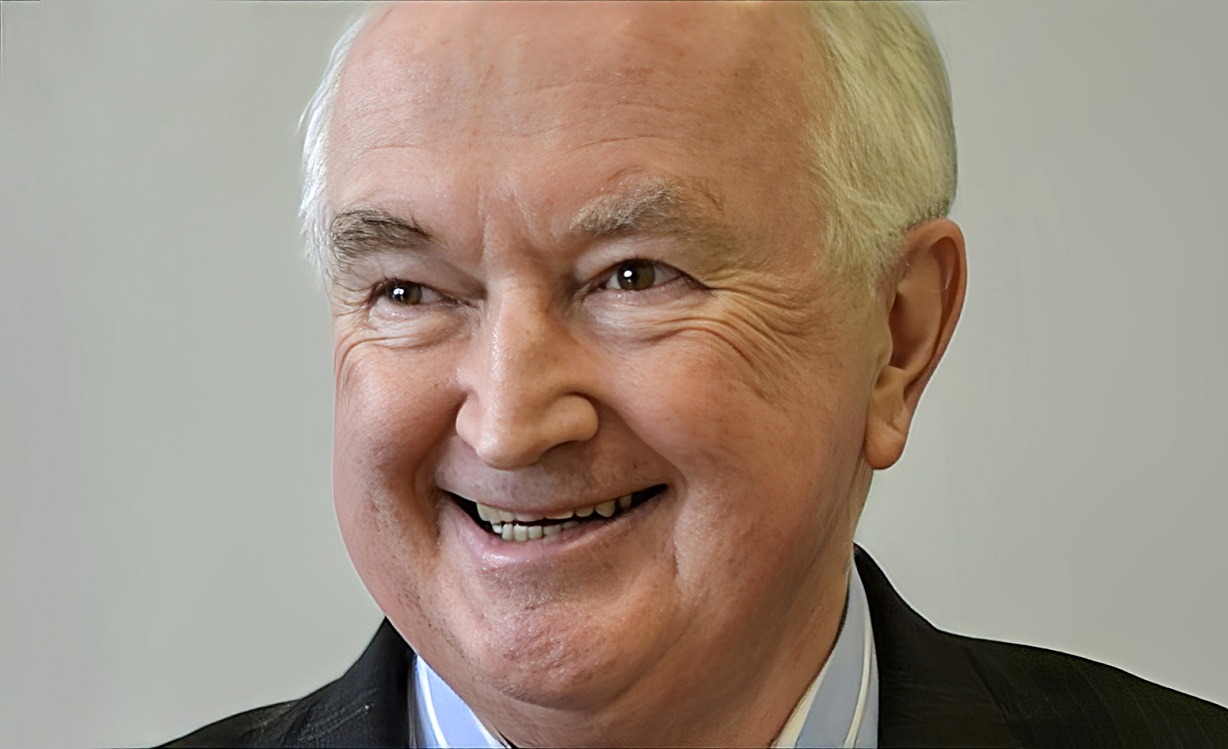
 Renfrew Christie was a man of great bravery and tenacity. (Photo: Afripod / Wikipedia)
 Born in 1949 in Johannesburg, Renfrew Christie grew up in boarding houses and the less salubrious parts of town as his mother struggled to make ends meet after his father died while he was still a small boy. With the stories of heroic deeds by family and friends in the battle against the Nazis in World War 2 the constant soundtrack of his childhood and youth, the King Edward VII school pupil very early on developed an understanding that apartheid was an evil from the same mould, and vowed to do what he could to bring about its end.
Called up for compulsory military service in the mid-1960s, Christie later described being on guard duty at the Lenz base on the periphery of what was not yet Lenasia when he “saw something that told me they were developing nuclear weapons”. He decided to make thwarting or at least delaying the programme his mission.
Detained four times as a student activist at Wits by the time he was 21, he nevertheless received a master’s degree cum laude at UCT and a Smuts doctoral scholarship to St Antony’s College, Oxford. Determined not to “spend the rest of my life drinking the college’s great red wines”, he focused his research on electrification in South Africa because this topic gave him access to Eskom’s archives.
There, he searched for anything he could find on the state-owned utility’s nuclear enrichment programme, an essential for any country wishing to build atomic weapons. Indeed, South Africa had, since the late 1940s, been a strategic partner in the United States’ nuclear weapons programme, a result of the abundant uranium SA produced as a byproduct of gold mining.
Christie was, as we now know, correct. South Africa refused for decades to join the international nuclear non-proliferation regime and had, by the end of apartheid, six bombs capable of being deployed, a programme achieved with the help of nuclear powers in possession of the necessary technological expertise and in defiance of international sanctions.
Betrayal
Three months after his return to South Africa in 1979 to lecture and conduct further research, Christie was arrested by the Security Police, tortured, and charged under the Terrorism Act. He had, he later recounted, been betrayed by Craig Williamson, the St John’s College boy turned police spy, bomber of the ANC and PAC offices in London, and murderer of Ruth First and Katryn and Jeannette Schoon, acts for which the Truth Commission granted him amnesty.
Williamson was, at the time of Christie’s arrest, the deputy director of the International University Exchange Fund in Geneva, which provided scholarships to exiled South African students. As Christie told it, his ANC contact in London asked Williamson to fund his research travel despite warnings to keep away from him because he was an apartheid agent.
/file/dailymaverick/wp-content/uploads/2022/07/MC-Craig-Williamson_9.jpg "Craig Williamson. (Photo: Supplied)")
Despite seven months in solitary confinement at the John Vorster Square police headquarters in Johannesburg, he remained determined to get his information and recommendations on action to the ANC. He did so via a guilty plea and a full confession read out in open court by the judge, ensuring that the details reached MK’s commanders in exile.
Just days before the enriched uranium fuel rods were due to be loaded into the Koeberg nuclear reactor in December 1982, four limpet mines exploded, planted by MK operatives Rodney Wilkinson and Heather Grey, who, as whites with no political record, had no difficulty getting jobs on the reactor building site. The weapons programme had suffered a significant setback of at least 18 months, and the damage was estimated at half a billion rands. Christie had been the driving force behind one of the ANC’s most significant military blows against apartheid.
Death row
Sentenced to 10 years in jail with two other sentences to run concurrently, Christie was further tortured by being held for two years on death row, where he was witness to more than 300 hangings, something which left an indelible impression on him.
Transferred to the section housing white political prisoners, he learned the details of similar acts of principle against the apartheid system by a range of other brave men, including Denis Goldberg and Dieter Gerhardt.
Released after seven years under an amnesty offered by the government as it tried to curry favour with an increasingly critical international community, “which I accepted because, unlike Nelson Mandela, my refusal would have no impact and I felt I could be more useful on the outside”, Christie moved to Cape Town and into academic life.
As dean of research at the University of the Western Cape he helped build what its vice-chancellor at the time, Jakes Gerwel, termed an intellectual “home for the left”.
/file/dailymaverick/wp-content/uploads/2023/11/MC-UWC-Women_1.jpg "Renfrew Christie helped build ‘an intellectual home for the left’ at UWC. (Photo: ER Lombard / Gallo Images)")
Significantly, his interest in and passion for a critical understanding of national defence continued. At one point, he was shortlisted for the post of secretary of defence, the civilian head of the department responsible for South Africa’s external security.
It was a job he could not get, of course. Like others, he was way too independent-minded and knowledgeable to be tolerated by the then President, a man who consistently preferred the venal and ill-equipped for senior government positions because they would owe him unconditional allegiance, never question his thinking, and be entirely manipulable as and when required.
Intellectual dexterity
Christie’s intellectual dexterity and inventive understanding of the need for every good speaker to pick his audience up at their starting point rather than lecture them from on high were on display some years ago at a media workshop addressing the question of why South Africa needed a well-equipped, functioning navy. He began by talking about the outbreak of the South African War in 1899.
The further into the detail of one land battle after another he went, the more his audience became perplexed — wasn’t this supposed to be about maritime forces? Then came the punchline: “At the height of the war, the British had deployed over half a million troops to South Africa. How do you think they got here? By sea, of course. And had the Boers had at least some sort of naval capacity, things might have turned out somewhat differently.”
His interventions at a strategic level were highly regarded by many military officers, civilians in the Department of Defence, and those engaged in the topic in academia. He was determined to take the subject seriously, unlike so many in the country who, frequently naively if not malevolently, railed against South Africa spending any money on defence at all.
The Navy honoured him with its highest civilian award. And in June 2013, he was appointed to serve on the Defence Force Service Commission, a body tasked with making recommendations on the terms and conditions of service of military personnel.
During some of Christie’s appearances on serious platforms, his inclination towards quirkiness was on display, whereby his occasional insistence on wearing a kilt, a nod to his Scottish heritage, was among the more entertaining. Less so his attempt in Stellenbosch once to sing his speech, to a rather dour audience of academics, officers, and engineers, not least because he proved that he had a voice best suited to mime.
Christie loved life — first and foremost, his wife and fellow academic Menan, whom he met soon after his release from prison, and his daughters Aurora and Camilla, young women he regarded as the most beautiful and smartest he had ever met. He loved his fleet of old clunkers, too, long versions of ancient Mercedes-Benz S classes, and a Volvo built like a tank.
He loved eating and drinking well while exploring all manner of horizons in engaged conversation, whether in the Winelands around Cape Town, in Stockholm, or Berlin.
So, farewell, Renfrew Christie, you were indeed a South African hero. DM
Stephen Laufer is a strategic communications, media relations and public affairs adviser. He was previously a political correspondent, and opinions and analysis and foreign editor of Business Day, spokesperson for the minister of housing, and a political correspondent and opinions and analysis editor at the Mail & Guardian.