




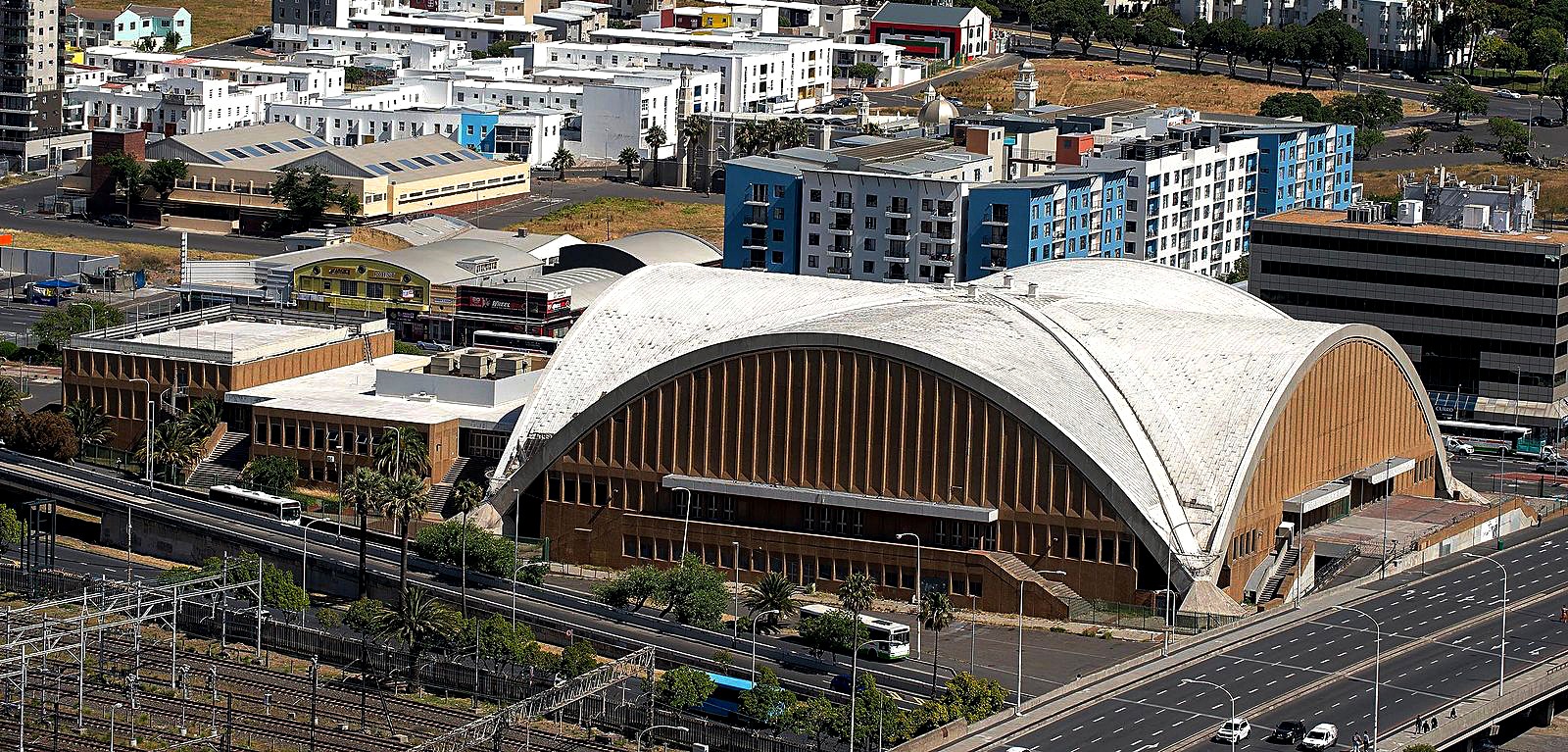
 This week, the City of Cape Town will auction about 50 sites, including the iconic Good Hope Centre. Organisations have questioned the move, claiming the land auctioned could be used for housing. (Photo: Supplied/ City of Cape Town)
On Tuesday, 24 February 2026, several organisations took to the streets of Cape Town over plans to auction 50 sites, including the Good Hope Centre. Critics argue the land should be used for housing, while the City says it is “leveraging private-sector investment to boost job creation and economic growth to benefit Cape Town residents”.
That auction will take place on Thursday, 26 February.
Daily Maverick explains how we got here.
Wait, is it only the Good Hope Centre?
On 16 February, the City of Cape Town released a statement about the auction, which featured an image of the iconic Good Hope Centre.
It’s not only the centre, there are also about “50 diverse City-owned properties across the metros” that are up for auction. There is a “wide-range” of opportunities across “multiple investment categories and strategic growth areas” which, as the City said, was available for sale and lease.
The residential sites included areas such as Kraaifontein, Westridge, Atlantis, Durbanville, Goodwood, Eerste River, Coniston Park, Bridgetown, Athlone, Maitland and Vredehoek.
The commercial sites include areas such as the Foreshore, City Centre, Mitchells Plain, Montague Gardens, Parow, Blue Downs, Century City, Bellville, Belhar and Goodwood.
The industrial sites are in Atlantis, Epping, Khayelitsha and Kuils River.
According to the City: “In total, about 282,000m² of land will be released, creating diverse entry points for developers with varying investment profiles, from mixed‑use precincts to industrial expansion and urban infill housing.”
Significance of the Good Hope Centre
The Good Hope Centre is centrally located in the inner city of Cape Town. It is within walking distance of places such as the CBD’s public interchange, the City Hall and the Civic Centre. It is also within walking distance of the District Six campus of the Cape Peninsula University of Technology.
The City said the release of the precinct for redevelopment was a “strategic move” aimed at unlocking its immense economic potential, revitalising the broader precinct, and leveraging private-sector investment to boost job creation and economic growth to benefit Cape Town residents.
According to James Vos, the Mayoral Committee Member for Economic Growth: “By releasing this site for revitalisation and redevelopment, we are giving the private sector the opportunity to develop a vibrant mixed-use precinct. Heritage elements, including the dome, are preserved through the conditions of sale, while the surrounding land can be transformed into multiple uses, unlocking significant economic and spatial value for the inner city.”
Historically, it has hosted events such as the Malay Choir competitions and the Spring Queen competition, which, during the heyday of Cape Town’s textile industry, showcased the work of the province’s clothing industry.
Human rights defender Tauriq Jenkins told Daily Maverick: “It is a landmark that ought to have been kept and preserved for the benefit of our communities.”
Why is the City auctioning the land?
In a release, the City of Cape Town said all properties identified for auction had been “thoroughly assessed and confirmed as not required for municipal purposes”.
According to the City: “The revenue generated from the sale or lease of these properties is reinvested directly into service delivery across Cape Town, benefitting our residents.”
Why are people upset?
The plan for the auction, particularly the Good Hope Centre, is not new. In a media statement in November 2025, the City said the redevelopment of the precinct represented “one of the most significant inner-city regeneration opportunities in Cape Town”.
“We are committed to ensuring that the site’s most important heritage features are preserved and celebrated. The conditions of sale, aligned with the Phase 1 Heritage Impact Assessment (HIA) guidelines and endorsed by the Impact Assessment Committee (IACom), will ensure that the redevelopment of the site is done in a respectful and contextually appropriate manner,” said Vos at the time.
‘The Good Hope Centre is a heritage asset, and we intend to preserve its iconic dome as a centrepiece. The conditions of sale will safeguard this heritage element, protect future community access – including affordable access, where appropriate, and guide the precinct’s revitalisation in a way that delivers meaningful and lasting value for surrounding communities and the City,” said Vos.
‘Potential future uses’
According to the City, when it came to the Good Hope Centre, its potential future uses included retail, commercial and entertainment, residential uses, structured underground parking, a revived multi-use heritage venue within the domed hall and public plazas and improved pedestrian environments.
But not everyone is happy with this move.
A new coalition comprising community organisations, indigenous and traditional councils, political parties and civic movements organised a mass mobilisation on February 24 against the auction.
They claim the auction was nothing but a “slap in the face to communities that are yearning for land, housing and dignity. Instead of using this land to address our massive housing backlog and provide social amenities, the City is selling it off to the highest bidder.”
Cosatu Western Cape’s Malvern De Bruyn told Daily Maverick: “Cosatu is against the auction of land and we are of the view that people that need housing are the ones that will not benefit out of that sale. For the City it’s just about making profits and not about providing housing to the needy in the city and province.”
He said the trade union had called on the City to reverse or review the current decision and to engage more with stakeholders in a bid to ensure that whichever land was sold met the needs of those still waiting for housing.
The South African Human Rights Commission (SAHRC) also held a meeting with the city over the issue.
In a media release on Monday, 23 February, the commission said it had received concerns from interest groups and social movements about the auction.
“These stakeholders argue that while revenue generation is necessary for municipal service delivery, the sale of public land – in the context of homelessness, inadequate access to shelter, land hunger and historical injustice related to land dispossession, displacement and gentrification – should always be treated as a last resort,” said the commission.
Voluntary postponement
It instead called for a voluntary postponement of the auction in the interest of cooperative governance and constitutional compliance.
“The commission remains concerned that the City is relying on public participation processes and in-principle approvals that occurred as far back as 2019, 2021, and 2022. In a post-pandemic socioeconomic landscape, the commission views these processes as no longer temporally relevant. Furthermore, during the meeting on 20 February 2026, the mayor indicated that the City intended for portions of the land to be utilised for social or affordable housing initiatives,” read the commission’s statement.
“However, the mayor confirmed that no conditions of sale to this effect would be applied to the auction. The commission is therefore unsure how the City’s stated intentions will be realised without enforceable legal conditions. The commission believes that the balance of convenience, favouring the public interest, supports a temporary postponement to allow for a comprehensive review of the disposal process. The commission has therefore proposed that the City undertake such postponement so that our respective offices may attempt to resolve this matter through cooperation instead of more adversarial legal processes,” read the statement.
The African National Congress (ANC) in the City said that while Vos had attempted to dress this up as an opportunity for economic growth, “we see it for what it truly is, a reckless fire sale of public assets that belong to the people of Cape Town. This is not proactive governance; it is the privatisation of the city’s future.”
In a statement, the ANC rejected the rationale for the sale, and said: “Land is the most basic and essential resource for human settlement and dignity. The City’s approach treats valuable public property as a commodity to be flipped for once-off revenue, rather than as a strategic asset to address the massive historical imbalances in our city. The Good Hope Centre, a landmark built with public funds, should not be handed over to private developers to maximise profits.” DM
Comments
Scroll down to load comments...