




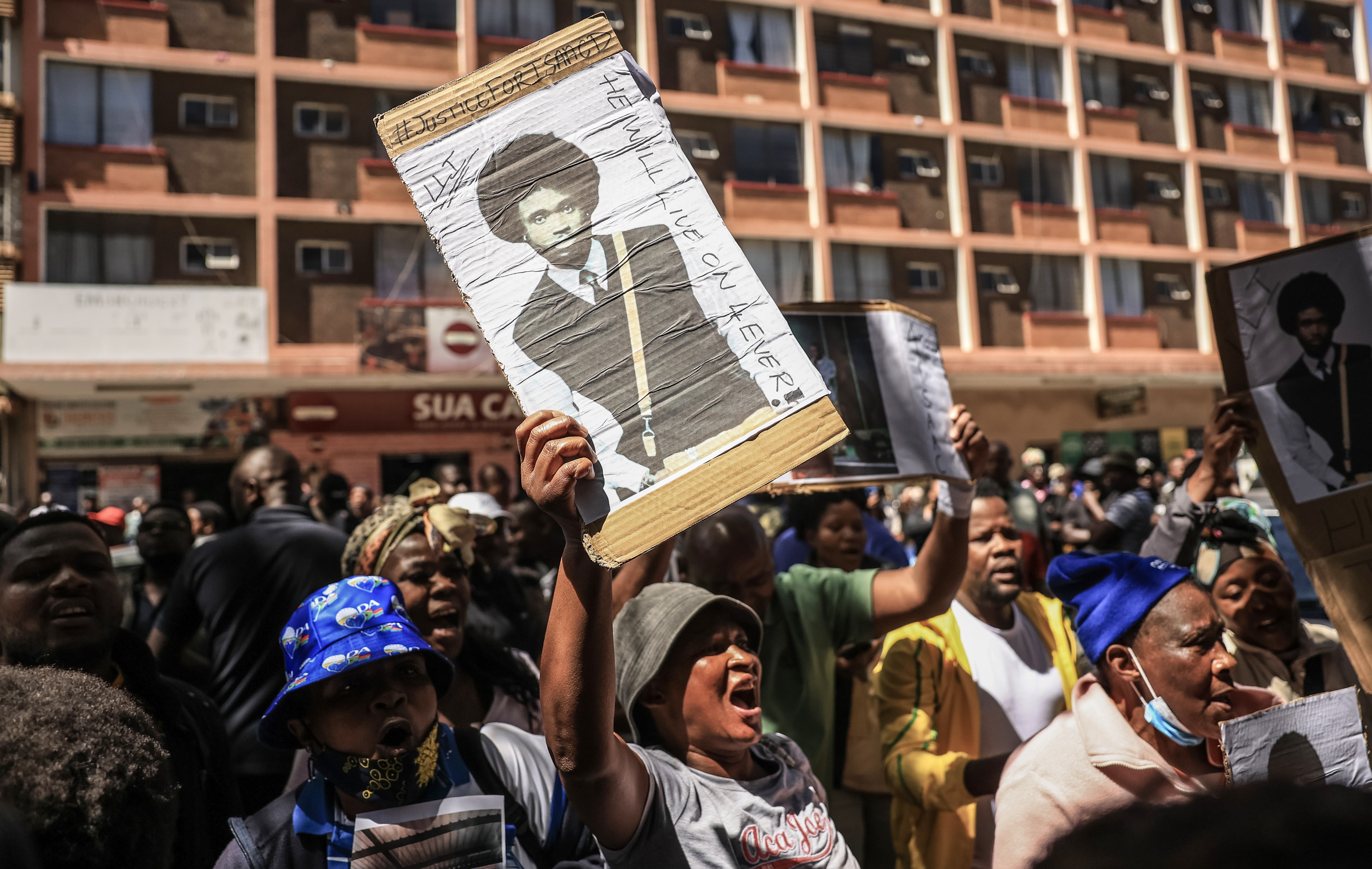
 People protest outside the Pretoria Magistrates’ Court on 16 February 2026 as three suspects appeared for the murder of an e-hailing driver. Isaac David Satlat (22) was strangled to death in Pretoria West last week. The suspects face robbery and murder charges. (Photo: Phill Magakoe / Gallo Images)
Murdered Bolt driver Isaac Satlat (22), who was robbed and killed on a trip in Pretoria on 11 February 2026, was not registered on the Bolt platform.
Bolt said it has conducted a thorough internal investigation, which confirmed that Satlat was not the registered owner of the Bolt profile that was active at the time of his murder.
“The profile belonged to […] a registered driver with an active account on the Bolt platform,” Bolt spokesperson Romaana Sutton told Daily Maverick on Tuesday, 17 February.
“On the day of the incident, [the registered driver] completed the required verification process, after which Mr Satlat operated using that profile,” Sutton said.
“This constitutes profile sharing. The profile has since been permanently hard-blocked and banned from operating on the platform.”
Satlat was murdered after accepting a ride request in the Pretoria West/Attridgeville area, where he operated.
He was a student at Divine Progress Technical College, an Further Education and Training College, where he was due to graduate in March upon completing his practical module.
Describing the family’s feelings following the murder, family friend Solomon Izang Ashoms said: “The family is broken and in serious pain. They have many questions about why the suspect murdered him.”
Ashoms said Satlat’s father became ill after identifying the body of his son and had to be admitted to a clinic after his blood pressure shot up. Ashoms said he is being monitored daily. He said Satlat’s father has seen the dashcam footage of his son’s murder.
The automobile engineering student, who was from Nigeria but has been in the country for 10 years, planned to leave South Africa to continue his studies in Canada after his graduation in March.
According to Ashoms, Satlat had been a Bolt driver for just five months.
“He started when he began his school practicals/internship,” Ashoms said. “He was given the car to use by one of his bosses. So, it was not his car. He was doing it to earn some money for himself.”
Satlat stayed with friends in Pretoria Central so that he could be closer to his school. Ashoms described him as a calm and non-violent person. Satlat has left behind three siblings.
Suspects in the dock
A total of four suspects have been linked to the murder – three men and one woman. The suspects are Dikeledi Tears Mphela (25), Goitsione Machidi (26) and McClaren Mushwana (30), while a fourth suspect, who surrendered to the police on Monday, 16 February, has not been named.
/file/attachments/orphans/ED_596016_573656.jpg "(From left) Dikeledi Mphela, Goitsione Machidi and McClaren Mushwana face hijacking and murder charges for the murder on 11 February of e-hailing driver Isaac David Satlat. The three accused appeared in the Pretoria Magistrates’ Court on 16 February. A fourth suspect, who handed himself in to the police, has not yet been named. (Photo: Phill Magakoe / Gallo Images)")
They are charged with premeditated murder and robbery with aggravating circumstances. The State alleges that the incident was a planned robbery which ended in murder.
According to the South African Police Service (SAPS), the accused ordered an e-hailing service using a mobile phone number that was not registered in their name. When the vehicle arrived, the two suspects got in, and the other two are said to have followed in a separate car.
“Mphela and her accomplice allegedly forced the driver to stop and […] strangled him to death and robbed him of his cellphone and vehicle which were later recovered,” a SAPS statement reported on Monday.
During their court appearance, the accused told the court that they were abandoning their bail application. The case against them has been postponed to 23 February 2026 for further bail investigation.
/file/attachments/orphans/ED_596013_878602.jpg "(From left) Dikeledi Mphela, Goitsione Machidi and McClaren Mushwana consult with a legal representative (far right) in the Pretoria Magistrates’ Court on 16 February 2026. They stand accused of premeditated murder and robbery with aggravating circumstances after e-hailing driver Isaac David Satlat (22) was strangled to death in Pretoria West. (Photo: Gallo Images/Phill Magakoe)")
New safety measures needed
National E-hailing Federation of South Africa (Nefsa) spokesperson, Tella Masakale, said safety measures introduced by e-hailing companies are not sufficient to combat the ongoing attacks on drivers.
“Current safeguards remain largely reactive and app-based, with limited real-time intervention capability,” Masakale said.
“Drivers continue to face exposure to robberies, hijackings, and fatal attacks, and therefore more robust preventative and enforcement-linked solutions are required,” Masakale said.
“This trend appears linked to organised criminal activity exploiting platform anonymity, economic pressures and inadequate rider verification processes.”
He said the industry is experiencing an increase in attacks on drivers. Masakale pointed to recent violent incidents in Phoenix, Durban; Elsies River, Cape Town; and Attridgeville, Tshwane.
“This trend appears linked to organised criminal activity exploiting platform anonymity, economic pressures and inadequate rider verification processes,” Masakale said.
Drivers have often complained that Uber and Bolt are hardly ever present when they need them the most.
According to Nefsa, driver feedback frequently highlights their frustration with response delays, automated support systems and a lack of on-the-ground intervention regarding safety issues.
“While escalation channels exist, they do not always meet the urgency required during violent incidents. Nefsa continues to engage platforms on improving responsiveness, accountability and local operational support,” Masakale added.
Security cameras
The E-Hailing Partners Council spokesperson, Melithemba Mnguni, said: “There is no doubt that attacks on e-hailing drivers by criminals during trips is on the increase. The reason it’s easy to attack e-hailing drivers is because of the use of the guise as an innocent passenger.”
He added: “The incidents are on the increase because it’s easy as the criminals masquerade as passengers.
“They usually get away with this because there is no evidence to link them to crimes in real-time, and now those who can afford surveillance cameras are installing them in their cars.”
Mnguni said security camera installation must be regulated to prevent loss of life.
Dashcam footage from the vehicle Satlat was driving led to the arrest of his alleged murderers, and e-hailing organisations are calling for them to become mandatory. They also want users to be vetted.
“After realising that app companies are not hearing our call for preventative security measures like vetting users […] we approached government since 2016 to exercise oversight by regulating security measures so that they become compulsory,” Mnguni said.
“Our call is to prioritise vetting, get every user accurately captured with their true identity when they sign up and to have each and every e-hailing car installed with a visible surveillance camera that is stored in the cloud.”
“We submitted during the drafting of the E-hailing Regulations that app companies be required to install surveillance cameras in all e-hailing vehicles. Unfortunately, the regulations ignored that; hence we are on a litigation process to get them set aside and reviewed,” he said.
Read more: 180-day countdown: SA’s e-hailing industry teeters on illegal status
He also called for a systematic process to record the identity of e-hailing users.
“Our call is to prioritise vetting, get every user accurately captured with their true identity when they sign up and to have each and every e-hailing car installed with a visible surveillance camera that is stored in the cloud,” Mnguni said.
Nefsa told Daily Maverick that it fully supports the calls for a panic button to be installed in vehicles.
“A vehicle-based panic button mechanism integrated directly with emergency response networks and SAPS – rather than limited to platform escalation – would significantly improve response times and potentially save lives. This proposal aligns with our ongoing advocacy for structured collaboration between platforms and authorities,” Masakale said.
Uber, Bolt react
Uber told Daily Maverick on Monday that safety remains the company’s priority. A spokesperson for the company said they were deeply saddened by recent reports of violence against e-hailing drivers.
Uber said it has introduced a comprehensive suite of safety features designed to provide protection before, during and after trips, including:
- RideCheck, which uses GPS and smartphone sensors to detect unusual stops, route deviations and potential crashes and prompts in-app check-ins;
- An in-app emergency button that allows drivers and riders to quickly connect to private emergency response and security services while sharing live trip details;
- Rider ID verification for cash trips to enhance accountability;
- Real-time trip sharing with trusted contacts; 24/7 in-app support; and
- A two-way rating system that helps promote respectful behaviour and remove consistently unsafe users from the platform.
“Bolt is deeply saddened by the tragic loss of life and extends its sincere condolences to the family, friends and loved ones of Isaac Satlat during this profoundly difficult time,” spokesperson Sutton said.
“Profile sharing is strictly prohibited on the Bolt platform. It undermines passenger trust, compromises safety and violates our agreements with drivers,” Bolt said.
“Bolt provides comprehensive support and compensation in cases where drivers are operating lawfully under their own verified profiles.
Bolt said it has implemented multiple safeguards to combat this practice, including mandatory identity verification, regular in-app selfie checks, device monitoring, data-led risk-detection systems, and immediate suspension or permanent bans where violations are identified.
“Bolt provides comprehensive support and compensation in cases where drivers are operating lawfully under their own verified profiles. This includes compensation in the event of death, serious injury, disability and coverage of medical expenses,” the company said.
“However, where impersonation or profile sharing occurs, the individual is operating unlawfully and outside the scope of the platform’s protections. In such cases, compensation policies do not apply. To protect the integrity of the investigation and respect all parties involved, we are unable to share further details at this time.” DM
Comments
Scroll down to load comments...