




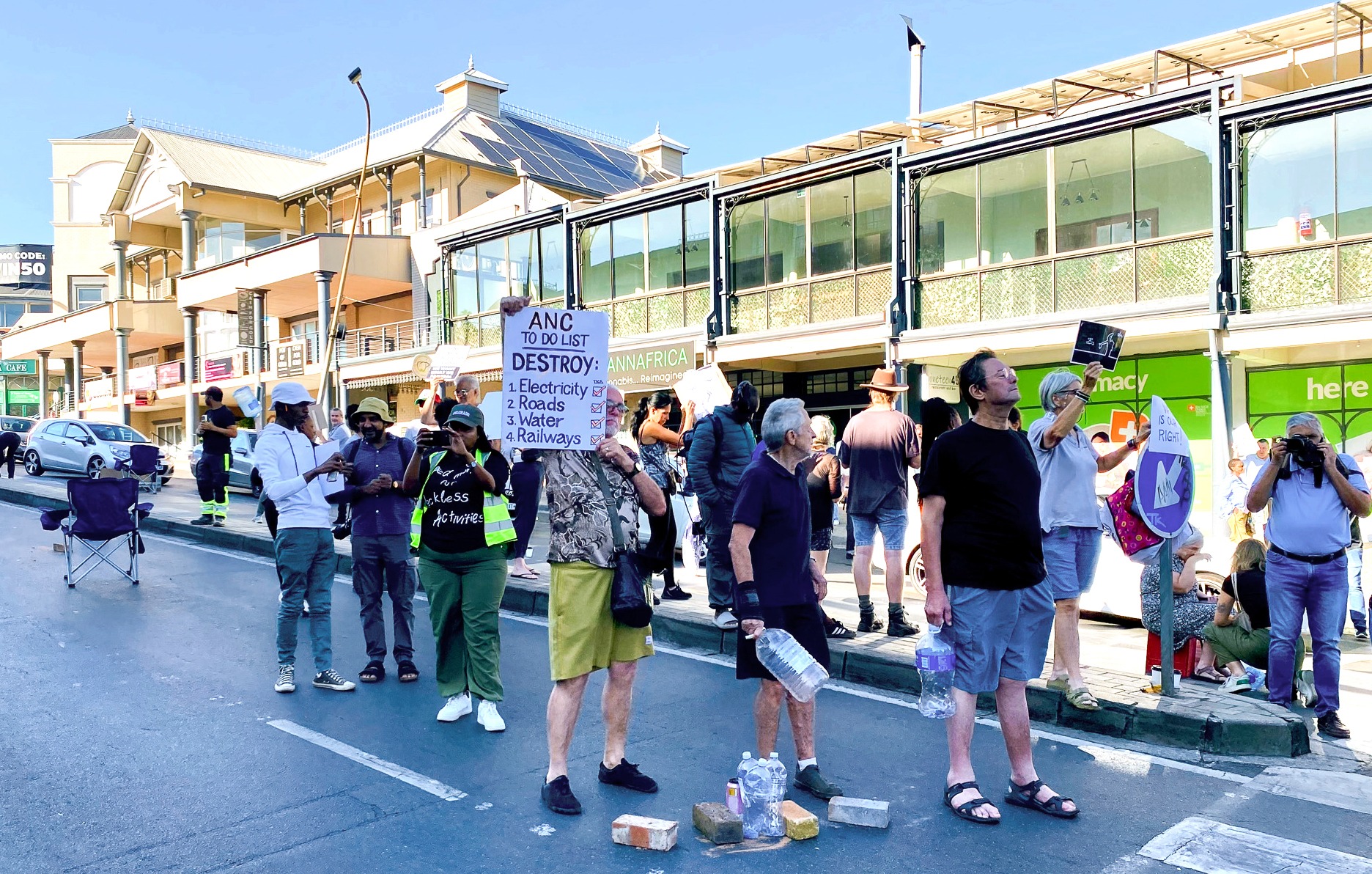
 Johannesburg residents protest against the ongoing water outages in various parts of the city. (Photo: Reitumetse Pilane)
 A week after residents in Melville and Parktown West protested against a prolonged water outage, there has been some relief, although taps remain dry across large parts of Johannesburg.
/file/attachments/orphans/IMG_2071_256336.jpg "Johannesburg residents protest against the ongoing water outages in the city. (Photo: Reitumetse Pilane)")
Brixton has now been without water for 18 days and counting. In Melville, residents in the higher areas are reporting little to no water. At the Key School for children with autism in Parktown West, principal Michelle Pellaton Emerick said the taps had run dry again. High-lying areas in Bruma have had no water for 13 days.
/file/attachments/orphans/Water_Autism_03aa_706351.jpg "A teacher and a student prepare a bucket of water for washing hands at the Key School for children with autism in Parktown West, Johannesburg. February 9, 2026. (Photo: OUR CITY NEWS / James Oatway)")
Read more: Desperate measures — Joburg residents pushed to the brink after days and even weeks without water
This week, tankers delivered water to Rahima Moosa Hospital in Coronationville, Randburg, Bertrams, Selby (without water now for more than six months), Diepsloot, Weltevredenpark, the Joburg CBD, Ivory Park, Zandspruit, Kensington, Boskruin, Kaalfontein, Milpark, Judith’s Paarl, Westbury, Bez Valley, Yeoville, Claremont, Hillbrow, and Kingstown.
/file/attachments/orphans/WhatsAppImage2026-02-12at1811181_986280.jpeg "Joburg residents fill up with water from a tanker. (Photo: Water Crisis Committee)")
At midday on Wednesday, Johannesburg Water reported that only the Randburg and Roodepoort systems were stable and supplying fairly. All other water systems are under some form of stress, particularly the Commando and Soweto systems.
During his State of the Nation Address last week, President Cyril Ramaphosa announced a series of interventions into South Africa’s water affairs. While these have been widely welcomed by civil society, the People’s Water Forum warned on Wednesday that the President’s statements were not enough.
“There is a long history of commitments without delivery, and a proliferation of task teams has not inspired confidence. For any meaningful execution, civil society must be embedded within all decision-making structures,” the organisation said at a press conference on Wednesday.
“We await a direct response from the Presidency to the letter endorsed by more than 160 organisations and 3,500 individuals. That response must be followed by concrete action that reaches every community, especially the most marginalised who carry the heaviest burden of this crisis,” said spokesperson Dr Ferrial Adam.
/file/dailymaverick/wp-content/uploads/2024/09/DSC_8397.jpg "Ferrial Adam. (Photo: Julia Evans)")
Government dysfunction
She said government dysfunction had left communities without support, forcing them to organise their own responses.
“Most major political parties have, at different times, contributed to the steady decline of Johannesburg’s infrastructure, including the water system. Communities see election tactics for what they are. What is needed is genuine political will that prioritises the rights of all residents, regardless of party affiliation, geography or income,” she said.
The People’s Water Forum said it was evident that neither the government nor any single political party alone could resolve the city’s crisis. “A collaborative approach that includes all sectors of society is essential. Civil society has consistently called for stronger action and accountability,” said the forum.
The forum has made the following demands of the national and local governments:
- A clear medium- to long-term sustainable national plan for water security. Short-term updates covering the next few months are insufficient without a coherent path toward an equal and just water system across the country.
- The urgent ringfencing of budgets for water and sanitation infrastructure. Real political commitment will be visible in national and municipal budgets that protect these funds from diversion. Allocations must not merely appear in documents but be secured in dedicated accounts. Revenue generated from water and sanitation must be reinvested in water and sanitation infrastructure.
- Meaningful civic and professional representation on the Presidential Water Task Team. This body must be action-driven, not a talk shop. It must be task-driven, with clear deadlines and plans. It should include community representatives, independent engineers, and independent experts in water and the built environment, together with state expertise from institutions such as CSIR and universities. The forum has demanded a face-to-face meeting with the Deputy President to discuss the composition of this task team.
- A firm government commitment to a professional civil service. Accountability for non-delivery must be enforced, recruitment to key posts must be transparent, and qualified professionals with proven experience must be appointed to drive implementation. Clear deadlines, project management discipline and consequence management are essential.
- Transparent and integrated communication. Communities can only respond effectively when information is clear, accurate and shared in real time. There must be coordinated communication between entities such as Rand Water and Joburg Water so that civil society and residents always understand the true state of the system.
The forum said it was looking forward to “positive engagement from the Presidency, national and provincial government, as well as the City of Joburg. We nonetheless commit to continue our civic oversight — tracking real situations on the ground and communicating with impacted communities.” DM
/file/attachments/2985/WhatsAppImage2025-11-21at1946001_346702_1cea9e715c05dc0a538fc79753ac3401.jpeg)
This story is produced by Our City News, a non-profit newsroom that serves the people of Johannesburg.