




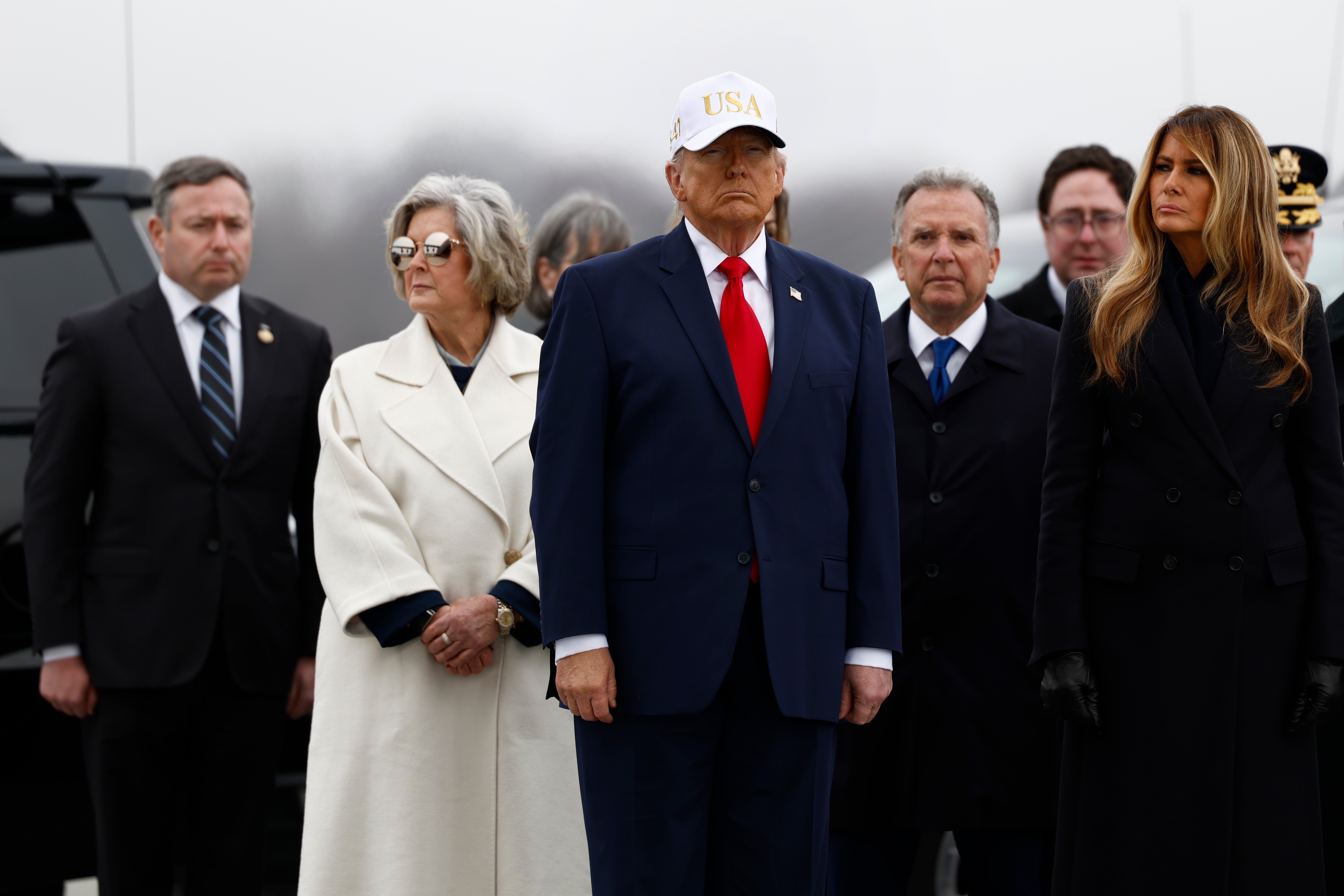
 US President Donald Trump and First Lady Melania Trump attend the dignified transfer of six fallen US service members at Dover Air Force Base in Delaware on 7 March 2026. (Photo: Will Oliver / EPA)
The world is now witnessing two devastating wars of choice – the Ukrainian conflict, now in its fifth year, and the newest outbreak of fighting in the Middle East: the US and Israel against Iran. Both demonstrate flawed, deeply dangerous strategic choices amplified by equally flawed leadership styles, seemingly taking place without regard to any harms for the rest of the world.
A critique of the chaotic strategic leadership and illusions about the realities in the Middle East can also illuminate Russia’s own quagmire with its invasion of Ukraine.
Even as the end games for either of the two conflicts still remain uncertain, examinations of the leadership and strategic vision failures for them, especially the metastasising Middle East war, are critically important. We can think about the Ukraine and US-Israel versus Iran conflicts as (un)controlled experiments in terms of the failure in wars of choice – and that they are dependent on how respective leaders have made their choices.
Begin with the Middle East conflict and Israeli Prime Minister Benjamin Netanyahu. Even as he is under threat from a legal challenge over charges of corruption, he has positioned himself as a combination of a transformational and a servant leader, but with a generous dollop of authoritarian instincts. As he sees it, his leadership addresses his nation’s security needs and thus his role is as its protector, shielding it from dangers at whatever the cost.
/file/attachments/2988/13700192_217463.jpg "Israeli Prime Minister Benjamin Netanyahu attends a special session to mark the 77th anniversary of the Knesset’s establishment and the 60th anniversary of the dedication of the current building at the Knesset, the Israeli parliament, in Jerusalem, on 2 February 2026. (Photo: Abir Sultan / EPA)")
This strategic vision has encompassed the destruction of non-state-actor terrorist –enemies such as Hamas and Hezbollah, and the neutering of their Iranian sponsor’s war-making capabilities, given its publicly professed goal of crushing Israel. For Netanyahu, this means measures that will end Iran’s missile capabilities and any possibility that it could resurrect any nuclear development programme degraded in last year’s “Twelve Day War”.
But a lack of clear limits and the violence spiralling out of the actual military actions based on this strategic vision have also triggered a growing decline in support for Israel among Americans (and even among a growing sector of the American Jewish community), in addition to the marked decline of support around the globe.
/file/attachments/2989/13804489_250413.jpg "In a picture made available by Iran’s Supreme Leader Office, Mojtaba Khamenei, one of the children of Iran’s slain supreme leader Ayatollah Ali Khamenei, attends a ceremony on 3 October 2024. (Photo: EPA / Handout)")
Trump’s tactical behaviour
Central to the current conflict with Iran is, of course, Donald Trump and his mercurial decision-making. Across the board, this has included a mix of transactionalism and quasi-authoritarianism, but also drawing on the patrimonial style of dispensing benefits to loyalists and wreaking vengeance on opponents.
In contrast to his predecessors (except, perhaps, Andrew Jackson or Richard Nixon), Trump has made little effort to be a servant leader operating on behalf of the entire nation, instead pitting one part of the nation against another to achieve political success.
But worse is that Trump’s behaviour goes hand in hand with a startling strategic incoherence: it is all tactical. This first became clear with his ever-
changing tariffs and trash-talking of allies, international competitors and potential antagonists – and their leaders (save for Vladimir Putin). Domestically, there have been harsh, restrictive visa regulations and the harrowing behaviour of Immigration and Customs Enforcement personnel against potentially undocumented aliens and citizens alike.
But most frighteningly, he initiated a war of choice with Iran, with constantly shifting rationales for the massive engagement of air and naval power against Iranian military and civilian infrastructure, in association with the Israelis. This has also included the troubling act of decapitating a whole cohort of senior Iranian government figures, including its supreme leader, the Ayatollah Ali Khamenei.
Moreover, the constantly shifting rationales have depended on who has been speaking for his administration. They have run the gamut from offering verbal support for a popular rising against a vicious, authoritarian Iranian government; ending any possibility of its uranium enrichment for nuclear weaponry and the construction and deployment of intercontinental missiles; eliminating Iranian support for terrorist non-state actors; and, most recently, Iran’s unconditional surrender, as determined by the US president. What he really believes his actual strategic vision to be is almost impossible to say.
As further US military casualties inevitably arrive at Dover Air Force Base, aerial attacks on Gulf Arab states (and US facilities there) and on Israel by Iran continue in response, and a new Iranian government – now headed by Mojtaba Khamenei (the previous supreme leader’s son) – vows to continue its struggle against the big and little Satans, regardless of the cost, the national consensus in America for this fight will decline.
As far as Iran’s leadership picture is concerned, unless things change dramatically with the selection of Mojtaba Khamenei as the new supreme leader, the leadership style and strategic vision will remain in the top-down, autocratic style of someone imbued with religious inspiration, together with bureaucratic impulses keeping structures of state, and especially the Islamic Revolutionary Guard Corps, in line.
But the Iranian leadership’s strategic vision has led to massive infrastructural destruction from aerial attacks, together with the earlier decimation of its client non-state actors, Hamas, the Houthis and Hezbollah, and loss of control over its former Syrian satellite.
The unsuccessful negotiations with the US over uranium enrichment, sanctions, missiles and other issues has led to the current disaster.
A further strategic failure has been Iranian attacks on neighbouring states, from Oman to Azerbaijan, as a part of its response to the US-Israeli attacks.
/file/attachments/2989/13738475_681431.jpg "German Chancellor Friedrich Merz meets President of Ukraine Volodymyr Zelenskyy at the 62nd Munich Security Conference on 13 February 2026. (Photo: Sean Gallup / EPA / Pool)")
Zelensky and Putin
As far as the fighting in Ukraine is concerned, what lessons can be drawn from the strategic vision and styles of the two nations’ leaders? Dmytro Kuleba, Ukraine’s foreign minister when Russia’s invasion began, believes the Trump administration may well have fallen into the same delusional overconfidence that has doomed Russia’s initial war plan.
Kuleba posted on social media that “American commentators are again talking about a ‘short war’. They said the same about Russia’s war against Ukraine. It will be short only if Washington quietly scales down its goals, gives up on regime change in Iran, and sells a much smaller outcome as victory... Breaking a large country, it is hard even for the United States.”
In Ukraine, President Volodymyr Zelensky found the inner resources to rally the country in its time of existential crisis. At the worst moment, he even declined offers to be evacuated from Kyiv when it appeared its capture was imminent.
Even as the US makes its support ever more conditional under the Trump administration, Zelensky has succeeded in convincing many European leaders that their nations have a dog in this fight – and that dog is a feisty Ukraine. Consequently, they have been pledging increased war materiel and financial support as the conflict has entered its fifth year.
/file/attachments/2989/13778993_586475.jpg "Russian President Vladimir Putin and Vietnamese Foreign Minister Le Hoai Trung during their meeting in Moscow on 24 February 2026. (Photo: Maxim Shipenkov / EPA / Pool)")
By contrast, Zelensky’s adversary, Putin, has chosen to lead with a reach back to Russian history and traditions, demanding automatic patriotism from citizens and obeisance from subordinates.
But as cracks in support for the war have begun to show, subordinates – generals, industrialists and a political rival or two – have been rusticated or worse. Any benefits from this invasion of Ukraine are now largely in Putin’s own dreamscape of resurrecting the tsarist-era empire, rather than in Russia’s international standing or any tangible benefits to its citizens.
The bottom line for the two most dangerous conflict zones in the world today – the invasion of Ukraine and the attacks on Iran and its retaliation – is that national leaders, save for Ukraine’s president, have been led by self-delusion, defective leadership and flawed understandings of coherent strategic visions. The outcomes are unlikely to be pretty. DM
This story first appeared in our weekly DM168 newspaper, available countrywide for R35.
/file/attachments/orphans/DM-13032026001CPTJHB_763962.jpg "Graphic: Jocelyn Adamson
<br>Image sources: iStock; Fani Mahuntsi; Brenton Geach; Frieda/Gallo Images and Leanne de Jager MPL")
Image sources: iStock; Fani Mahuntsi; Brenton Geach; Frieda/Gallo Images and Leanne de Jager MPL
Comments
Scroll down to load comments...