



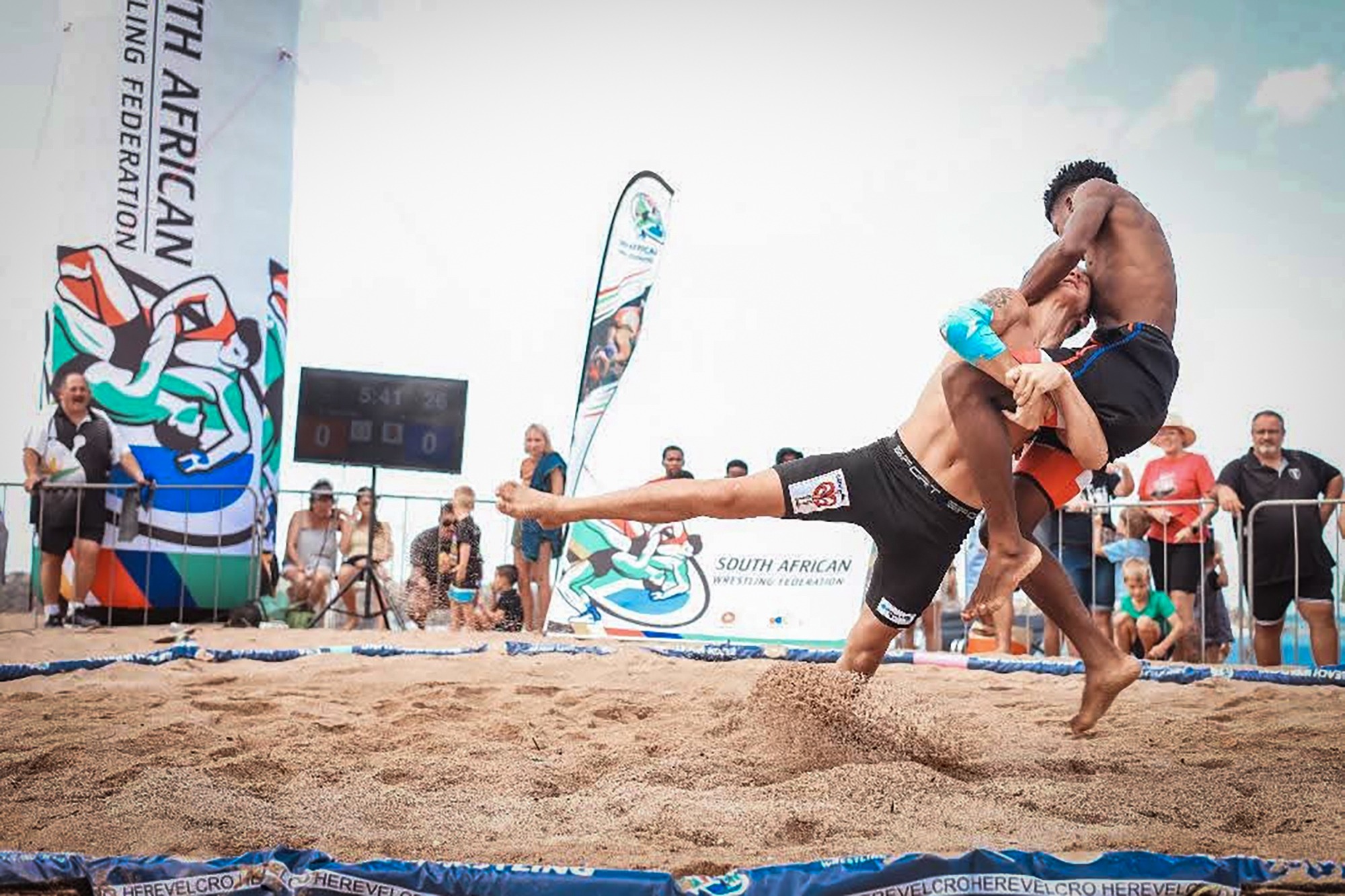
 Some of SA’s best grapplers are heading to Jeffreys Bay in the Eastern Cape to compete at the National Beach Wrestling Championships later this month. (Photo: SA Wrestling Federation)
 For many beachgoers, getting sand in uncomfortable places is one of the few snags of a lovely day by the sea.
However, for a select group of athletes, it is an occupational hazard. In fact, from afar it might even look like that’s the goal as they try to tackle and throw each other across the beach.
At the end of this month, some of the country’s toughest grapplers will flock to Jeffreys Bay, on the Eastern Cape coast, for the second annual South African Beach Wrestling Championships.
In 2005, global body United World Wrestling recognised beach wrestling as an official discipline. It steadily spread across the world, and while South Africans have been doing it informally for some time, the first national championship under the SA Wrestling Federation took place last year.
Following the inaugural tournament in Richards Bay, where the Eastern Province (EP) team walked away with top honours, the sport’s popularity has grown exponentially, particularly along the country’s coastal regions.
On 28 March, more than 200 wrestlers from across the country will lock horns on Dolphin Beach, where EP Wrestling president Wouter Nell hopes his team will defend their title.
“For the better part of the last decade, EP Wrestling was dormant, and the sport struggled in our region. Four years ago, we managed to revive it here in Nelson Mandela Bay and it has grown steadily since then.
“Due to the down time, we have a lot of catching up to do in terms of mainstream mat wrestling. But beach wrestling is quite new to everyone, and we have the advantage of beach access for training. We won the first national championships, and if we defend the title this year, I think we can establish ourselves as the home of this relatively new wrestling discipline,” Nell said.
/file/attachments/orphans/BeachWrestle1_397870.jpeg "Gqeberha grappler Jason du Randt (left) qualified to take part in the SA Beach Wrestling Championship in Jeffreys Bay later this month. In this match, he fought teammate Julian Schmidt on his way to securing a spot on the Eastern Province team. (Photo: Foolproof Photography)")
Nell explained that each match has a three-minute time limit, but few matches last the full round.
Athletes compete in a seven-metre diameter circle and score points by pushing each other out of the circle or forcing their opponent to the ground.
Pushing the opponent out of bounds, or forcing ground contact with anything other than their hands and feet, counts for one point. A clean toss, from the feet on to the back, scores three points. The first person to three points wins the match.
Male and female athletes compete across age divisions, starting at under-eight, and senior divisions are divided into varying weight categories.
According to Nell, the EP team’s success can be attributed to dedicated coaches and hardworking athletes.
“Our weekends are spent on the beach. Our team and coaches are there to ensure we prepare as well as we can, running through techniques and pushing each other to become better in every facet of the sport.”
As most of the EP team is based in Nelson Mandela Bay, Nell said they initially hoped to host the national championship in Gqeberha. However, some logistical challenges led to the organisers casting a wider net, and the Kouga Municipality, about 75km down the road, welcomed the event with open arms.
Kouga spokesperson Monique Basson said they were thrilled to host the tournament and grateful for the opportunity to again showcase themselves as an ideal venue for beach events.
“Hosting the SA Beach Wrestling Championships provides an excellent platform for promoting the Kouga region as a destination of choice for sporting and recreational tourism. The event is expected to attract athletes, support teams, spectators and media from across South Africa and beyond, boosting local tourism, hospitality and retail sectors.”
/file/attachments/orphans/JBaySurf1_306039.jpg "Jeffreys Bay in the Eastern Cape will host the second annual South African Beach Wrestling Championships. (Photo: World Surf League)")
Basson said Kouga hoped to negotiate a long-term agreement with the organisers so that Jeffreys Bay could host future events as well.
Nell said entries closed with 239 participants expected to compete, but he was confident that the local team could win back-to-back championships.
“I believe we have what it takes to prove ourselves worthy hosts, and to grow this relatively new sport in our region. We have the capabilities to make the Eastern Cape known as the home of beach wrestling in SA,” Nell said.
Competing in the +90kg division, Jason du Randt is no stranger to grappling sports.
Having trained with the professional fight team at the PE Submission Fighting Academy (Pesfa) since he was a boy, Du Randt, 24, has dedicated the past five years to becoming a full-time professional grappler.
He has competed in Brazilian jiu-jitsu and submission grappling globally, and recently dipped his toe into the wrestling pool as well.
“While I’m still trying to wrap my head around the rules, the transition from jiu-jitsu into wrestling, and more specifically beach wrestling, has been interesting and fun,” Du Randt said.
Earlier this month, he competed in his first beach wrestling tournament in Gqeberha, which doubled as qualifiers for the national championship. The deck was stacked against him as his road to a gold medal included a match against last year’s national champion.
“Luckily, there is a lot of crossover between various disciplines and I was able to put some of my limited judo experience to good use as well. My matches were not easy, but I was able to secure that spot for SA champs.”
While the tournament is no longer taking place in Gqeberha, Du Randt said competing in Jeffreys Bay will still feel like having a home-ground advantage.
“Knowing that your friends, family and teammates will be there in person to support you is a major boost. I’ve been fortunate to compete at events across the world, but doing it in front of a home crowd just elevates the experience,” Du Randt said. DM