




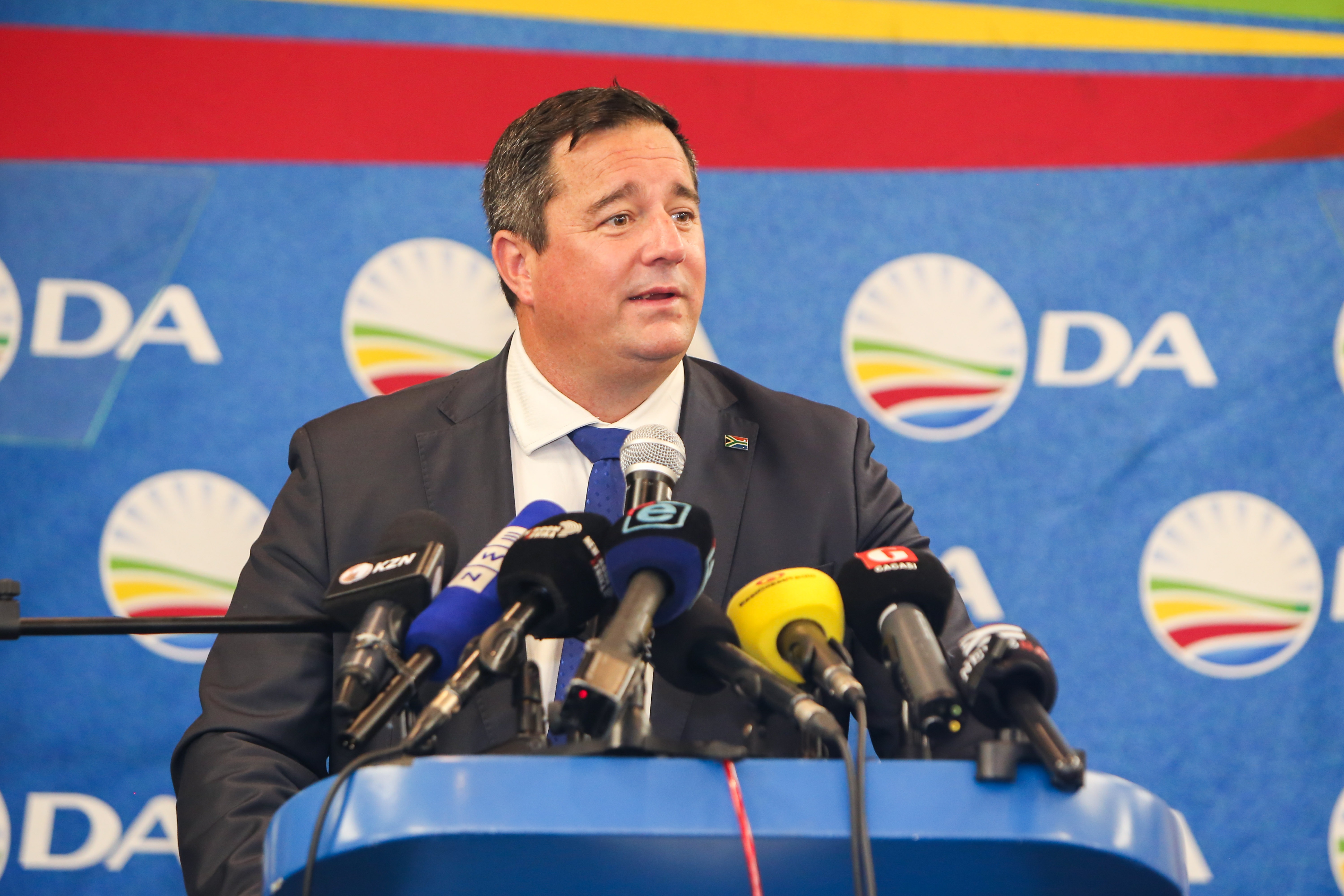
 John Steenhuisen addresses the media at the Riverside Hotel in Durban on 4 February 2026. (Photo: Gallo Images / Siyabonga Sokhela)
 When John Steenhuisen stood before the party faithful on Wednesday, 4 February to announce he would not make himself available for re-election as DA leader, there was a certain Shakespearean element to the moment. The rules of engagement for internal party warfare had been written years earlier, and Steenhuisen himself had helped draft them.
Former DA leader Mmusi Maimane described the moment of his own political death in the DA in his book Dare to Believe. September 2019, he wrote, was defined by a concerted campaign to make his leadership impossible to sustain. Former friends and allies – including his own chief of staff, Geordin Hill-Lewis, and the party’s then chief whip, Steenhuisen – were, he alleged, colluding with Helen Zille and others, including then party spokesperson Gavin Davis, to box him in from all sides.
An insider at the time described Maimane as “reeling from the betrayal”. Maimane recounts waking up on Sunday mornings with a pit of dread in his stomach, waiting to see what the newspaper Rapport would publish about him.
Rapport, he believed, had become the preferred conduit for smears about him. They arrived thick and fast. He was driving a car subsidised for the DA by disgraced Steinhoff boss Markus Jooste. He was renting a Claremont home for his family owned by a Durban businessman and had incorrectly disclosed its ownership in Parliament.
By today’s South African political standards, these allegations barely register. But that was never the point. The message was clear: the leader was no longer protected. Maimane was dead in the water.
This is how Steenhuisen chose to characterise those events in his Wednesday speech: “The previous leader walked off the job.”
It’s a revision of history that whitewashes any role in Maimane’s exit beyond his own, painting him as someone who simply lacked the grit to finish the job.
/file/dailymaverick/wp-content/uploads/2025/09/anso-maimane.jpg "Illustrative image, from left: The late DA official James Selfe. (Photo: Gallo Images / Netwerk24 / Jaco Marais) | Helen Zille. (Photo: Gallo Images / Fani Mahuntsi) | Build One South Africa leader Mmusi Maimane. (Photo: Gallo Images / Luba Lesolle) | DA Logo (Image: Wiki commons)")
But the rules of the battle were set there, in Maimane’s ousting. And now Steenhuisen finds himself strung up with the same ropes he himself helped knot in 2019 – however much his decision not to stand for a third term in April will be framed as one made on his own terms.
Tightening the grip
Steenhuisen is described by both detractors and supporters as a man with razor-sharp political instincts – or, as one former colleague put it to Daily Maverick this week, as a “ruthless political operator”.
These traits served him well once he took over the DA leadership in 2019. Maimane’s departure, together with the resignation of former party chairperson Athol Trollip and former Johannesburg mayor Herman Mashaba, had left the party internally in disarray.
A common complaint against Maimane at the time was that he had failed to hold the party together tightly enough; he was seen as indecisive and dithering on points where he needed to be resolute.
This perceived weakness had allowed various factions formed against Maimane’s leadership to flourish openly. One group, which called themselves the “1959s”, mobilised by former DA MP Ghaleb Cachalia and drawing in figures like former DA MP Michael Cardo and the late DA MP Belinda Bozzoli, presented themselves as the true intellectual bastion of “classical liberalism”.
/file/attachments/2987/ED_562251_609163.jpg)
Bozzoli would die of cancer shortly afterwards; Cardo resigned two months into Steenhuisen’s interim leadership tenure; and Cachalia would leave the DA in 2024 after being demoted for public criticism of Israel. James Selfe, another veteran liberal, would resign in 2021 – mainly because of ill health, but also an intensifying fallout with Zille.
By the end of Steenhuisen’s two leadership terms, if there remains a bloc within the DA still stubbornly committed to the ideological principles of old-school classical liberalism, it is hard to discern.
The anti-Maimane faction that had won the day was the party’s true power brokers, marshalled by Zille. Their man – Steenhuisen – was now in place. And for the new leadership team, as Selfe later wrote, there was one priority apparently above all others: to win back the 400,000 votes lost to the Freedom Front Plus in the 2019 elections, seemingly alienated by Maimane’s stance on topics like race, apartheid and “white privilege”.
“Little attention is [now] paid by the DA to being a party for all the people,” Selfe would later write.
If Maimane’s central failure was not to stamp sufficient authority on the DA, Steenhuisen could not be accused of the same. He inherited a party in which internal discipline was weak and every internal dispute seemed to land up in the media. The leaks – until very recently – stopped.
Loyalists and acolytes – those viewed as trustworthy by Zille and Steenhuisen – were cultivated and promoted. The likes of Ashor Sarupen – a Zille protégé who ran her 2019 campaign for Federal Council chair – and Dean Macpherson – Steenhuisen’s closest friend in the DA since early KwaZulu-Natal days – saw their stars rise.
Steenhuisen was aided in his campaign to tighten internal discipline by the departure from the party of a number of inconveniently dissenting black voices by the end of his first term. Feisty MP Phumzile van Damme was gone by May 2021.
Mbali Ntuli, a key KZN organiser viewed at one stage as one of the DA’s brightest rising stars, left in March 2022. Former DA deputy Federal Council chair Makashule Gana followed in August of that year.
/file/attachments/2987/ED_159101_584352.jpg "Back in 2021, John Steenhuisen was among the DA leaders at the front of a march in central Johannesburg focusing on corruption in the ANC as part of a campaign organised by former DA leader Tony Leon. (Photo: Laird Forbes / Gallo Images)")
Steenhuisen installed a large portrait of John F Kennedy, his political idol, above his desk in his office.
A former staffer claimed that to be reassured that his grip on the party was not slipping, the leader would routinely monitor the social media accounts of DA representatives for signs of dissent.
The DA was now in firm hands, and the donors seemed reassured: the Electoral Commission’s political funding disclosures show that during Steenhuisen’s tenure the DA routinely pulled in the highest amount in donations of all political parties.
The 2021 electoral mirage
Steenhuisen’s first major political test came in the 2021 local government elections, where the leader was anxious to show that the DA’s underperformance in the 2019 general elections could be pinned on Maimane and left in the past. The DA came out with 21.62% in 2021, indeed an improvement over 2019’s dismal 20.77%.
Steenhuisen said it was evidence that “our project of stabilisation and consolidation of the DA is very much on track”.
But this obscured the fact that one cannot easily compare general election results with local government election results. In the municipal elections, South Africans vote for which party’s councillor is most likely to be able to fix the pothole outside their door, rather than more high-minded ideological considerations. For this reason, the DA has always performed better in local elections.
The figures were clear: in the 2016 local government elections, under Maimane, the DA had won 1,782 seats nationally, emerged the leading party in 24 municipalities and with outright control of 19. After the 2021 local government elections, under Steenhuisen, the DA won 1,396 seats nationally, was the leading party in 23 municipalities and had outright control of 11.
When pundits and election analysts pointed this out, Steenhuisen was furious – insisting that they should focus on the 2019 results, not the 2016 results.
It was the beginning of an intensifying hostility between Steenhuisen and media outlets he perceived as critical. The DA under Steenhuisen has entirely stopped holding leader’s press conferences, as were held under Maimane, Zille and Leon, meaning there is no chance that Steenhuisen could be surprised with a critical question.
/file/attachments/2987/ED_312115_301181.jpg "John Steenhuisen flights a DA poster promoting voter registration in Cape Town on 22 June 2021. (Photo: Gallo Images)")
Instead, the party moved to a system where Steenhuisen would address the nation in live broadcasts, with no questions from journalists. The only option for posing a live question to Steenhuisen was to doorstop him at events: a troubling setback for political accountability, of which President Cyril Ramaphosa is even more guilty.
In the 2024 general elections, which Steenhuisen has made clear should be considered – together with entry into the Government of National Unity (GNU) – as the high watermark of his leadership, the DA did improve on its 2019 results, from 20.77% to 21.81%.
Under normal circumstances there would have been more questions asked about the DA’s inability to capitalise better on the ANC’s clear state of terminal decline.
That those questions were not more sharply posed was thanks to Steenhuisen’s Hail Mary: the barnstorming entry of Jacob Zuma’s MK party, which – far more than the DA or any other party – was responsible for bringing the ANC below its 50% threshold for the first time.
Into the GNU
Yet Steenhuisen is correct in saying, as he did in his speech on Wednesday, that he will be remembered as the DA leader who brought the DA into national governance for the first time. This is no small feat, given that the ANC was insistent that a coalition with the EFF and MK was equally on the table. However, the DA also benefited from the obduracy and disorganisation of the EFF and MK during negotiations, as well as MK’s insistence that a coalition government led by Ramaphosa was a no-go.
Regardless, Steenhuisen deserves significant credit for grasping the nettle, for knowing that, regardless of what conservative voters and donors might say, a chance to join national government might not come along again and had to be tried.
He deserves credit for appointing a hard-nosed team of party negotiators who would ultimately extract a number of key posts from the ANC, even if not to the extent that was hoped.
It must also be recognised that the task Steenhuisen has faced in repositioning the party from opposition to governance has not been easy. Inside the GNU, the DA’s ideological positioning has become – if anything – more unclear than ever.
The party that had once positioned itself as a liberal alternative to the ANC has found itself struggling to articulate what it actually stood for beyond opposition. Was it a party of classical liberalism? Social democracy? Centre-right conservatism?
Under Steenhuisen, the answer has seemed to shift depending on which audience was being addressed.
/file/attachments/2987/0000276653_523526.jpeg "John Steenhuisen during the DA’s general election manifesto launch at Rand Stadium in Johannesburg on 23 February 2019. (Photo: Gallo Images / Netwerk24 / Deaan Vivier)")
Steenhuisen has qualities that made him an excellent parliamentary chief whip: chippy, bolshy, quick on his feet, combative. But these traits have not translated well to the emotional intelligence needed to be the leader of a party working hand-in-hand for the first time with “the enemy”.
His failure to establish a meaningful relationship with Ramaphosa has probably harmed the DA’s ability to extract the vital concessions on pieces of legislation it needs to reassure voters that it has not entirely been subsumed into the ANC’s mandate.
More recently, the revelations about Steenhuisen’s failure to manage his own financial situation – evidence of which Daily Maverick has seen stretching back to his KZN days – has raised the legitimate concern that Steenhuisen’s refusal to countenance withdrawing his party from the GNU might be due in part to an unwillingness to relinquish his own ministerial salary.
Live by the sword, die by the sword
The catalyst for Steenhuisen’s exit now, at a time when his re-election for a third term seemed until recently a foregone conclusion, appears to have been the firing of Minister of Forestry, Fisheries and the Environment, Dion George.
The reasons for George’s dismissal remain decidedly opaque, and Steenhuisen appears not to have shared them with the federal executive. It was a rare miscalculation for a man who had perhaps grown too comfortable operating without significant internal challenge.
Steenhuisen reached for the Maimane-ouster playbook. Rumours of grave misconduct on George’s part, including allegations of sexual harassment, were fed into the media pipeline. Multiple outlets ran them uncritically.
But what Steenhuisen failed to account for was that he was not dealing with an increasingly isolated Maimane figure. He was dealing with a party veteran who has served on the DA’s federal executive on and off for 15 years, and in a particularly significant role: the finance chair.
Someone who knows where many of the financial skeletons in an organisation are buried is unlikely to submit meekly to being pushed out. And such was the case with an evidently raging George.
What’s striking about Steenhuisen’s downfall is how little he appears to have learnt from Maimane’s experience. Both men were ultimately undone by the same mechanisms: internal party machinations, carefully placed media stories, and a federal executive willing to look the other way as the knives came out.
The difference, perhaps, is that Maimane could claim he was ambushed. Steenhuisen has no such excuse. He knew exactly how the game was played. He had helped perfect the rules. And in the end, he was hoisted by his own petard. DM
This story first appeared in our weekly DM168 newspaper, available countrywide for R35.
/file/attachments/orphans/DM-06022026001CPTJHB_933247.jpg)