



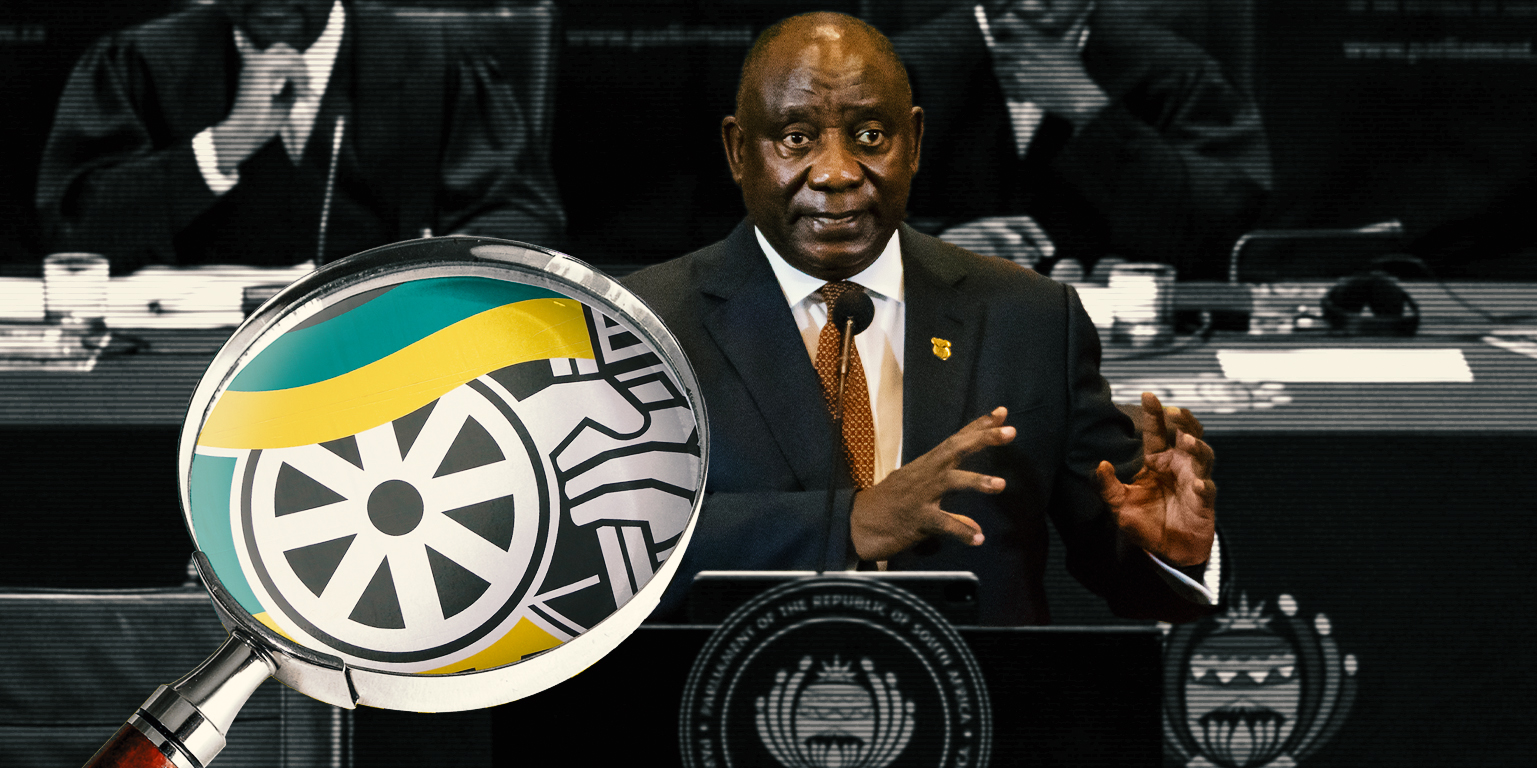
 Illustrative image | President Cyril Ramaphosa delivers the State of the Nation Address on Thursday, 9 February 2023. (Photo: Dwayne Senior / Bloomberg) | (Photos: Rawpixel | Felix Dlangamandla)
 /file/dailymaverick/wp-content/uploads/2025/10/label-analysis-2.jpg)
Just over eight years ago, Cyril Ramaphosa was elected to office in the National Assembly. To watch that ceremony now is to be reminded of how uncertain things in South Africa were then.
When the then Chief Justice, Mogoeng Mogoeng, announced the result of the election, for a few seconds Ramaphosa appeared immobile. Then, he broke into a broad smile as the realisation sank in.
It was not clear then how much power he really had.
Jacob Zuma had led the ANC for 10 years. His supporters were in top strategic positions. Ace Magashule was the party’s secretary-general. Tony Yengeni’s tweets were taken seriously as an indication of feelings in the party, of the scale of the threat to Ramaphosa.
Government institutions like SARS and the National Prosecuting Authority had been completely hollowed.
The electricity sector was a mess, to the point where Ramaphosa had already had to intervene as Deputy President to appoint a new board to Eskom, just to reassure the markets.
His hold over the ANC seemed fragile, and he appeared to delay implementing wholesale reforms while playing what supporters called “the long game”.
Despite leading the party to victory in 2019, when the Covid pandemic hit in 2020, there was much grumbling that it seemed he was not in charge.
Conspiracy theories abounded that Dr Nkosazana Dlamini Zuma, as cooperative governance minister, was taking power from him in her quest to either eliminate cigarette-smoking in South Africa, or to help the illegal tobacco industry (pick your conspiracy theory).
/file/dailymaverick/wp-content/uploads/2025/08/PHOTO-2025-08-04-19-06-28-1.jpg "President Cyril Ramaphosa and Dr Nkosazana Dlamini Zuma. (Photo: Musa Masilela / ANC)")
Even as late as December 2022, fewer than four years ago, it was not entirely certain that Ramaphosa would win another term as ANC leader.
At one point, for a few hours following the Phala Phala scandal, it was not even clear whether he would stand for another term.
Taking charge
His 2026 State of the Nation Address last Thursday and the manner in which he delivered it showed how much has changed.
Zuma has left the ANC, taking his strongest and loudest supporters with him.
The current ANC secretary-general, Fikile Mbalula, quashes any talk of succession in the party and makes it clear that he supports Ramaphosa through thick and thin.
The MK party and the EFF have been consumed by infighting, have lost senior leaders and seem incapable of providing strong and thoughtful opposition.
Even the DA, which has provided a more cogent and sustained opposition to the ANC over the last 30 years, is now a part of Ramaphosa’s choir.
Read more: A Sona for (almost) all — Ramaphosa’s masterclass in political crowd-pleasing
Power may expand throughout a presidency, but it usually carries a heavy tax: a growing collection of enemies and grievances.
/file/attachments/orphans/WhatsAppImage2026-02-12at201223_856815.jpeg "President Cyril Ramaphosa delivers the 2026 State of the Nation Address. (Photo: Jairus Mmutle / GCIS)")
That is not the case here, where Ramaphosa could find his popularity increasing for two major reasons.
The first is that the economy is growing.
The second is that more people are beginning to realise how difficult it will be to follow him, and how unclear the post-Ramaphosa picture is.
This is rare. It is uncommon for leaders to grow more popular in their second term than in their first (although in Brazil, Luiz Inácio Lula da Silva’s second term is famous for being the moment when he really acted and reformed the country).
All of this suggests that Ramaphosa’s strategy of the “long game” was correct.
Mounting successes
While it is obviously true that he is in a much more powerful position now than before, it is only a true victory if the state is reformed.
Here, while there are important successes, the picture is more mixed, mainly because of the weakness of the state.
Much of this weakness, probably most of it, was a direct result of Zuma’s rule, what Ramaphosa has called the “nine wasted years”.
/file/attachments/orphans/ED_596373_751707.jpg "Patriotic Alliance leader Gayton McKenzie greets Jacob Zuma during the 2026 Sona debate on 17 February. (Photo: Jeffrey Abrahams / Gallo Images).")
But some of it must also be because of the Covid-19 pandemic. While it is easy to criticise after the fact, there are still many consequences from Ramaphosa’s government’s decision to lock down as hard and for as long as they did.
Certainly, the rise of the illicit tobacco industry is a direct consequence of the inexplicable complete ban on these products during this period. While Ramaphosa may not have been the main driver, as President, he allowed it to happen.
On the other hand, some institutions, and in particular SARS, have been completely reformed.
And, breaking new ground, the National Director of Public Prosecutions has departed on her own terms and gone on record stating that her decisions were never compromised by political meddling.
Ramaphosa is responsible for these positive developments.
He must also be given credit for virtually all of the success of Operation Vulindlela.
Many of the achievements he listed last week, such as the end of load shedding, the improvements at Transnet and in the logistics sector, and the positive changes in the public rail system, are mainly because of this initiative.
While Ramaphosa may not play a direct role there, he has provided political cover to ensure that it succeeds.
Also, while his decisions to institute inquiries into various issues can be legitimately criticised, the longer term might well show he was right.
The inquiries into the SAPS will probably allow him to reshape not just the actual leadership in the police, but also how the leaders are appointed. He may even be able to change the very structure of the SAPS to ensure its members are properly depoliticised.
‘Cyril’s economy’
However, for many people, very little of this affects them.
The phrase “Cyril’s economy”, when heard in workplaces, in taxis and at braais, is not a compliment. It is a recognition of how tough life is.
And municipal councils, many of them riven by a fractured politics in which the ANC is central, seem almost unfixable.
That means that Joburg’s water crisis, which threatens so many people, may take a long time to fix.
And the promise to bring in the SANDF to deal with crime rings hollow. The SANDF is led by someone who uses government money to support soldiers charged with murdering a Hawks investigator and is spending hundreds of millions of rands on a Defence Force day in his hometown, while his soldiers don’t always have enough money for food.
Masterful game
Politically, there can be no doubt that Ramaphosa has played a masterful game.
He is in charge.
Our recent history is littered with the political carcasses of Magashule, Dlamini Zuma, Yengeni, and so many others who opposed Ramaphosa.
The person who posed the biggest threat, Zuma, is no longer a threat nationally (even though MK might soon find itself leading the provincial government in KwaZulu-Natal).
It is also true that many of the reforms at the top level of government and in our economy have been positive.
Slowly, so very slowly, there are signs that this will soon have an impact on millions of people who live in poverty.
Ramaphosa has won the long game. However, the real test is whether our economy can grow and create jobs. Given the nature of our society and its racialised inequality, this is a very tough ask.
But for millions of people, it is the only game that matters. DM