
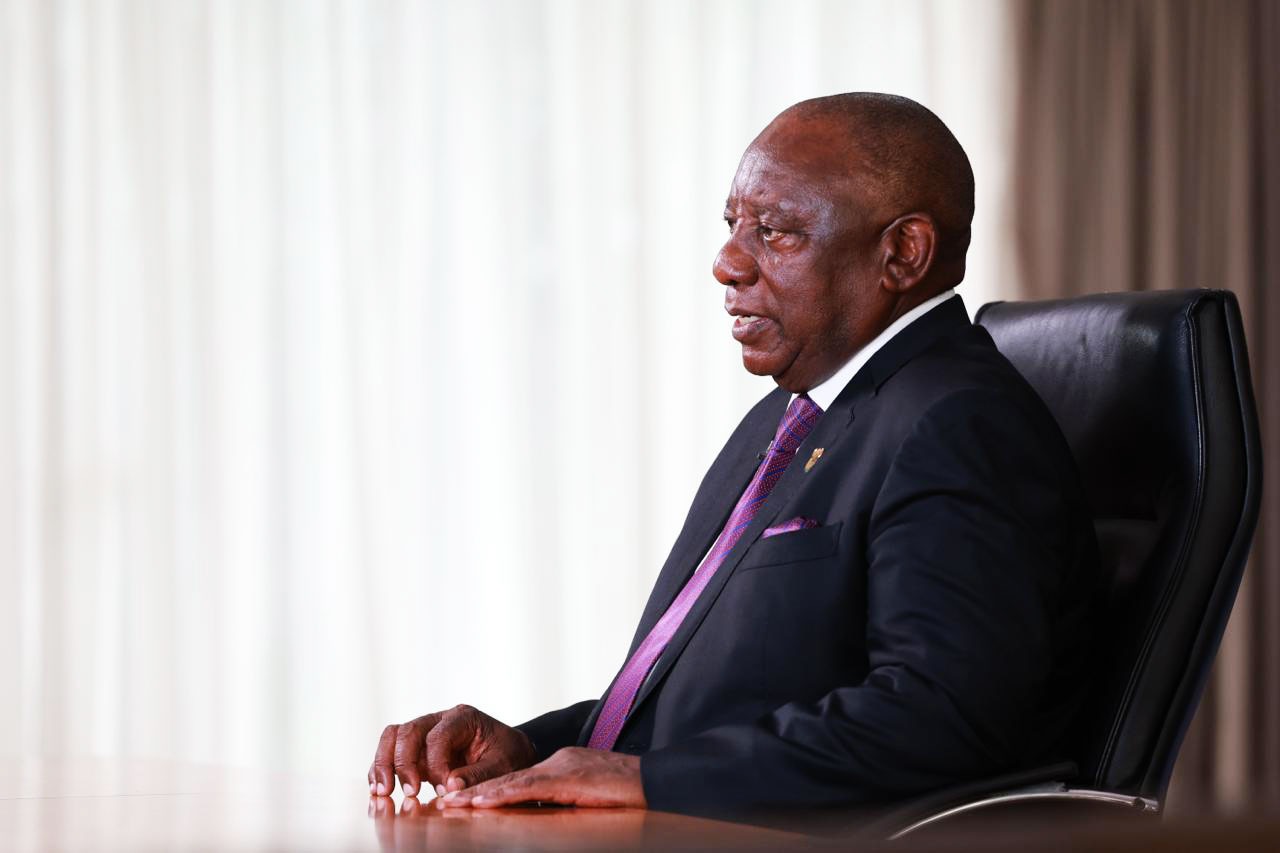
 President Cyril Ramaphosa. (Photo: GCIS / Baba Jiyane)
 The Presidential Climate Commission (PCC) comprises government ministers and 22 commissioners who represent diverse perspectives and interests. The commission meets quarterly, with ad hoc working groups focused on various thematic areas meeting more frequently.
Established in 2020, the PCC is a multistakeholder body tasked with advising on South Africa’s climate change response, focusing on the just transition to a low-emissions, climate-resilient economy and society.
The term of the former commissioners ended on 31 December 2025, and the new commissioners will serve for five years from 1 January 2026 to 31 December 2030, in accordance with the Climate Change Act 2024 (Act No 22 of 2024).
Daily Maverick spoke to PCC executive director Dorah Modise on Thursday, 8 January, as she welcomed President Cyril Ramaphosa’s appointment of new commissioners.
Modise said the commission’s priorities in this new term include supporting local governments to build climate resilience and mobilising adaptation finance.
/file/attachments/2986/1000171746_914023.png)
The commission would “support local governments to plan, implement and respond to climate disasters while playing a bigger role in the energy sectors”. It would also mobilise adaptation finance and grants for small-scale local projects, while supporting the government to build the capacity and policy coherence to implement quick wins.
Modise said this needs to be backed by monitoring and evaluation mechanisms to measure real action and outcomes of the climate policy.
They aimed to “continue to build consensus among social partners [and] increase community engagement and awareness, [while] mobilising domestic and international climate finance”.
Modise added that the commission boasts “diverse leaders of our society and communities, to drive and guide our country’s just transition journey and climate action efforts”.
Asked what lessons from the PCC’s first term (2020-2025) will guide its work, Modise said the greatest lesson was to bring South Africans on board with the transition. South Africans remain anxious about any major transformational change that will disrupt their lives and livelihoods, she added.
“For many South Africans, they understand the impact of climate change but remain worried about jobs and energy security, and to the commission it meant taking South Africans along on all aspects of climate science. The lesson was to make sure that people, policymakers and donors understand the implications of inaction and the opportunities of acting now.”
A report by the Human Sciences Research Council states that although almost three-quarters of South African adults reported exposure to extreme weather conditions, only 5% said environmental issues was one of the nation’s most pressing concerns.
Unemployment was mentioned by 73% of adults. Second was crime and safety, at 47%.
The council said “this does not imply that environmental concerns are unimportant, but they are presently overshadowed by basic socioeconomic and human security concerns”.
Elaborating on the importance of striking a balance between the urgency of climate change and the realities of unemployment, poverty and inequalities, Modise said:
“For the PCC, the notion of a ‘just transition’ addresses exactly that. The changes must be ‘just’, the risks and opportunities shared equitably. We also emphasise that the triple challenges will worsen if we do not diversify our energy sources, develop new economies that are not energy-intensive, and [do not] ensure that our infrastructure is climate-resilient.” They were also urging “social ownership” of renewable energy projects locally, “including ramping up investments in the green economy”.
Energy and coal are among the sectors that become jittery at the mention of the just transition, but Modise said the phase-out of coal need not affect the country’s energy needs.
“The decommissioning should be done with due consideration to our global commitments, [the]... environment of current generation and coal mining, and the consideration of new economies post-decommissioning to ensure that we don’t have stranded assets in mining towns and the energy hubs, particularly in Mpumalanga.”
The commission has proposed strategies to support vulnerable communities most affected by climate change and economic transition, including:
- Climate change adaptation and resilience investment plans for special ownership of micro-grids in rural areas, townships and community residential schemes;
- Reskilling workers and new skills for young people for future green jobs; and
- Diversification and recovery plans to address agriculture, manufacturing, tourism and logistics, which can be adaptable to existing rail, port and road value chains used in the mining-energy complex’s economic activities.
Asked what success might look like in 2030 for the PCC, Modise said that while most commissioners represent varying interests and priorities, the common goal “is a more solid consensus on our just transition development pathways, and the ability to have mobilised the resources needed to support the change”. DM