




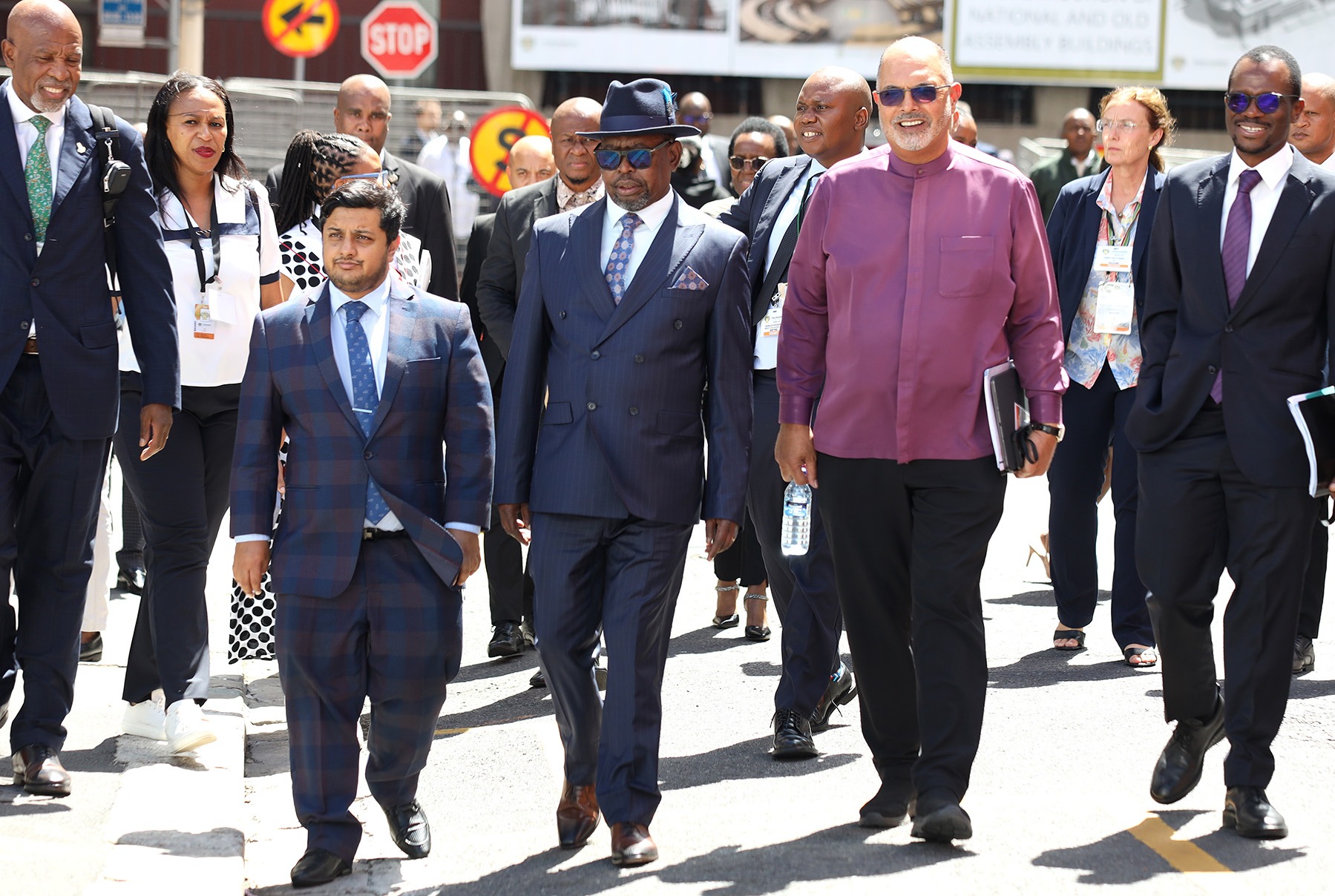
 Finance Minister Enoch Godongwana (second from left) and SARS Commissioner Edward Kieswetter (second from right) arrive at the 2026 Budget Speech at the Nieuwmeester Dome in Cape Town on 25 February 2026. (Photo: Ziyaad Douglas / Gallo Images)
As Finance Minister Enoch Godongwana delivered the 2026 National Budget on 25 February, the stakes for South Africa’s fiscal arithmetic have seldom been as high.
Following a dramatic reversal of the proposed VAT hike in 2025 – a move that left a R75-billion hole in the books – Treasury has been forced to find a path between maintaining fiscal discipline and re-igniting a stalled economy.
Daily Maverick breaks down what the numbers and endless Excel tables actually mean, where every R100 of your tax goes, how South Africa is handling debt and if, amid tentatively positive signs, the 2026 Budget also reflects a stronger economy than a year ago.
/file/attachments/2988/budgetinabox2_864636.png)
The 2026 Budget shows a smaller shortfall than 2025’s Budget, alongside a R400-billion increase in economic output.
In 2025, proposed VAT hikes were scrapped in the third and final iteration of the Budget. Last year, Godongwana announced a R20-billion tax plan, which was set to be revealed in 2026. But lo and behold, the South African Revenue Service (SARS) did such a good job of collecting tax that the previously pencilled R20-billion has been withdrawn from the budget.
“Given the opportunity presented by higher-than-expected in-year revenues and the projected achievement of key fiscal targets, [the R20-billion proposal] is withdrawn,” the Budget Review document reads.
/file/attachments/2988/taxhighlights3_418613.png)
Driving from point A to B is about to become more expensive for South Africans. Changes were made to the fuel levy, the Road Accident Fund levy and the carbon tax on fuel, which all saw increases.
Sin taxes, or excise tax, levied on tobacco and alcohol increased by 3.4%. With one eye on the fiscus and the other on business and legislation, talk of an online gambling tax is bound to evoke a few nods of approval.
Have you ever found yourself staring at your payslip, wondering which government black hole just swallowed a chunk of your hard-earned change?
By dividing the Treasury’s latest breakdown of consolidated spending, we’ve mapped out the food chain of the 2026 Budget, revealing which departments are feasting on the lion’s share and which ones are left scrounging for leftovers.
For every R100 the government spends, the biggest amount (R16,20) goes to the cost of debt servicing, which is actually less than in the 2025 Budget. Basic education, social protection and health also take large slices of the R100 pie.
The losers in this scenario seems to be labour affairs and work programmes, arts, culture and sports, as well as home affairs, which all receive less than R1 for every R100 government spends.
/file/attachments/2988/DebttoGDP_407464.png)
A country’s debt-to-GDP ratio is a financial metric that compares its total public debt to its annual economic output, essentially measuring a nation’s ability to pay back what it owes.
In 2025, this ratio was the highest since 1994. This year that number has dropped, albeit slightly, to 77.3% and South Africa’s GDP is expected to grow by 1.6%.
/file/attachments/2988/borrowingcost2_663256.png)
Having kept the country’s VAT rate the same to stay in the GNU’s good books, the state now finds its borrowing requirements, or borrowing cost, shrinking by R155.8-billion.
To provide more clarity on the potentially ambiguous budget lines mentioned above, here is a breakdown of some of the different categories:
Social security funds: This category is dedicated to safety nets such as the Unemployment Insurance Fund (UIF) and the Compensation Fund. These funds act as targeted financial buffers, offering relief for specific life events.
Community development: Think of this as neighbourhood upliftment. This budget focuses on improving the quality of life through housing initiatives, the creation of public amenities, and broad-scale rural or urban renewal projects.
Economic regulation and infrastructure: This pillar supports both the rules and the roads of the economy. It finances the oversight bodies that govern markets, and highways.
Public administration and fiscal affairs: This covers the back-office operations of the state. It encompasses the essential bureaucratic machinery required to run a country, such as tax collection, national budgeting, auditing and the general oversight functions of National Treasury and government.
Payments for financial assets: In simple terms, this represents the government acting as an investor or a safety net for its own companies. It usually involves liquidity injections (capital boosts), state-owned entity bailouts, or the strategic acquisition of shares and other financial instruments.
/file/attachments/2988/Socialgrants_923330.png)
During his State of the Nation Address earlier in February, President Cyril Ramaphosa announced that the Social Relief of Distress Grant, which was introduced during the pandemic, will be continued.
“This year, we will redesign the grant more effectively to support livelihoods, skills development, work opportunities and productive activity,” he said.
Along with this grant, all other social grants saw increases in the 2026 Budget.
Your tax money is also being funnelled into a trillion rand promise that better roads and sturdier pipes will fix a fractured economy.
/file/attachments/2988/Infrastructure1_557729.png)
/file/attachments/2988/Infrastructure2_382006.png)
To understand the above-mentioned categories better, please take note the municipal equitable share is the allocation for municipalities. It directs resources to communities based on the number of poor households and service delivery needs. DM
Comments
Scroll down to load comments...