




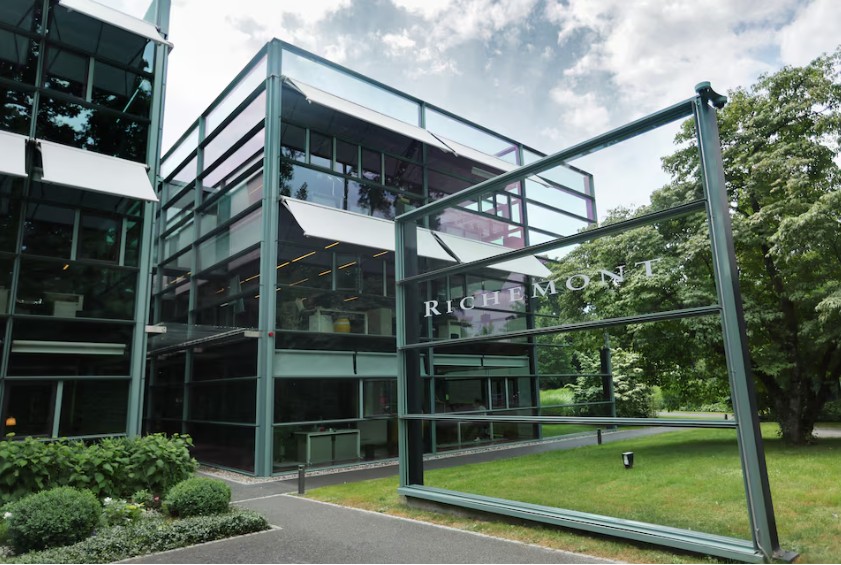
 The logo of the luxury goods company Richemont is pictured at its headquarters in Bellevue near Geneva, Switzerland, June 2, 2022. REUTERS/Denis Balibouse
 The Swiss company's shares rose 3% on the reading with investors looking for signs the luxury goods industry can return to stable growth in a year already marked by geopolitical turmoil and the bankruptcy of one of the sector's largest retail groups, Saks Global.
The world's second-largest luxury company, which also owns Van Cleef & Arpels and Buccellati, said sales in its September-to-December third quarter rose to 6.4 billion euros ($7.45 billion), a 4% year-on-year increase in reported currencies.
That beats an analyst consensus of 6.28 billion euros cited by Visible Alpha and represents an 11% increase when measured in constant currencies.
Richemont's trading update provides the first clues on demand for luxury goods going into 2026. LVMH is due to report its annual results later this month, followed by Hermes and Gucci-owner Kering in February. Smaller Italian cashmere brand Brunello Cucinelli was the first luxury brand to report quarterly sales this week.
Shares of sector peers, including watch company Swatch and Birkin-bag maker Hermes, rose in early trade following Richemont's results announcement.
CHINESE MARKET CONTINUES GROWTH REBOUND
Richemont highlighted continued improvement in China, Hong Kong and Macau, where its sales rose by 2%. China accounts for just under 20% of the company's sales, according to a Bank Vontobel estimate, ranking second behind the United States.
The greater China performance "mostly led by solid activity in Hong Kong" was the second quarter in a row that Richemont has reported improved sales in the region, following a 7% rise in the previous three months.
China has been luxury's main growth engine in recent years, but has been struggling with a sticky real estate crisis and a shift in consumer appetite that have weighed on demand for Western brands.
Richemont's reported trends from China "may be regarded as a pivotal moment", RBC analyst Piral Dadhania said in a note, adding that its performance is a positive signal for the wider luxury sector.
Demand in China, where most European houses saw their sales decline heavily last year, is seen as a decisive factor for the luxury industry to return to sustained growth.
"The Chinese consumer holds the key to luxury and is thus the critical sector theme for 2026," Berenberg analyst Nick Anderson said in a recent note to clients.
JEWELLERY UP BUT GOLD PRICES, STRONG FRANC PRESSURE MARGINS
Following two years of stagnation, analysts are beginning to turn more optimistic on the $400 billion luxury industry, with jewellery seen as a critical growth driver since inflation-wary shoppers view it as an investment rather than a mere treat.
Richemont's jewellery sales were up 14% helped by the launch of novelty items such as bracelets and pendants, which tended to be slightly cheaper and were popular during the gifting season.
"Jewellery is in strong shape, and Richemont dominates it with its brands," Bernstein analysts said.
The company's watchmaking business, which includes the IWC and Jaeger-LeCoultre brands, lifted sales by 7%.
Pressures on Richemont's margins due to record-high gold prices and the strong Swiss franc, however, will likely persist and could impact the group's profit outlook for the next business year if not countered by more price increases, analysts from Deutsche Bank said.
A company spokesperson declined to comment on the bankruptcy of Saks Global, the owner of US department stores Saks Fifth Avenue, Bergdorf Goodman and Neiman Marcus.
Richemont is among the retailer's top unsecured creditors. Saks owes about $3.4 billion to creditors, while claims by the top 30 unsecured creditors are worth a total of $712 million, bankruptcy filings show. DM
Reporting by John Revill in Zurich and Tassilo Hummel in Paris; Editing by Joe Bavier.