



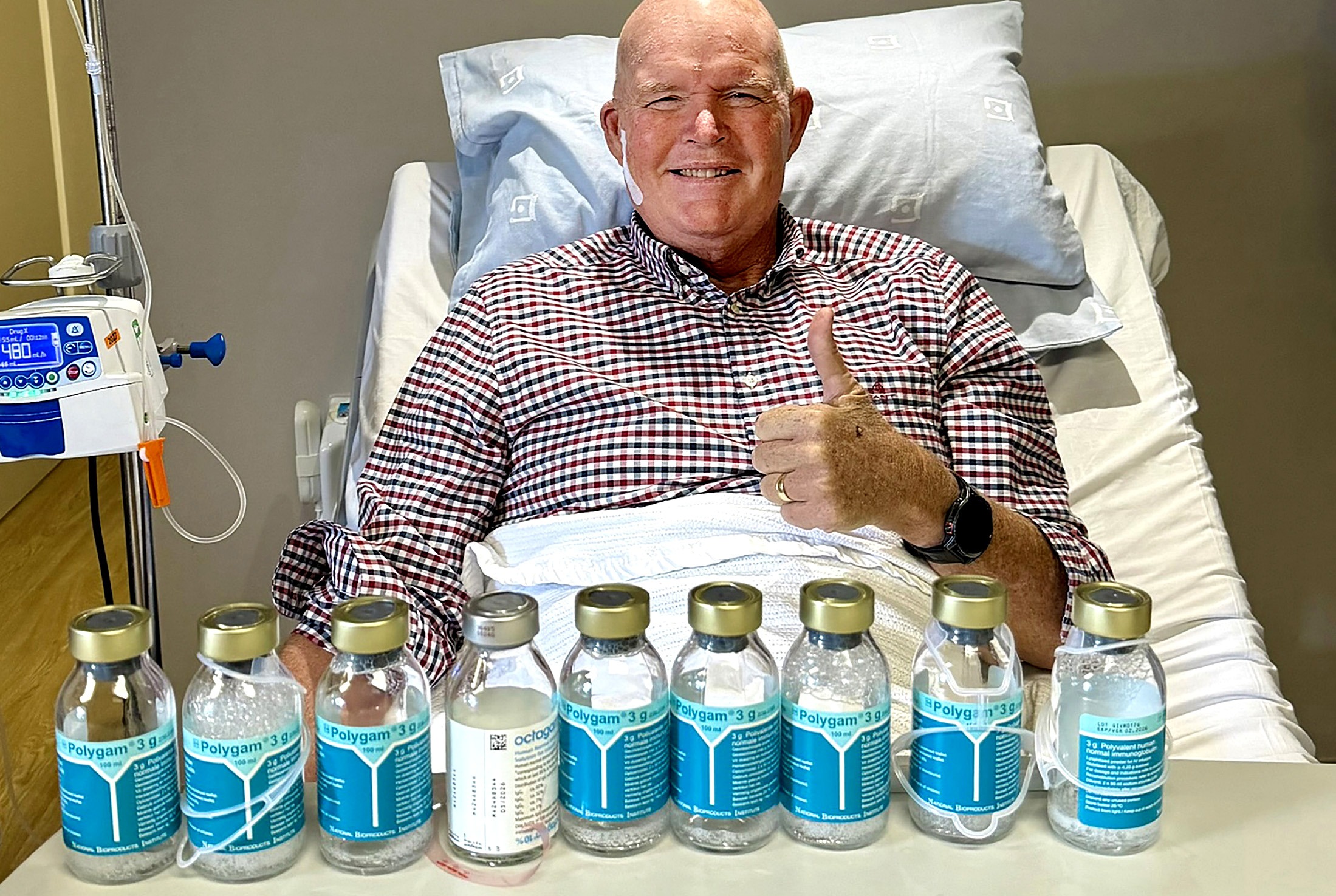
 Oscar Chalupsky has been fighting cancer since 2019. He’s also fighting Discovery Health Medical Scheme to fully fund his treatment. (Photo: Supplied / Oscar Chalupsky)
 A landmark ruling is in the offing that could clear a path to compel medical schemes to revise how they pay for multiple myeloma cancer treatments that schemes have until now declined, or approved but with burdens of hefty co-payments for patients.
In this fight is 62-year-old Capetonian Oscar Chalupsky against Discovery Health Medical Scheme, the largest medical aid in the country, which has an estimated three million beneficiaries. The matter first came before the Council for Medical Schemes for adjudication in January 2024.
Chalupsky is a well-known sportsman having had a formidable sporting career. He is a 12-time Molokai Challenge surfski champion, multiple winner of the Umkomaas River Canoe Marathon and he represented South Africa in the 1992 Barcelona Olympics.
The case has centred around the funding of a cancer drug called Daratumumab (Darzalex) that Chalupsky needed as his cancer progressed. Chalupsky was diagnosed in 2019 with multiple myeloma, a blood cancer that affects plasma cells. It is classified as a prescribed minimum benefit condition under the Medical Schemes Act 1998. According to the Council for Medical Schemes, prescribed minimum benefits are a set of “essential healthcare services that all registered medical schemes are legally required to cover, regardless of the specific plan chosen. This ensures all members have access to continuous care for serious conditions.”
/file/attachments/orphans/TL_581353_219625.jpg "Oscar Chalupsky and Bafana Bafana star Doctor Khumalo during the 1999 Dusi Canoe Marathon.<br>(Photo: ©Duif du Toit/Gallo Images)")
(Photo: ©Duif du Toit/Gallo Images)
/file/attachments/orphans/TL_621520_819542.jpg "Dusi Marathon, Day 1, 21 January 1999. Doctor Khumalo and Oscar Chalupsky waved on by a local schoolboy.<br>(Photo:: © Duif du Toit / Gallo Images)")
(Photo:: © Duif du Toit / Gallo Images)
Chalupsky started his treatment in June 2020. Three years later his maintenance cancer therapy failed and he suffered recurrent relapses. Chalupsky’s doctor put him on Daratumumab because of his prior treatments and complications. He had also had melanomas (skin cancers).
While the medical scheme approved the prescription it only paid 50% of the costs, said Chalupsky. This left him having to lean on friends and family to help make up a shortfall, which he says came close to R300,000.
With the support of the NGO Campaigning for Cancer that fights to help patients get the treatment they need without ending up in financial stress or ruin, Chalupsky lodged a complaint with the Council for Medical Schemes.
His counsel argued that his treatment with the use of Daratumumab was medically justified and should have been paid in full in accordance with prescribed regulations.
Discovery argued that Chalupsky’s treatment didn’t follow their sequencing of treatment for his type of cancer, and that skipping to Daratumumab did not constitute prescribed minimum benefit treatment. The Council for Medical Schemes disagreed and ruled in favour of Chalupsky, finding that had his physician followed Discovery’s treatment protocol and used the drug listed for next use, it would have been ineffective or caused Chalupsky harm. The council also found that Daratumumab was the correct treatment choice and that it should have been paid for by the scheme in full.
/file/dailymaverick/wp-content/uploads/2022/09/Discovery-results2.jpeg "The Discovery building in Johannesburg, South Africa. (Photo: Flickr / Raphael de Kadt)")
Ruling appealed
But Discovery didn’t pay up. It appealed against the ruling – twice. This December another hearing was scheduled at the Council for Medical Schemes, but it has had to be postponed till early 2026.
The delays in finalising the case have now stretched into an almost two-year wait for Chalupsky to get his money back. As he waits he is currently a patient in a hospital in Shanghai, China, seeking advanced new treatment. It’s treatment he’s paying for out of his own pocket.
“I need Discovery to pay up the very money they should have paid to fund this next treatment that they will also not cover,” he said.
Chalupsky says he’s chosen to go public – including to his large social media following – with his fight against Discovery because he realises that there are hundreds of people who are in a similar position to the one he’s in, “but they don’t know their rights and after fighting for a long time they just lose the fight, but it’s what the schemes are counting on because fighting cancer is exhausting enough”.
/file/attachments/orphans/AiGenerated_SACancerRates_450859.jpg "(Ai Generated)")
But Chalupsky says he’s “not like other people”. He has defied the odds over and over again. He has had last rites performed and he was told at some point early in his cancer journey that he only had six months to live, but he refuses to quit.
The self-confessed fighter, who uses the hashtag #noretreatnosurrender, says he’s not backing down – not from the fight against the cancer nor from getting Discovery Health Medical Scheme to pay him back his money.
“I have had hundreds of comments on my Facebook, Instagram and LinkedIn over this case. I’m not a controversial person, but I am going to fight because there are so many people who are not as lucky as I am to have had people who have helped me to pay for treatment. And the medical aid schemes can’t keep taking people’s premiums but then not paying up when people need help,” he said.
The comments have been scathing. They include: “Discovery’s priority is profit! They don’t really care about the patients,” and: “Disgraceful action by Discovery…” and: “Discovery, why are you delaying?”
Discovery Health said in its response to Daily Maverick that: “Independent clinical advisers maintain that this treatment (Daratumumab) does not constitute prescribed minimum benefit level of care and that its appeal submissions were not duly considered. In addition, an appropriate cost-effective treatment alternative to Daratumumab is available to Mr Chalupsky.”
The scheme also maintains that it did approve the use of Daratumumab between October 2023 and May 2024, saying: “The member experienced no financial shortfall for this treatment, other than a 25% co-payment (R18,500) in December 2023 when he was on a lower plan type. Discovery Health Medical Scheme funded 75% of the cost of Daratumumab with the remaining 25% funded through a third-party co-payment support programme. There have been no claims for Daratumumab since May 2024.”
Discovery says that in total the scheme has funded R3-million to Chalupsky’s cancer treatment, R1-million of was which was for Daratumumab in the eight months between October 2023 to May 2024.
/file/attachments/orphans/Photo21_311147.jpg "A lifetime athlete and champion sportsman, Oscar Chalupsky says the will to win has kept him fighting hard to beat his cancer. (Photo: Supplied / Oscar Chalupsky)")
Discovery responds
Discovery was asked to respond to questions about how it was reforming its funding models to ensure it was robust enough and adaptive enough for the coming cancer tsunami. Also, what work it did to ensure that people understood fully what they got for their premiums and memberships. For instance, even its top plans only have oncology benefits of just R500,000 a year. For cancer treatments this can fall short by woeful margins.
Discovery said it needed another working week beyond deadline to answer more comprehensively, but did forward links to its policy sales brochures.
/file/attachments/orphans/2025-12-1520_27_03-Greenshot_994917.jpg "(Source: SA Journal of Oncology)")
/file/attachments/orphans/2025-12-1520_28_31-Greenshot_192165.jpg "(Source: SA Journal of Oncology)")
The sobering truth is that a cancer crisis is coming. According to a study by actuaries and public health experts and actuaries at the Universities of Cape Town and Witwatersrand, breast, cervical, prostate, lung, haematological and paediatric cancers are on the rise in South Africa. Their forecasts are that by 2030 there will be 121,000 incidents of cancer compared with 62,000 in 2019.
At the same time the encouraging news is that cancer medicines and treatments have advanced. They are able to extend survival and preserve quality of life, but many of these interventions come at huge price tags.
Lauren Pretorius from Campaigning for Cancer says that knowing this reality should be a wake-up call for medical schemes to revise their funding models. It should, she said, be about aligning their funding models with the demands, realities and costs of paying for modern patient care – not simply refusing payments or shifting financial responsibility to their members.
“This case has also shown the need for medical schemes to show how they have come to the funding decisions. Patients deserve transparency and accountability to know what they get for the contributions they pay for every month, even as their premiums keep going up.
“Corporate principles and policies are killing people,” she said.
Pretorius added that decision-making on funding treatment needed to factor in the merits and specifics of individual cases; the impact on society when cancer patients were supported to live fuller lives; and that it should be benchmarked with the most up to date treatments around the world.
As Chalupsky and Campaign for Cancer wait a little longer they said the case should be a turning point. It was raising awareness that cancer patients should have a clear idea of what they should be getting from their schemes. It was also the time for medical schemes to turn their attention to smarter funding that kept them in business in the long run without penalising their members. DM