




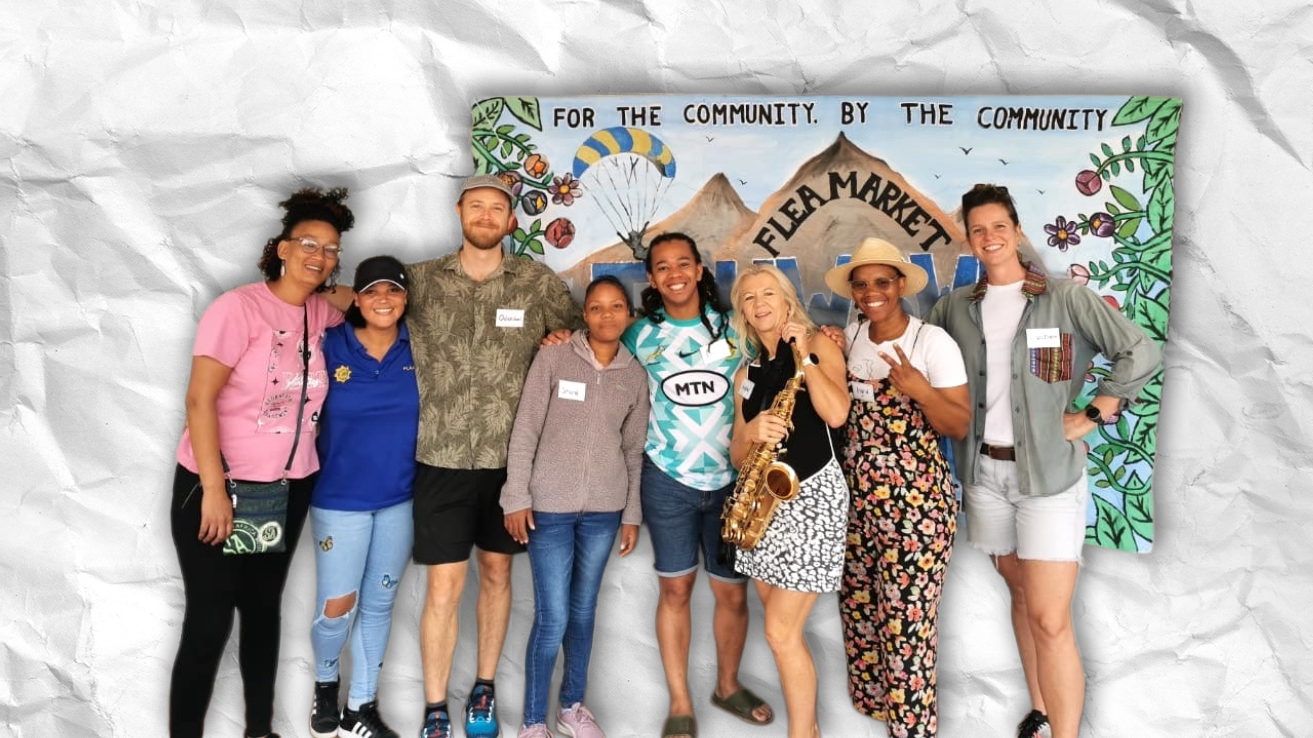
 Expensive national dialogues often lack genuine engagement, while grassroots approaches can offer a more authentic and effective path to resolving issues. (Photo: Ashleigh Owen Adapted)
 /file/dailymaverick/wp-content/uploads/2025/10/label-Op-Ed.jpg)
South African President Cyril Ramaphosa’s 12 February 2026 State of the Nation Address (Sona) closed with a reference to the National Dialogue initiated by his office in 2025. This was probably intended to convey that the government wants South Africa to be an inclusive and participatory society.
Dialogue should be one of the tools used to overcome the country’s many challenges. This is perhaps even more the case now than in 1955, when the Freedom Charter was crafted through dialogue.
Dialogue is necessary to build understanding, empathy and trust, especially when there is a diversity of perspectives and beliefs. It can be messy and difficult, and doesn’t work as a once-off, performative undertaking. It is particularly important at the local level to address issues as they arise, connect citizens with the state and prevent an escalation of problems that could lead to violence or insecurity.
When based on an ethic of care, dialogue that resolves conflict and builds citizens’ capacity to solve their own problems in collaboration with one another and the state, is possible – and the results are encouraging.
Four years ago, a dialogue started across race and class lines in Hoekwil and Touwsranten, on the outskirts of George in Western Cape province. This small peri-urban community, like many others in SA, faces various social and developmental challenges. Born out of a concern about crime and violence, the Community Dialogue is convened jointly by the author and others from the community.
Experience
The approach draws on the experience of the national Violence Prevention Forum (VPF), convened by the Institute for Security Studies. Since 2015 the forum has brought together professionals from the government, non-governmental organisations, academic institutions and the private sector to collaborate and use their collective knowledge and skills to prevent violence.
The Community Dialogue first convened in August 2021 and was attended by community and South African Police Service (SAPS) members. Despite our differences in background and income levels, we examined together the problems that undermined our sense of safety.
We established values for engagement that are still being applied four years later. We have found our way through conflict and difference, overcome bullies and gatekeepers and constructively engaged local government to address practical problems. These ranged from sanitation to the need for recreational infrastructure and income generation; from heavy-handed and racist practices by a local security company to alcohol and drug abuse.
As an established, inclusive structure, the Community Dialogue provided a credible basis from which to ask for support from the municipality, Private Security Industry Regulatory Authority, SAPS and Western Cape Police Ombudsman. The shared commitment is to a healthy, safe community for all.
Some of our efforts have been successful, some not – either because an initiative ran out of steam or an idea did not align with reality. But through it all, we have kept talking, building relationships and seeking solutions. Solving local problems requires tenacity and determination, and an acceptance that there will be failures and times when nothing happens.
Every month when the Community Dialogue meets, the local SAPS sector commander gives an update on crime in the area. In January 2025, after the festive season – usually a peak time for crime and violence in SA – the community experienced an all-time low in all forms of crime in the area.
New presence of organised crime elements
However, drug dealing targeted at the youth, copper wire theft and allegations of police corruption have recently increased, raising concerns about a new presence of organised crime elements in the community.
Copper plumbing connections are being stolen from houses, and old telephone poles and new electricity poles are being torn down at night. Their wires yield copper when the thick black plastic coating is burnt off. The daytime air in some parts of Hoekwil and Touwsranten is thick with the toxic smell of burning plastic.
We don’t yet know how to solve these problems, but the community has a forum to raise concerns with trusted police members. We have experience in mobilising local government, and we know we can work together.
This brings hope and enables agency, and is only possible because we slowly and patiently built the trust necessary to overcome differences. This is the basis of resilience and active citizenry – and represents the kind of dialogue SA needs.
This approach is likely to be far more beneficial than large, expensive, once-off, performative national dialogues that cost the state and citizens millions of rand, and where there is little real listening and a lot of posturing. Effective dialogue requires hearing different views, experiences and beliefs. This takes time.
The National Dialogue referred to by Ramaphosa could consider lessons from the Community Dialogue. Launched with much fanfare in mid-2025, the national process aims to “reimagine our future and forge a new social compact for our country’s development” through a “citizen-led” process. But the Presidency’s lead role in establishing its complex infrastructure, along with the high cost, have tainted the dialogue with questions of legitimacy and trust.
Sona presented a good vision for the future. But this can only be achieved if the state’s current weakness is countered by active citizenry supported by meaningful dialogue. For a national dialogue to work and build trust, it should have roots in local communities, be led by credible non-partisan conveners, be skilfully facilitated and be given time. DM
Chandré Gould is a Senior Research Fellow, Justice and Violence Prevention, Institute for Security Studies (ISS).
First published by ISS Today.