




 British American Tobacco South Africa in Cape Town, South Africa. The company has blamed the illicit trade in cigarettes in the country for its exit from local manufacturing, but the reality is more complex. (Photo: Gallo Images / Ziyaad Douglas)
 British American Tobacco (BAT) is currently executing two very different strategies that, when viewed together, tell a cynical story of global capital optimisation.
In South Africa, the company is cutting muscle. Most recently, BAT announced the closure of its historic Heidelberg manufacturing plant later this year, slashing 230 people from its local workforce.
Daily Maverick has it on good authority that the company also cut a number of sales positions towards the end of last year.
These are all signs pointing to BAT transitioning from a committed local manufacturer to a lean importer.
Read more: British American Tobacco stubs Heidelberg plant as illicit smokes snuff 230 jobs
While South African workers face the grim reality of retrenchment, the company’s global treasury is operating with an entirely different set of priorities. On Monday, 19 January 2026, the company announced the continuation of its aggressive share buyback programme, purchasing 138,086 of its own shares on Friday, 16 January at prices reaching up to £43.86 (about R965 at that day’s exchange rate) per share.
BAT is offloading the social and industrial cost of a tough market in South Africa while simultaneously using its vast cash reserves to reward global shareholders and boost its earnings per share (EPS).
What workers saw coming
A former BAT employee who worked at the company for more than a decade and agreed to speak to Daily Maverick on the condition of anonymity, described a workforce that had long anticipated the outcome of the Heidelberg closure.
According to the source, the dominant sentiment was not anger at the company but frustration with the sustained state failure to contain the illicit cigarette trade.
Even though the former Western Cape employee was one of many retrenched from BAT late last year, they described the news of the Heidelberg closure as “a shock”, and added: “I’ve got no ill feelings towards BAT, it is one of those things.”
/file/attachments/2987/Threatstothecigaretteindustry_734050.png "Graphic: Kara le Roux")
According to the source, the tobacco manufacturing sector had been shrinking steadily, with repeated restructurings in the company becoming normalised.
“It’s not a personal attack on anybody,” the source said. “It’s just a matter of role redundancies.”
Johnny Moloto, area head of corporate and regulatory affairs for BAT Sub-Saharan Africa, told Daily Maverick that the company could not discuss specific severance or retention package details publicly while the consultation process was ongoing.
“What we can say is that we’re committed to fair and comprehensive packages that meet all legal requirements,” Moloto said.
A managed decline
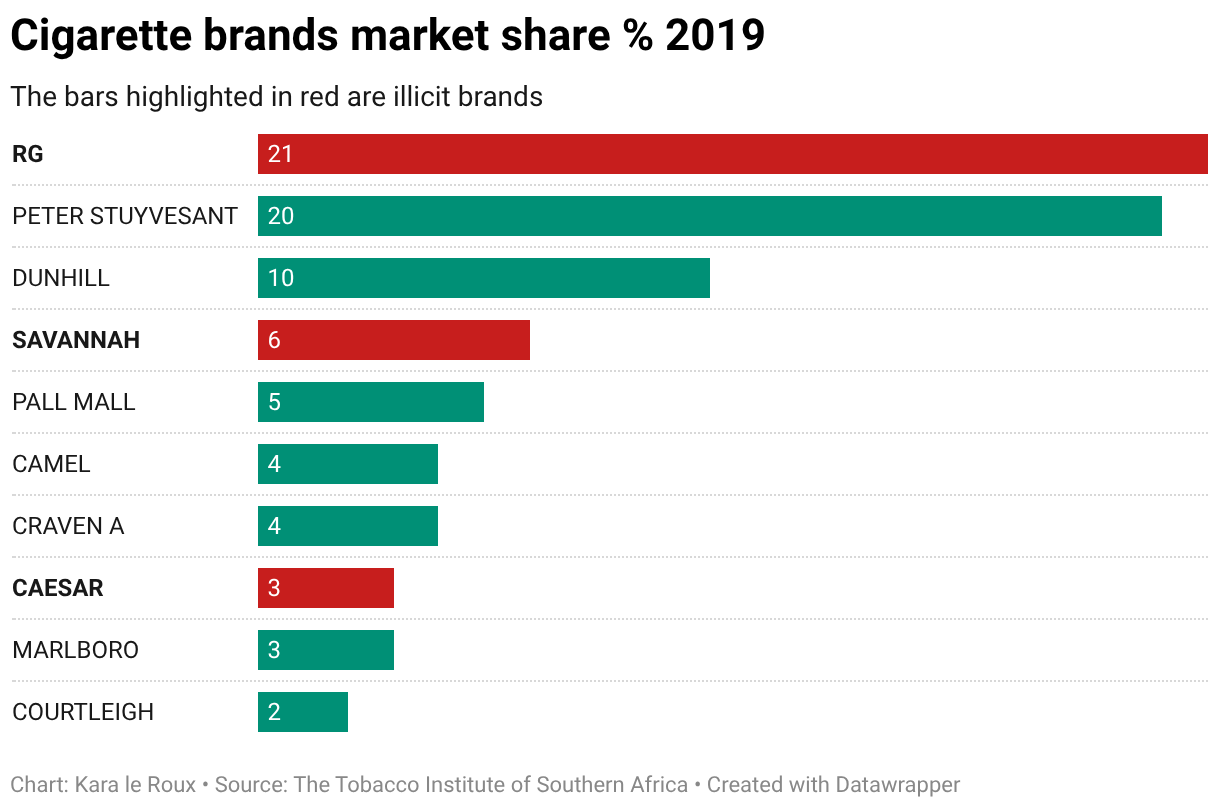
BAT has pointed to the illicit cigarette trade – which it estimates now controls 75% of the South African market – as the primary driver of its retreat.
Finance Minister Enoch Godongwana corroborated the severity of the crisis in his November 2025 Medium Term Budget Policy Statement, noting that the state had lost R40-billion in excise revenue since 2020 as a result of the cigarette black market.
Read more: Alcohol and cigarettes in the 2025 Budget — anchor policy in data, not industry spin
“[People will] pay R8 for a packet of cheapies (cheap, illicit cigarettes) instead of paying R30 for something that is legit,” the former employee said.
/file/attachments/2987/export_649925.jpeg "Graph: Tobacco Control Data Initiative (TCDI)")
While the illicit market is a genuine headwind, BAT’s response suggests it has characterised South Africa as a market in managed decline rather than a priority worth defending with capital expenditure.
Closing Heidelberg strips away the heavy overhead and labour demands of local production. This retreat, coupled with a decimated sales force, allows the company to pivot toward a high-margin, low-friction import model.
Ultimately, the cash saved from South African retrenchments and plant closures feeds the global pot used for dividends and buybacks.
Shareholder first mandate
By exiting or slimming down in high-risk, low-margin jurisdictions like South Africa, BAT maintains its group margins and keeps institutional investors happy.
Its Stock Exchange News Service announcement confirmed that BAT remains a cash-generating machine. By purchasing and cancelling more than 138,000 shares in a single day, the company is engaging in classic financial engineering to support its share price.
BAT closed at R926.50 yesterday afternoon, having gained 10.28% over three months and climbing 43.04% over a year.
/file/attachments/2987/Gemini_Generated_Image_euaqwveuaqwveuaq_608615.png "Graphic: Neesa Moodley. Source: Sharedata. Created with: Nano Banana Pro")
From a South African perspective, this lands as a textbook case of a multinational prioritising its global balance sheet over its host economy. While 230 factory workers in Heidelberg face an uncertain future and upstream suppliers lose a cornerstone client, the company is visibly spending billions globally on financial clean-up.
Regulation and enforcement
“The real culprit, honestly, in this whole thing is the government,” the former BAT employee said. “They’ve done nothing to help fight illicit trade. I’ve seen it happening, getting worse and worse and worse.”
Godongwana said the SA Revenue Service recently suspended three tobacco manufacturing licences for non-compliance and was using Financial Intelligence Centre data to target syndicates.
At the same time, the sector faces stricter regulation. The Tobacco Products and Electronic Delivery Systems Control Bill, tabled in Parliament in December 2022 and currently before the National Assembly, aims to repeal the 1993 Tobacco Products Control Act and align South African law with the World Health Organization’s Framework Convention on Tobacco Control.
Read more: After the Bell: The new tobacco legislation is a burning issue
The bill proposes plain packaging, graphic health warnings covering at least 65% of packaging, a ban on point-of-sale displays, a prohibition on indoor smoking without designated areas, restrictions on vaping products and a ban on cigarette vending machines.
Read more: If your cigarette box isn’t disgusting, it’s not doing its job
The tobacco industry has argued in submissions to Parliament that measures such as plain packaging could further fuel illicit trade by making products harder to distinguish, pushing consumers towards cheaper illegal alternatives.
“Cigarettes will always be there. You won’t get rid of cigarettes,” the former BAT employee said. “But unless something is done, really harshly, it’s (illicit trade) going to continue.”
The ‘S’ in ESG
With local manufacturing ending, BAT said that prices would not rise as a result of the shift to imports.
“We are very aware of the stretch on consumers in South Africa and we have no plans to increase prices as a result of this supply model change,” Moloto said.
The company has also resisted the idea that it is abandoning South Africa entirely. Moloto told Daily Maverick that the viability of restarting production would depend on a sustained reversal of current market conditions.
The transition from a manufacturer to an importer represents a permanent loss of industrial capacity and tax base for South Africa. As BAT continues to spend billions on share buybacks in London, it is becoming evident that the company no longer views South Africa as a market for expansion, but a problem to be managed with as little local investment as possible. DM