




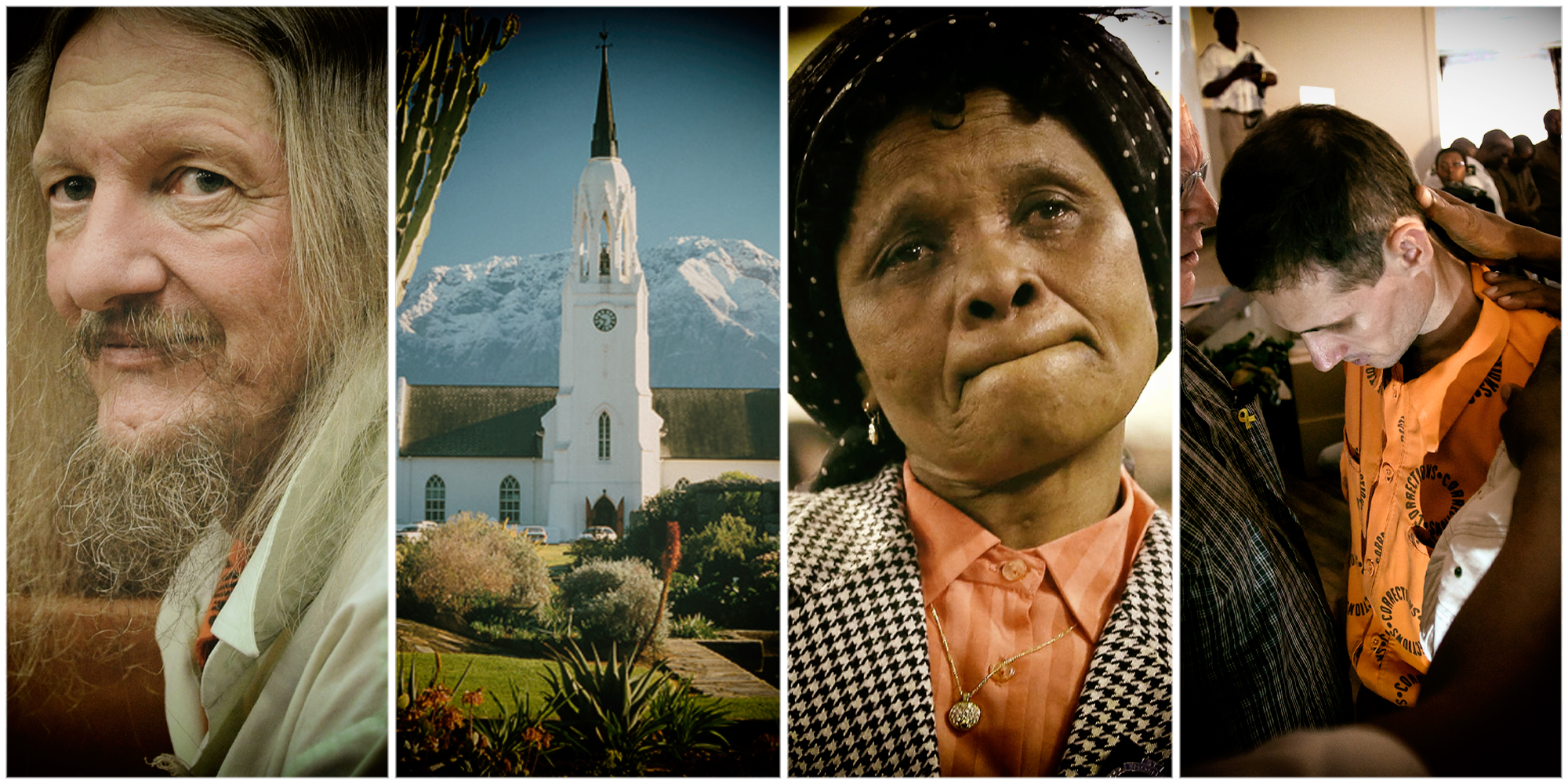
 From left: Convicted Worcester bomber Cliffie Barnard in 2012. (Photo: Gallo Images / Foto24 / Deon Ferreira) | The Dutch Reformed Church in Worcester. | One of the 1996 Worcester Shoprite bombing survivors, Olga Macingwane, in 2015. (Photo: Gallo Images / Sunday Times / Esa Alexander) | Former right-winger Stefaans Coetzee meets victims of the 1996 Worcester bomb blast at the Pretoria Central Prison on 31 January 2013. (Photo: Gallo Images / The Times / Daniel Born)
 /file/dailymaverick/wp-content/uploads/2025/10/label-Op-Ed.jpg)
On Christmas Eve 1996, a bomb exploded at a Shoprite in Worcester. Four people were killed, two of them children, and dozens were injured.
The attack was deliberate. It was designed to kill black and coloured shoppers. It was carried out by four young men shaped by far-right extremism and a distorted theology that cast democracy as betrayal and people of colour as enemies.
For the country, it became another entry in the violent archive of the 1990s.
For survivors, it never became history.
This year marks 30 years since that explosion.
Years later, one of the perpetrators, Stefaans Coetzee, asked from prison to meet the victims.
Most declined.
One person said yes.
Olga Macingwane, who was injured in the blast, agreed to meet him at a correctional facility in Pretoria. That decision altered the moral trajectory of a town.
The courage that shifted the story
Olga did not go because she felt forgiving. She went because she wanted answers.
Trauma leaves unfinished questions lodged in the body:
Why us?
Did you know there were children?
What did you believe about us?
In prison, she encountered acknowledgement without excuse. Stefaans admitted his racism. He admitted hatred. He admitted that the bomb was intended to kill people of colour.
And he was remorseful.
Remorse matters. It is the hinge between truth and reconciliation. Without it, apology is strategy. With it, apology becomes exposure.
Olga returned to Worcester and reported honestly what she had witnessed. Only then did other survivors begin to consider meeting him.
Reconciliation in Worcester did not begin with consensus. It began with one survivor’s bravery and her refusal to sentimentalise what she had seen.
That encounter became the catalyst for what we later called the Worcester Hope and Reconciliation Process.
The Peace Train and the mirror
With the support of the Khulumani Support Group and the Department of Correctional Services, survivors travelled on what became known as the Peace Train to Pretoria, a structured victim-offender dialogue rooted in survivor dignity rather than spectacle.
Khulumani had long warned that reconciliation without reparations becomes hollow. Their presence ensured that this was not theatre.
For many survivors, boarding that train was as difficult as the prison meeting itself. They were not seeking comfort. They were seeking truth.
The answers were blunt. The intention had been racial terror.
Forgiveness did not descend like a miracle. Some felt empathy. Others felt anger intensify. Some felt both.
Later, Stefaans apologised publicly before nearly 2,000 residents in Worcester.
That apology did more than close a chapter.
It held up a mirror.
If one man could say, “I was racist. I was wrong. I caused harm”, what did that require of the rest of us?
Not equally guilty but differently responsible.
When reconciliation moved from emotion to economics
The Worcester Hope and Reconciliation Process brought together white business leaders, black and coloured activists, clergy, educators, municipal officials and NGOs.
We moved from apology into harder conversations: unemployment, housing, education, substance abuse. The structural wounds of the town.
For a moment, something shifted.
We began exploring whether Worcester could become a prototype, a community-led restitution model. If the bombing was a condensed metaphor of South Africa’s history, could the town respond by modelling shared responsibility?
We discussed voluntary economic contributions. Targeted development funds. A civic compact in which those with accumulated advantage would invest intentionally in repair.
The energy was real.
But when reconciliation moved from vulnerability to material consequence, the mood changed.
Enthusiasm thinned. Leadership shifted. Business grew cautious. Politics resumed its rhythms. Civil society fatigue set in.
No one renounced reconciliation.
People simply returned to ordinary life.
And that quiet retreat proved decisive.
The national parallel
What happened in Worcester was not unique.
After the Truth and Reconciliation Commission concluded its work there were attempts to translate moral acknowledgement into material repair. One initiative invited white South Africans to sign a declaration acknowledging that they had benefited from apartheid and to contribute financially and with skills to a restitution fund.
The response was minimal.
Only a small fraction of white citizens participated. Political parties criticised the initiative as divisive. Many rejected the idea that reconciliation required financial obligation.
The TRC itself had recommended broader reparative measures, including possible wealth contributions from those who had benefited structurally from apartheid. Those proposals never gained traction.
Instead, reparations were reduced to modest state payments far below the commission’s recommendations. The deeper architecture of inequality remained intact.
In other words: we accepted apology.
We resisted cost.
What I learnt
I gave about seven years of my life to the Worcester Hope and Reconciliation Process.
For a long time, it felt wasted.
I believed that if you followed the moral sequence carefully, acknowledgement, responsibility, truth-telling, remorse, apology, restitution and reconciliation would follow.
It did not.
But those years were clarifying.
Reconciliation is not defeated by anger.
It is defeated by avoidance.
It collapses not because truth is spoken, but because truth becomes expensive.
And perhaps the deeper insight is this: reconciliation cannot be the goal. It is a by-product. Like happiness, it emerges when justice, accountability and repair are taken seriously. When those conditions are absent, the word becomes hollow.
Why the word now feels like a swearword
More than three decades after democracy, “reconciliation” is a contested term.
For many black South Africans, it sounds like emotional labour without economic repair.
For many white South Africans, it became a completed chapter rather than an ongoing responsibility.
For political elites, it became rhetoric.
For business leaders, it felt safer than redistribution.
We romanticised reconciliation without asking what it would cost to make it real materially, structurally and economically.
What South Africa achieved in 1994 was largely negative peace, the absence of civil war. The deeper inequalities that apartheid engineered were never fundamentally restructured.
We asked victims to reconcile before we transformed the system that harmed them.
Thirty years later: what would responsibility look like?
Reconciliation is not emotional closure.
It is accountability embodied.
If we are serious about redeeming the word, responsibility must become concrete.
It could mean voluntary wealth contributions into transparent local development funds.
It could mean targeted educational endowments in historically disadvantaged communities.
It could mean business equity restructuring beyond compliance optics.
It could mean sustained investment in township infrastructure and youth employment pathways.
It could mean acknowledging that inherited advantage carries present obligation.
Not as punishment.
As responsibility.
The Worcester bombing was meant to kill black people.
Thirty years later, one perpetrator showed remorse. Survivors showed courage. A town glimpsed possibility.
The apology was real.
The vulnerability was real.
The remorse was real.
What has remained fragile locally and nationally is the sustained willingness of those with power and privilege to absorb the discomfort of structural repair.
Worcester held up a mirror.
The question, 30 years on, is no longer whether reconciliation is beautiful.
It is whether we are finally willing to make it costly. DM
Deon Snyman is the MD of the Goedgedacht Trust, a rural development organisation in the Western Cape. He holds a PhD in Old Testament, an MA in ancient languages and an MPhil in political studies and has worked for more than two decades at the intersection of social justice, community development and leadership formation, with a focus on children, youth and families in vulnerable communities.