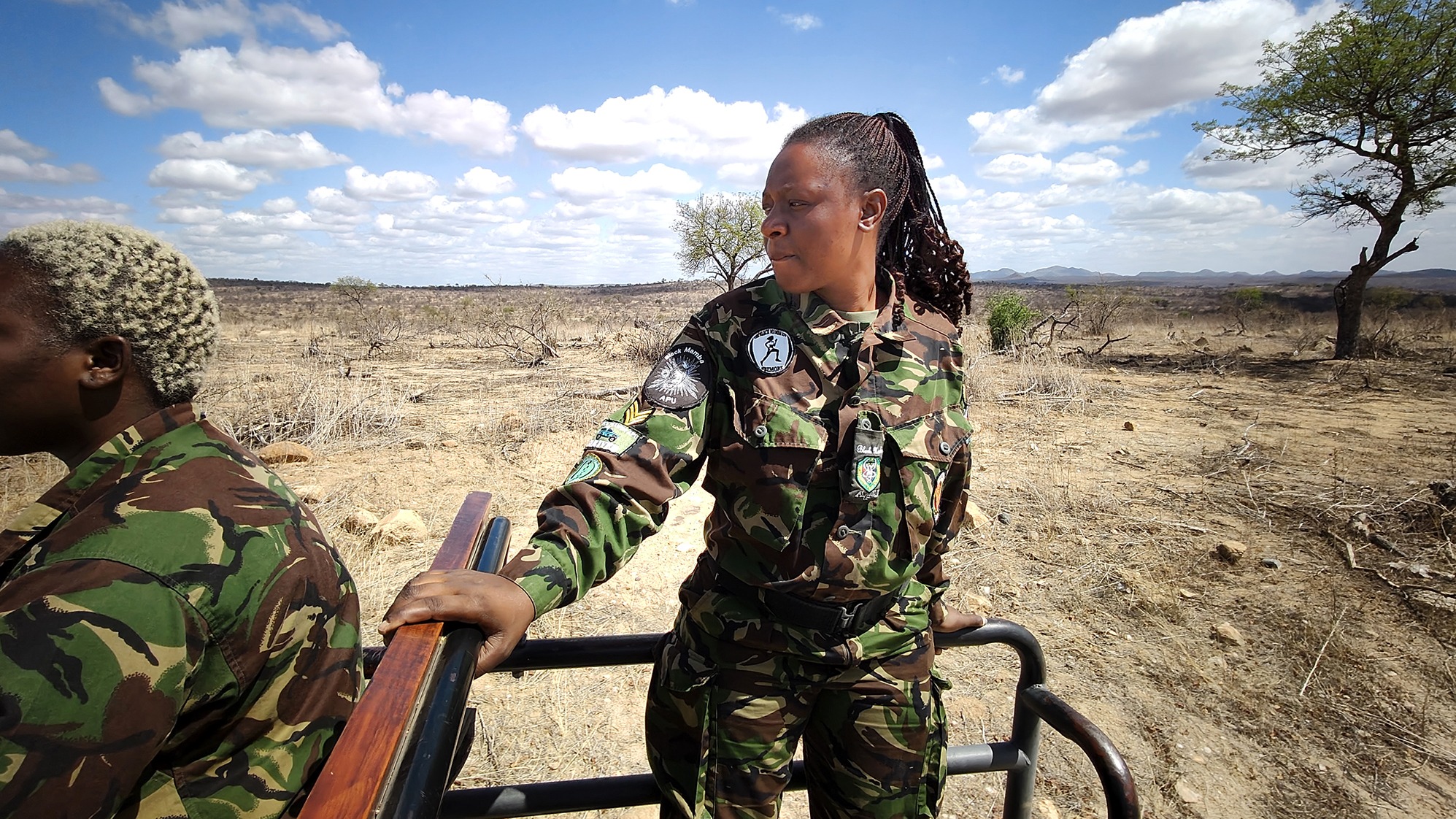
 Nkateko Mzimba and her team on patrol. (Photo: Kemunto Ogutu)
 We sit on the porch of the rangers’ house, watching the sun slipping into the low hills, painting them gold and then rust. The branches of a tall, uneven mopane hold the evening light like a secret.
For the past two evenings in Olifants West, a private reserve on the western edge of the Kruger National Park, a giraffe has wandered in at about this hour, stretching its neck into the same canopy. Tonight, it doesn’t come. Instead, there’s a faint splash from the direction of the Olifants River ahead of us.
“Crocodiles,” Nkateko says, smiling. “They play when it’s cooler.”
Her voice is soft, like she’s half speaking to the bush itself. Around us, the day is folding into night, the air cooling, the crickets taking over. It’s the kind of quiet that lets you hear yourself think.
It’s then that I finally get to talk to her – Nkateko Mzimba, ranger, teacher, and one of the women who call themselves Black Mambas. The day has been taxing with patrols and other tasks.
Growing pressures
Poaching remains among the biggest threats to conservation in South Africa, with endangered species, notably rhinos, hit hard. In May 2025, Dr Dion George, the then environment minister, revealed that in the first quarter of the year alone the country lost 103 rhinos to poaching, mostly in Kruger and surrounding reserves.
The poaching death toll was in line with last year’s 420 rhinos killed, said the minister, calling for urgent, intensified efforts to curb poaching.
Unarmed protectors
The fight against poaching has taken many forms in South Africa, with armed rangers “waging war” being a central thrust to a strategy that some critics charge is overly militarised and risks deepening the divide between the people living near protected areas and conservation efforts.
A desire to help bridge this divide led to the formation of the Black Mambas, an all-women anti-poaching unit, whose 36 rangers operate in Greater Kruger – a network of privately managed conservation areas that share unfenced borders with the national park.
Unlike many ranger units, they patrol unarmed. It’s a deliberate choice meant to build trust with local communities and favours collaboration over confrontation. Their work has been credited with reducing snaring and poaching in the region while offering women new roles in frontline conservation.
Nkateko has been doing this for years. “We wake up early,” she says, “and check the fences. If there’s a hole or a wire cut, we fix it. Sometimes animals get trapped there. We release them. At night, we patrol again, with only a torch and our radios for communication. No guns. Just us.”
She speaks of it not as danger, but as duty. There’s pride in her tone, a calm assurance that this is where she’s meant to be.
“We protect the animals,” Nkateko said, “but we also protect our future. Because when these animals are gone, the jobs are gone. The tourism is gone. Everything is gone.”
But the pressures rangers face go far beyond long patrols and the risk of encountering poachers.
Nkateko knows these pressures well. Low pay often leaves rangers exposed to bribes, and sometimes corruption comes from within the system.
“If someone comes with R50,000, a ranger under financial strain could be tempted. But accepting it only increases poaching,” she says.
“But if we stand together for the voiceless animals, no one can corrupt us.”
Better pay is part of the solution too. “Some rangers earn so little it doesn’t help their families. But we have to fight for better pay, so we can keep working and protecting wildlife.”
Deadly risks
Nkateko’s uncle, Anton Mzimba, spent more than 25 years on the front line protecting rhinos and other wildlife at Timbavati Private Nature Reserve in Greater Kruger. He was known for his courage and integrity; a ranger who refused to bend to threats or bribes. In July 2022, he was gunned down in his compound in front of his family.
None of his murderers has been brought to book, and the killing cast a long shadow over the family.
“I don’t like talking about it or even thinking about it,” Nkateko says. “The fact that it happened in his own compound still chills me. I find myself thinking it could happen to any of us. Rather than dwell on this fear, I avoid such thoughts completely.”
Home in Hluvukani
The Olifants West reserve is in Limpopo. It’s an hour-and-a-half drive from Nkateko’s home in Hluvukani, a village about 30km from Kruger’s western boundary, in neighbouring Mpumalanga. Like many people who are passionate about what they do, she takes her work home, but not in the typical laptop-under-your-arm, reports-in-a-file way. She volunteers at her local crèche, teaching young children the importance of conservation.
The home, which Nkateko built for her mother with money saved while working as a conservation trainer in Saudi Arabia two years ago, is a few blocks from the main road. Women shout Tsonga salutations from their porches and compounds as we pass by. Nkateko, no stranger here, replies jovially. Her mother, Betty Mzimba, is beside herself with joy when we arrive, as is her youngest sister, Ruwenzo.
Mzimba Snr tells me of her pride in having two daughters in the Black Mambas, Nkateko and Nocry. She fears for their safety, however, she says. “I always put them in prayers so that God can protect them wherever they are working.” The bush, she acknowledges, is not the safest place for them. “They are women, not men.”
I meet Portia Mathebula, a neighbour and mother of four whose children have all passed through the nearby Mbuwetelo Crèche, where Nkateko volunteers. Mathebula holds her eight-month-old child as we talk, the morning heat already pressing down.
“She helps us a lot,” Mathebula says. “With food, with clothes. She keeps our children busy, sometimes she even takes them on trips. They learn so much from her.”
For many families living near Kruger, the park still feels like another world. Few can spare the cash for an entry ticket. A recent study found that nearly three-quarters of people in neighbouring communities had never set foot inside Kruger. Those with relatives working in the park tended to view it more positively, but others spoke of lost crops, broken fences and wild animals straying too close to home.
Conservationists say that this disconnect makes it harder to curb poaching.
/file/attachments/orphans/WhileSouthAfricaishometosomeoftheworldsrichestwildlifemanycommunitiesnearparkshaveneverseentheseanimalsPhoto_KemuntoOgutu_598306.jpg "While South Africa is home to some of the world’s richest wildlife, many communities near parks have never seen these animals. (Photo: Kemunto Ogutu)")
It is much the same in Hluvukani. “I’ve never been there myself,” Mathebula admits, “but my children have, because of Nkateko.” She smiles, remembering. “They went to Skukuza, inside Kruger. It was their first game drive. They came back telling us about lions and elephants, things they’d never seen before.”
For her, the crèche has been a lifeline. “If a child stays home, maybe he breaks a leg or plays with fire,” she says. “At the crèche, they’re safe. They learn to talk, to read. They’re not shy anymore. They’re active, ready for school.”
Life in Hluvukani is tough. “There’s no work,” says Mathebula, “poverty is high”. In the first quarter of this year, Statistics South Africa reported that unemployment in Mpumalanga stood at 35.4%, compared with the national average of 32.9%.
She wishes Nkateko could create some small jobs at the crèche for women like her – “we’re just sitting” – but is grateful for the help the ranger brings.
Sometimes, Nkateko calls out of the blue. We have something for you. “Then she comes and gives us food,” she says. “She never comes empty handed.”
When I ask what difference Nkateko has made to their lives, Mathebula doesn’t think for long. “She brought us light,” she says quietly. “Before, we didn’t know much about animals. Now our children come home teaching us about conservation. Even we parents, we’re learning through them.”
Nkateko’s work has changed how people in Hluvukani see Kruger. “It’s an opportunity,” says Mathebula. “People know the animals now. They respect them. Some even get work there. She’s done more than we ever expected.”
Fences and distance
Eksoda Mazumbuko, a volunteer at Nkateko’s foundation, helps run the children’s camps when Nkateko is away, teaching conservation. The village appears to be far from Kruger; why the need to bang the conservation drum? Mazumbuko tells me it’s not far for people who know the bush. “The poachers can walk from here to Kruger.
“There are a lot of people here who still don’t understand why it matters,” says Mazumbuko. “Some of them even used to hunt. But now, when the children come back from the camps, they talk about what they’ve seen. They even teach their parents. That’s how we change, slowly.”
/file/attachments/orphans/NkatekoMzimbaandEksodaMazumbukoworktogethertoteachchildreninHluvukaniabouttheimportanceofconservationPhoto_KemuntoOgutu_627946.jpg "Eksoda Mazumbuko and Nkateko Mzimba work together, teaching children in Hluvukani about the importance of conservation. (Photo: Kemunto Ogutu)")
Mazumbuko has witnessed the joy their trips bring to children, their families and even himself. It was during one such trip that he first touched an elephant. “I never imagined myself touching such a big animal. I was scared. Even a lot of kids were scared too, but when we saw the others touching it, we all wanted to see and experience it,” he said.
Nkateko hopes to expand her initiative. For now, she funds it from her own salary, but her goal is to scale up and find the support she needs.
Funding remains a constant challenge and registering as a fully fledged organisation has also proven difficult. “Few share my vision,” she admits. “Especially when it doesn’t come with immediate monetary value.”
Nkateko takes me to a piece of land where she hopes to build a crèche. She bought the plot two years ago, but save for a lone tree and two brick rooms with one of the walls already collapsing, her plans are yet to align. Still, she is hopeful.
/file/attachments/orphans/NkatekoMzimbahopestobuildherowncrcheonthislandPhoto_KemuntoOgutu_522941.jpg "Nkateko Mzimba hopes to build her own crèche on this land. (Photo: Kemunto Ogutu)
<br>")
“Building my own crèche would give me a chance to scale up my foundation,” she says. “To do more work than I can while under another crèche.
Beyond the fence
Meanwhile, she volunteers at Mbuwetelo Crèche, three minutes from her home. We walk there. Dust rises in our steps. A yellow wall comes into view. At its top, the name of the crèche is written in even letters; below it, an incomplete school badge in shades of grey, blue and white. On both ends of the wall Mickey Mouse smiles down at the children.
Behind the classrooms, five mango trees stand in a neat row, their shade a relief from Hluvukani’s heavy summer heat.
At the gate, Nkateko smiles. “Here is where I started as a child,” she says. “This was my crèche.”
Inside, we meet Patience Ndlovu, the centre manager. She moves easily among the children, pausing to watch a group tracing animals in colour. She oversees everything – lessons, meals, play. The crèche serves about 120 children, aged nought to five.
“Nkateko has been with us for quite a while now,” says Ndlovu. “She teaches the children about conservation. The Big Five, the rhino, all the endangered animals.”
It is at crèches where children take their first real steps into learning, she explains: tracing letters, singing numbers and discovering language. It’s why South Africa is pushing to make Grade R compulsory, and in many communities it’s small, often underfunded crèches like Mbuwetelo that are making the difference.
/file/attachments/orphans/NkatekoMzimbaandPatienceNdlovuinteractwithchildrenatMbuweteloCrche_336830.jpg "Nkateko Mzimba and Mbuwetelo Crèche manager Patience Ndlovu join children at the crèche as they sing songs about the Big Five.
<br>(Photo: Kemunto Ogutu)")
(Photo: Kemunto Ogutu)
Ndlovu says the lessons have changed how the children see the world. “Even when Nkateko isn’t here, we keep teaching. We already know everything we need to know about the Big Five.”
Later, we met Agreement Mujovo. She went to school with Nkateko and lives near her mother’s home. She speaks to me in English, punctuated with a bit of Tsonga.
She has never been inside Kruger itself, though she has visited Orpen Gate, an entrance to the park’s central region, where locals, if lucky, can catch a glimpse of elephants foraging in the distance. “I’ve been to the gate, not inside,” she says.
Her children, however, thanks to Nkateko’s foundation, have seen the animals up close. Mujovo says they were enraptured. We speak briefly, light banter. It was lunchtime, and one of her sons was eating. I asked what it was, curious because the area is known for game meat. “It’s just beef,” she says.
I press further. How does she feel about game hunting for the table? Mujovo says while she enjoys game meat, she values conservation. “The meat is good,” she says. “However, if we keep hunting it, it will finish.”
Bushmeat
Across much of rural southern Africa, bushmeat has long been part of daily life. It’s a source of protein and income where options are few. But what was once subsistence hunting has, in many places, grown into a commercial trade, putting pressure on already vulnerable wildlife.
Conservationists warn that the unregulated bushmeat market threatens to undo years of progress in species recovery. Still, for many families living near game reserves, hunting remains tied to culture and survival, leaving a delicate balance between need and protection.
It is an issue Nkateko faces daily. She knows a bushmeat poacher could be someone desperate from a neighbouring family. She often thinks of Chico Khoza, a 45-year-old Mozambican her team caught hiding in thick grass outside the boundary of Grietjie Private Nature Reserve in September 2021. Nearby were two bags of bushmeat, a saw and a kitchen knife.
Apprehended and handcuffed, Khoza pleaded for release.
“He said he knew poaching was wrong, but he had no choice – a four-month-old baby depended on him,” Nkateko recalls.
Despite being caught red-handed, the legal consequences were minimal. Through his attorney, Khoza later denied knowledge of the bags, and a spokesperson for the National Prosecuting Authority, Mashudu Malabi-Dzhangi, said his field confession would not stand up in court. So, he was never charged for possession of bushmeat. He walked away with only a suspended fine for trespassing and being an illegal immigrant.
“There is nothing we can do,” Nkateko reflects. “It was not the police who caught him – we rangers do our job”.
These grey areas – the intersection of poverty, crime and conservation – drive her commitment to the crèche and her foundation. Fences and patrols alone cannot protect wildlife if surrounding communities remain desperate and disconnected.

We were mid-conversation when Mujovo’s 13-year-old son, Quiet, walked into the compound from school.
He embodies his name, shy and soft-spoken. He is one of the children who have visited Kruger courtesy of Nkateko. He wants to become a ranger someday, he says, a dream that stemmed from his first experience with elephants at the park.
/file/attachments/orphans/QuietholdsanelephantstrunkatKapamaPrivateReserveduringafieldtripwiththeNkatekoFoundationPhoto_KemuntoOgutu1_959455.jpg "Quiet holds an elephant’s trunk at Kapama Private Reserve during a field trip with the Nkateko Foundation. (Photo: Supplied)")
His favourite animal, Quiet says, is the rhino, and it saddens him that they are now endangered. “I want to protect the animals for the whole community,” he says with pride, but until then, he says he does his part by sharing his knowledge with his schoolmates.
Day patrol
The patrol starts at 6am, the engine humming as we slide into the back with three other rangers. We head deep into the bush. I try to imagine what it must be like to cover these grounds on foot, looking for snares and wires. I ask if the animals scare her. Or the threat of meeting poachers. Or working with the relentless sun overhead. Nkateko smiles.
“It’s not a dangerous place,” she says. “Honestly, I’m more scared of humans than animals. The animals are in their habitat.”
Half an hour later, the vehicle slows to a stop. We jump out and begin sweeping the ground. Nkateko and her team pick up wire and debris, leaving nothing behind that might harm an animal.
On our way back from the morning patrol, something catches our eyes near the Black Mamba’s residence. “Stop!” she shouts at the driver. At first, it is not clear what is wrong. Fearless, Nkateko jumps out. “Did you see that?” she asks me. I follow her cautiously. That’s when we see it. A vulture struggling to lift itself off the ground. After two attempts, it lies in an unnatural position, foam dripping from its beak. “It looks like it has been poisoned,” she says, approaching the bird.
Within minutes, calls are made, vehicles dispatched and the vulture is whisked away to a vet. Later, we learn it survived, saved by an intravenous antidote.
I asked her why they went to such lengths for the bird. She says that in the bush all lives matter, and they create the perfect balance for the ecosystem. She confesses to being a bird fan herself, knowing the calls of many by heart.
/file/attachments/orphans/NKATEK_3_597140.jpg "Nkateko Mzimba calls for assistance after discovering a poisoned vulture. Vulture
<br>poisoning is a growing crisis in South Africa, with Kruger National Park recording more
<br>than 400 deaths this year. (Photo: Kemunto Ogutu)")
poisoning is a growing crisis in South Africa, with Kruger National Park recording more
than 400 deaths this year. (Photo: Kemunto Ogutu)
Night patrol
Night falls, and it’s time to go back on patrol. Blackness swallows the bush, with the only light from the vehicle’s headlights and our torches, we drove deeper into the night.
Suddenly, one of the rangers signalled the driver to stop. Nkateko had spotted a white rhino. She needed to log it, report its health. An endangered species, she reminded me.
Moving on, we drove for an hour-and-a-half before arriving at our next watch station, a watering hole in the near distance. “This is where most poachers are likely to wait for the animals,” Nkateko said, her voice low. “Elephants come here to drink, and the poachers know it.”
We waited in silence, listening to the night. A hyena laughed in the distance. I shivered. Nkateko only laughed.
“How do you make peace with the voices of the night?” I asked. She smiled. “I find calm in the bush.”
As we settled into the rhythm of the night, the pulse of the bush, and its watchful eyes, Nkateko shared stories of her travels. She has taught conservation around the globe, recently returning from three weeks in Laramie, Wyoming, where she educated students about protecting wildlife.
Suddenly, the sounds of elephants splashing at the watering hole and the snapping of a tree broke our conversation. I flinched.
Nkateko, unfazed, simply nods. It was good. DM
Additional reporting, Fred Kockott.
This Roving Reporters story was produced with support from the Yazi Centre for Science and Society and the Resilience Fund run by the Global Initiative Against Transnational Organised Crime.