




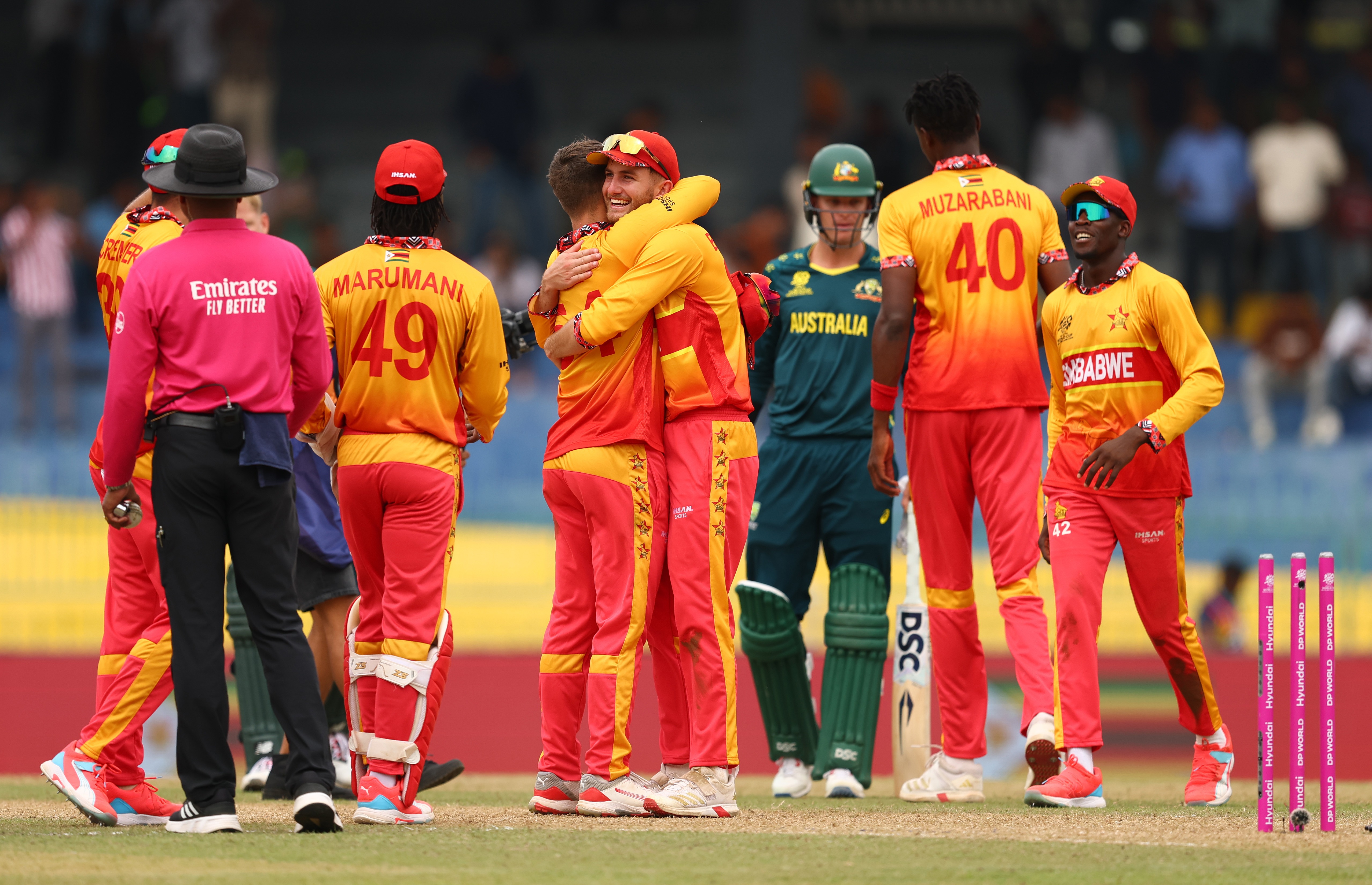
 Zimbabwe players celebrate victory over Australia at the 2026 T20 World Cup. (Photo: Robert Cianflone / Getty Images)
Five years ago, Zimbabwean left-hander Ryan Burl posted a photo on X of his worn-out shoes being held together by a clamp with a tube of glue laying beside the shoes.
Below the photo Burl tweeted: “Any chance we can get a sponsor so we don’t have to glue our shoes back after every series?”
/file/attachments/orphans/2263698050_314182.jpg "Zimbabwe’s leading batter Brian Bennett has been one of the players of the tournament at the T20 World Cup. (Photo: Nikhil Patil / Getty Images)")
Fast forward to today and Zimbabwe can celebrate a remarkable World Cup campaign: they defeated Australia and advanced to the Super Eight stage, a monumental achievement, even if they did place last.
From a near sponsorless squad to challenging some of the best teams in the world, this year’s World Cup is a testament to how far Zimbabwe have come in their cricket journey.
However, it also prompts a much bigger discussion of the shrinking gap between full members and emerging nations, and the undeniable rise of the so-called minnows on the global stage.
Unexpected upsets
From the outset, Zimbabwe came into the World Cup as a smaller participant, not expected to surpass the group stages.
That is, however, until they wrote the biggest twist in this tournament’s story and claimed victory over both highly ranked Australia and Sri Lanka.
Barring their game against Ireland that was rained out, Zimbabwe went unbeaten in the group stage, ultimately topping the table.
This caused one of the biggest upsets of the World Cup when Australia exited the tournament before the play-offs and Zimbabwe qualified for the next stage of the competition.
Despite losing all three games in the Super Eights, the qualification proved to be a sign of a nation clouded by a tumultuous cricketing history getting back up on its feet.
/file/attachments/orphans/2264193736_221407.jpg "Zimbabwe captain Sikandar Raza (right) celebrates taking the wicket of South Africa’s Dewald Brevis during a Super Eight clash at the T20 World Cup. (Photo: Prakash Singh / Getty Images)")
Rocky past
Despite their rich cricket history dating back to the 1800s, it was not until 1981 that Zimbabwe became an associate member of the International Cricket Council (ICC).
Just two years later, in Zimbabwe’s first-ever World Cup, the side made waves by upsetting Australia, one of the “Big Three” cricketing nations alongside India and England.
They were then granted full ICC membership and Test status in 1992, ushering in what became known as Zimbabwe’s “golden era” during the 1990s.
They were consistently competitive against the “Big Three”, even beating India in a Test match in 1998 when Henry Olonga took five wickets in the second innings and Zimbabwe won by 61 runs.
Zimbabwe was not just a minnow; they were a disciplined, world-class side with some of the best players in the game with the likes of Olonga, the Flower brothers, Andy and Grant, and Heath Streak.
But the increasing political unrest in Zimbabwe spilt over into the cricket, ultimately triggering the collapse of Zimbabwean cricket.
Some of the most poignant moments include the 2003 World Cup when Andy Flower and Olonga wore black armbands to mourn the “death of democracy” in Zimbabwe under Robert Mugabe’s presidency.
This sparked major controversy and the two were forced into exile.
Following that instance, Streak, the captain at the time, was axed after protesting against political interference in team selection. This led to 14 senior players walking out, forcing Zimbabwe to field a B team, leading to a self-imposed withdrawal from Test cricket in 2004.
Once again, due to political interference, the ICC briefly suspended Zimbabwe in 2019, causing them to miss out on major tournament funding and qualifiers, culminating in the plea from Burl for sponsors.
After falling short in 2024, Zimbabwe returned stronger.
As it stands, Blessing Muzarabani is tied with Shadley van Schalkwyk, from the United States team, with the most wickets taken in the tournament, having taken his 13th against South Africa on Sunday 1 March.
/file/attachments/orphans/2260376688_401383.jpg "The USA's Shadley van Schalkwyk was the leading wicket-taker at the T20 World Cup before the semi-finals. (Photo: MB Media / Getty Images)")
On the batting side, Brian Bennett has quietly put his hat in the ring for one of the top batters of the tournament. Over the course of the tournament Bennett has only been bowled out twice, despite opening the batting throughout.
This has allowed him to claim the top spot in terms of batting averages, boasting an average of 146 and setting a decent margin against Mitchell Marsh of Australia, coming in second with 118.
Bennett is also, at the time of writing, the second-highest run scorer with a total of 292 runs.
In their match against South Africa on Monday, Sikandar Raza almost singlehandedly served the Proteas their first loss of the tournament.
While it was not to be, the skipper made it difficult for the Proteas when he batted a 43-ball 73 and followed that up with three very important wickets of Aiden Markram, Quinton de Kock and Dewald Brevis.
“It has been a real eye-opener,” Raza told the media regarding Zimbabwe’s World Cup campaign. “We now know the combinations that we need, we know what needs to be done to be a mid-table team, we now know the areas we need to get better at... Even though we lost the game, these lessons have been so valuable. Hopefully if we find Zimbabwe in a similar position next time, we can at least do better than we’ve done now.”
A narrowing gap
A system of disparity has long been entrenched in cricket, with financial power concentrated among a handful of nations.
In contrast, associate members lack Test status, voting influence and comparable funding from the ICC, relegating them to the margins of the game’s economic and decision-making structures.
In 2023 the ICC even came under fire for the implementation of a new revenue-sharing model, whereby 12 full members would receive almost 89% of the $600-million in net surplus from 2024 to 2027, and the remaining 11% would be distributed among the 98 associate members.
/file/attachments/orphans/2261385487_255364.jpg "Five years ago Zimbabwe's Ryan Burl was pleading for sponsorship for the team on social media. (Photo: Robert Cianflone / Getty Images)")
The disparity leaves no room for development, ultimately risking the growth and universality of the sport.
However, the 2026 T20 World Cup has shown that the gap in skill is no longer a canyon, it is a crack where the narrative has shifted from “this big team will win” to “which giant will fall today?”
Amid world-class bowlers such as Varun Chakaravarthy and Rashid Khan, US pacer Van Schalkwyk has held the position of the tournament’s top wicket-taker for weeks, and will only now be surpassed as the tournament heads to the semi-final stage.
Scotland wrote their name into the history books when they became the first associate nation to score more than 200 runs in a T20 World Cup.
Initially excluded from the tournament, Scotland replaced Bangladesh after their withdrawal over geopolitical tensions, and their 207/4 against Italy showcased the growing batting depth among associate nations.
A few days later, Yuvraj Samra of Canada became the first player from an associate nation to record a T20 World Cup century, blasting 110 off 65 balls against New Zealand in Chennai in one of the most memorable innings of the group stage.
Cricket needs a broader base, and Zimbabwe’s World Cup performance proves just how deserving “minnow” nations are of the spotlight and how much the game is ready to expand. DM
Comments
Scroll down to load comments...