



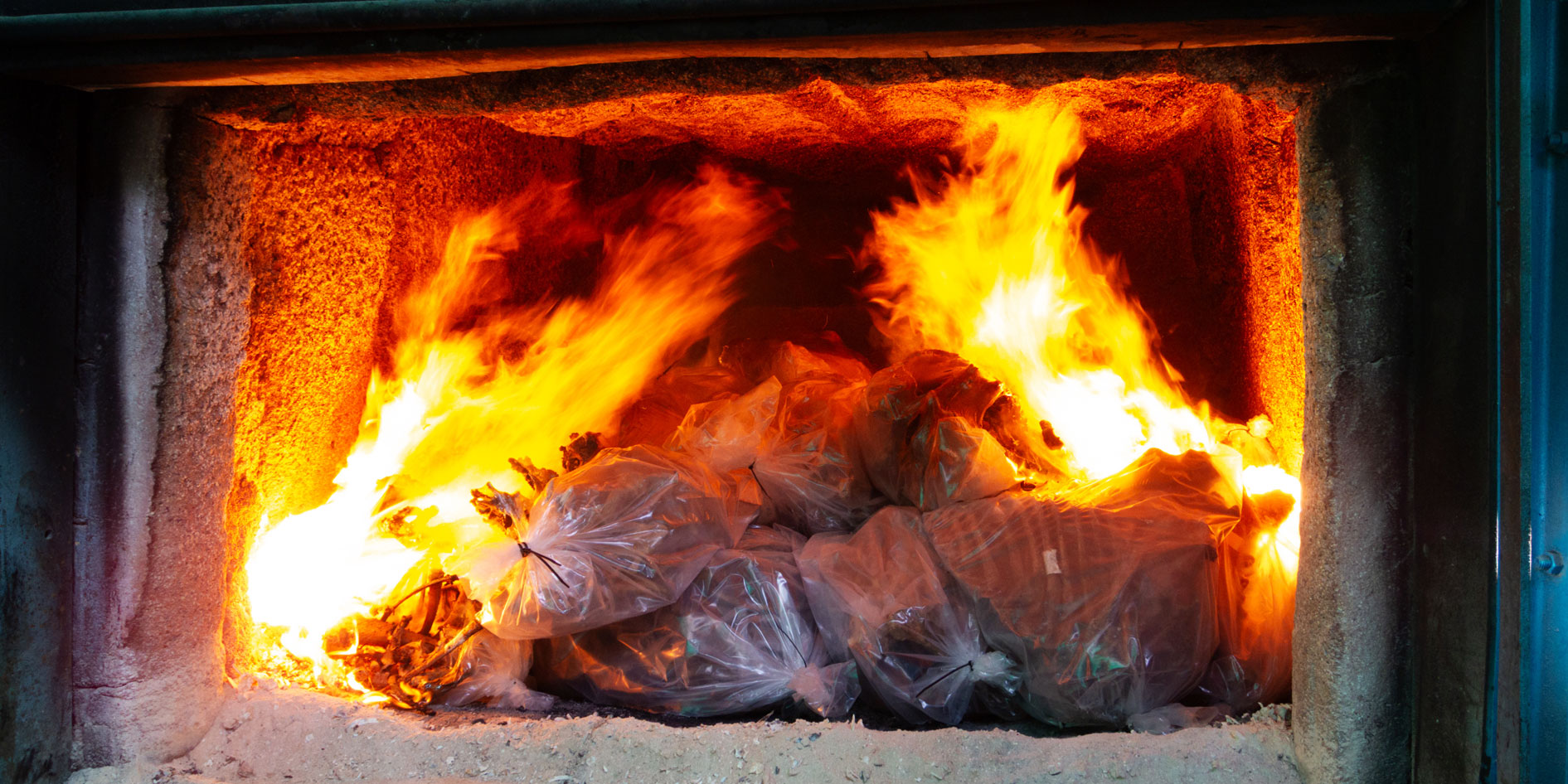
 Incinerator flames begin turning the bones of 42 lions to ashes. (Photo: Don Pinnock)
 At 10am on Wednesday, 10 December, an incinerator somewhere in Gauteng came alive with a roar, superheated flames instantly melting the plastic bags around the bones of 42 lions. It was dramatic, symbolic and garishly real. Ribs, leg bones and snarling skulls blackened in the intense heat as the doors of the hellish cauldron slid shut, having given observers a brief glimpse of the blaze that would reduce nearly half a tonne of lion remains to ash.
Symbolic, because an estimated 8,000 to 10,000 lions still live behind fences on breeding farms across South Africa. But also a statement – a stark, emotional reminder that in a humane society, dead lions should have zero value.
Those who had come to witness the burn – provincial government officials, a handful of NGOs, Kobus Steyn (the dealer who owned the bones) and Lord Michael Ashcroft – stepped back from the heat, visibly shaken by the spectacle. For most of them this was a moment shaped by years of work to shut down the captive lion breeding industry. Instead of triumph, however, there was gathering concern.
/file/attachments/orphans/4_887871.jpg "Lion bones in an incinerator before the burn. (Photo: Don Pinnock)")
A government process to phase out captive lion breeding – painstakingly built through panels, parliamentary colloquiums, white papers and cross-sector collaboration – had been abruptly destabilised. The minister who’d backed animal wellbeing reforms and a halt to the lion-bone trade had been suddenly removed and a replacement aligned with breeders and hunters installed, raising serious concerns.
Lord Ashcroft, invited to the burn by the previous minister after years of involvement in the campaign, did not mince words: “This is a trade that needs to and has to be banned. This is awful. Such cruelty too. And what’s it all about? Profit motive by a few unscrupulous operators who farm captive-bred lions.”
His commitment was unequivocal: to push for international condemnation, leverage global support and accelerate the end of the industry. His book Unfair Game – repeatedly cited by NGOs and government team members – provided much of the early political momentum that ultimately shaped the current policy direction.
/file/attachments/orphans/3_215797.jpg "Lord Michael Ashcroft, a powerful opponent of captive lion breeding, flew in from the US to witness the burn. (Photo: Don Pinnock)")
The breeder who walked away
Steyn, who had bought the bones from a lion farmer in the hope of selling them at a profit, stood quietly at the edge of the crowd. For him, the burn was deeply personal. “I’ve seen where they come from. I’ve seen some of them alive,” he said. “So that’s where the emotion comes from.”
His account showed the strange duality of the captive lion industry – part business, part burden and eventually, for him, a moral weight he no longer wished to carry.
The export quota for lion bones was stopped in 2019 when the high court ruled that the setting of the bone quota in 2017 and 2018 was “unlawful and constitutionally invalid” and that consideration should have been given to welfare issues relating to lions in captivity when determining the quota.
/file/attachments/orphans/2_501038.jpg "Trader Kobus Steyn signs away his lion bones for incineration. (Photo: Don Pinnock)")
As a result, the remains of those animals had stayed on his property for seven years. During that time the risks grew. He described the farm environment as dangerous. Protecting the bones had become both a liability and a psychological strain. Voluntary exit was, for him, a relief.
“Economically, it doesn’t make sense… but morally, absolutely. It’s not a nice business to be in. This is a solution, actually.”
Steyn believed that other farmers would follow the same path – not out of idealism, but inevitability. “I think nobody’s got a choice. It’ just a question of time.”
He described the temptation for farmers to quietly make bones “disappear” into illegal markets – a practice long suspected and difficult to prove – and spoke of the pressure within the industry itself. Turning away from that world had taken courage. “I’m 62… I’m really not scared,” he said, shrugging off the likelihood that many in the industry would target him for cooperating with the exit programme.
An uncruel life
For Blood Lions’ Ian Michler, the burn signified the intersection of politics, ethics and public pressure. He emphasised how shocking it remained that in South Africa, even the concept of animal wellbeing – not rights, merely wellbeing – was fiercely contested. “Are we not talking about sentience? Are we not talking about granting animals a basic, decent, uncruel life?”
Michler called the burn “very symbolic” on many levels:
- A signal that the fight continues, despite the ministerial reshuffle intended to stall reforms;
- A reminder that lion bones have no value except to a living lion; and
- A repudiation of the cruelty and brutality inherent in the conditions of captive-bred lions.
/file/attachments/orphans/6_973317.jpg "The value of a lion lies in its life, not in its bones. (Photo: Four Paws)")
He credited NGOs like Four Paws, journalists, officials and Lord Ashcroft for building the momentum that had carried the process so far, and warned that strategy, unity and pressure would remain essential. “If they thought removing a minister… would stop us, they’ve got it wrong.”
A policy suddenly at risk
Kam Chetty, whose calm, methodical leadership of a task team which helped craft the state’s voluntary exit pathway but who had just been effectively fired by the new minister, offered a detailed account of the multiyear journey that led to this moment – and why the return of industry-aligned leadership poses such danger.
2019-2021: The breakthrough
- Parliamentary colloquium triggered renewed scrutiny of captive lion breeding;
- A high-level panel of experts was established. After two years, the panel’s report concluded decisively:
- The industry should be phased out;
- It contributes nothing to conservation; and
- It carries serious ethical and safety risks.
Barbara Creecy’s reform agenda
Former ANC minister Barbara Creecy accepted the panel’s findings and initiated a three-pillar reform strategy:
- Voluntary exit programme – incentivising breeders to leave the industry;
- Legislative reform – including a new white paper embedding animal wellbeing into law; and
- Formal prohibition notices – the critical step needed to legally close the industry.
Animal wellbeing was introduced into legislation through the National Environmental Management: Biodiversity Act, a milestone fiercely opposed by hunting and breeding interests and now the subject of a constitutional challenge.
Regulatory battles
The Threatened or Protected Species (TOPS) regulations, last properly approved in 2007, were rewritten to include animal wellbeing. But under pressure, the department removed the wellbeing provisions, prompting the task team to push back and get them reinstated.
Chetty described how provinces were gradually approving:
- Four provinces had already agreed to zero breeding, effectively phasing themselves out;
- Several others were on the brink; and
- A prohibition against establishing new facilities had been drafted and, by constitutional default, was technically approved – though inexplicably delayed in Parliament.
The task team also moved to block:
- Interprovincial movement of lions, undermining the pipeline that fed trophy-hunting provinces;
- Noncompliant facilities, which made up 40% of audited farms – a disturbing figure; and
- Untrained inspectors, by developing a national training programme to standardise enforcement.
Then-minister Dion George was fired. As Chetty put it: “I feel as if we’ve been moved back to 2019.” The new minister, aligned with the very industry under scrutiny, cancelled the task team’s term. How the reform agenda will survive is now uncertain.
/file/attachments/orphans/5_261413.jpg "The bones of 42 lions were trucked in for the burn. (Photo: Four Paws)")
“I’m not convinced the department and government, without any pressure, will be able to take this forward,” he told those assembled to watch the bones turned to ashes. But for those present, the burn was a rallying point: a collective insistence that stalled reform cannot be allowed to collapse.
The meaning of the flames
In the conversations that followed, three threads stood out:
- Captive-bred lions – raised for petting, canned hunts, bone sales – have value only in life, not as inventory. Watching their bones burn stripped away the illusion of “stock”;
- Years of expert work, cross-party engagement and public pressure will not be undone quietly; and
- Steyn’s courage in stepping away from the industry illustrated what becomes possible when the government creates a viable path out.
The burn affirmed something else too: that despite political headwinds, the coalition for change is broad, experienced and resolute.
If the flames in that Gauteng incinerator marked anything, it was that the value of a lion lies in its life, not in its bones. And that, for many who witnessed it, was reason enough to keep fighting. DM