




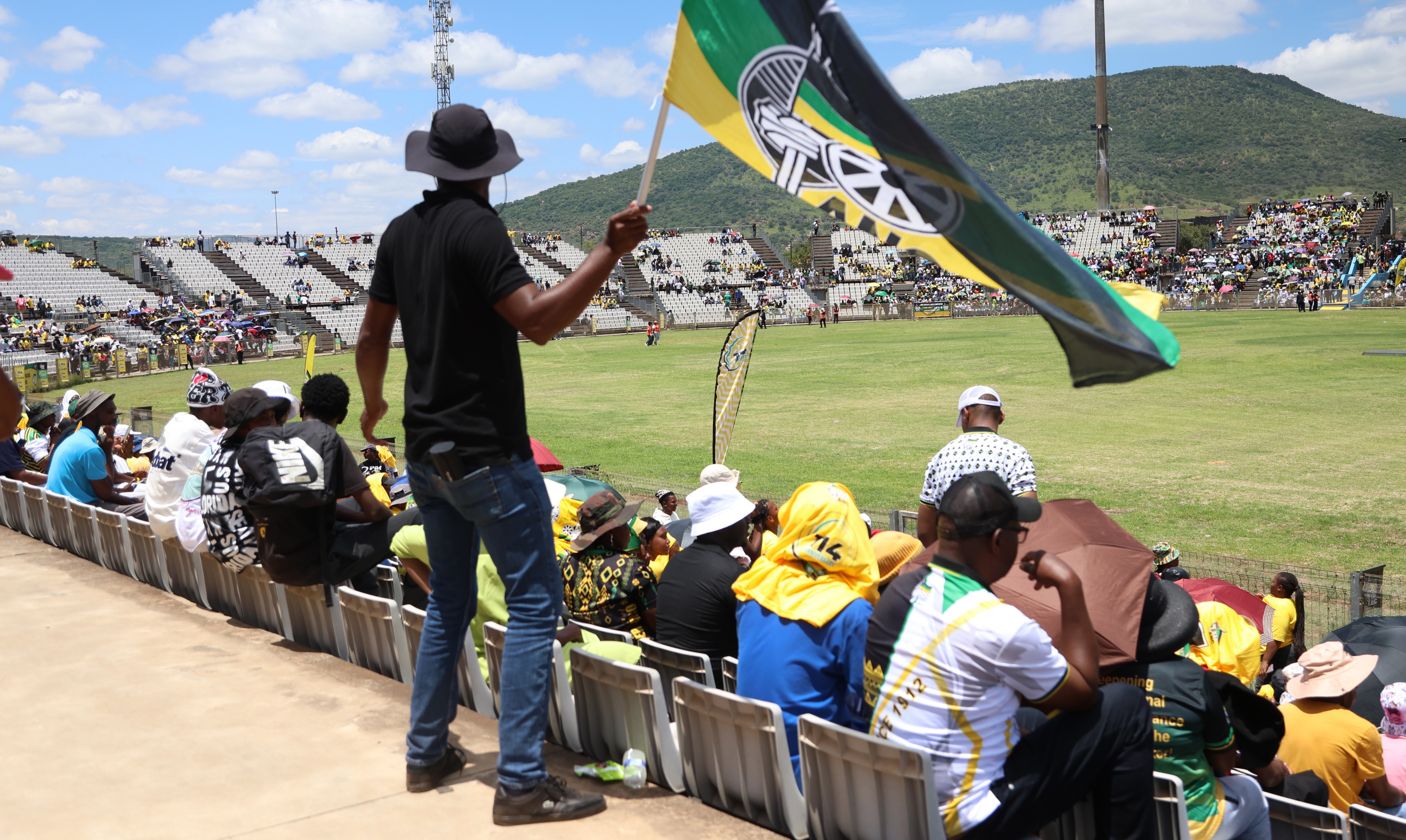
 ANC supporter waves a flag at an almost half-empty Moruleng Stadium, 65km north of Rustenburg, on 10 January 2026. (Photo: Felix Dlangamandla)
 ANC bigwigs spent the week in North West, mobilising support, campaigning and fundraising in the lead-up to the party’s 114th birthday celebration, but were unable to fill Moruleng Stadium, which holds no more than 20,000 people.
This is striking given that North West is meant to be one of the ANC’s strongholds. In the 2024 national and local government elections, the province secured more than 500,000 votes, or 58.28% of the national vote.
It was among the top-three-performing provinces, alongside Limpopo and the Eastern Cape.
The party was unable to fill the venue despite the fact a number of attendees were bused in, mostly from neighbouring provinces including Gauteng and Limpopo.
Access to the stadium proved to be a logistical nightmare, with attendees, members of the media and even some executives spending hours stuck at poorly managed traffic and security checkpoints.
/file/attachments/orphans/WFD_1363_590640.jpg "ANC supporters walk on a dirt road to Moruleng Stadium on 10 January 2026. (Photo: Felix Dlangamandla)")
/file/attachments/orphans/6I1A9994_814576.jpg "ANC supporter with a temporary stamp of Nelson Mandela at Moruleng Stadium on 10 January 2026. (Photo: Felix Dlangamandla)")
While many eventually gained entry, others grew tired of waiting. Although the event was scheduled to start at 10am, President Cyril Ramaphosa only delivered his address later in the afternoon, at which point some chairs remained empty while attendees walked outside to seek shade and others left the stadium as the temperature climbed to a scorching 33°C.
The drive to Moruleng laid bare the collapse of service delivery, with pothole-riddled roads along the way. In some areas there were clear signs of last-minute road repairs, a common feature of the party’s annual celebrations.
Ramaphosa used the celebration to declare 2026 “the year of decisive action” to fix local government and boost the economy, even as the setting suggested otherwise.
Five things you need to know:
1. Fixing local government and basic services
Ramaphosa returned to a pledge he made in 2025, to end load shedding and ensure reliable water supply by upgrading, maintaining and expanding municipal infrastructure, while confronting sabotage and corruption.
/file/attachments/orphans/6I1A0096_769906.jpg "President Cyril Ramaphosa arrives for a walkabout at Moruleng Stadium on 10 January 2026. (Photo: Felix Dlangamandla)")
/file/attachments/orphans/6I1A0114_613767.jpg "Moruleng Stadium was far from full on 10 January 2026. (Photo: Felix Dlangamandla)")
Between then and now, Ramaphosa said, there has been “dramatic improvement” in electricity supply, citing Eskom’s recovery and increased private investment in generation.
But he also acknowledged that municipal load reduction and power cuts used to manage debt to Eskom continue to be problems for many, including the residents of North West he engaged with this week.
Load reduction, he said, is a result of nonpayment and illegal connections that overload systems. His message was clear: citizens must pay for services, and communities must help the state to curb unlawful connections.
/file/attachments/orphans/WFD_1531_285490.jpg "President Cyril Ramaphosa watches a praise singer before delivering his keynote address during the january 8th celebrations at Moruleng Stadium in North West on 10 January 2026. (Photo: Felix Dlangamandla)")
2. Speeding up economic transformation, inclusive growth and job creation
Ramaphosa said that after 15 years of low growth there were signs that the economy is approaching a turning point.
Efforts to turn the tide were hampered by several factors including youth unemployment which, according to Statistics South Africa, was roughly 32.9% in the first quarter of 2025.
Read more: Confronting SA’s unemployment crisis through urgent reforms needed to revive the job market
This is despite the fact that since 2020 new public employment programmes have created more than two million opportunities.
He also touched on black empowerment policy which the party would continue to defend as it has come under “severe attack”.
“Disruptions to global trading systems threaten South African exports. Government will accelerate export-market diversification. South Africa also plays a leading role in implementing the African Continental Free Trade Area to grow exports across the continent,” Ramaphosa said.
/file/attachments/orphans/WFD_1375_467250.jpg "ANC members dance on stage at Moruleng Stadium as the ANC celebrates 114 years on 10 January 2026. (Photo: Felix Dlangamandla)")
/file/attachments/orphans/WFD_1371_462270.jpg "ANC members dance at Moruleng Stadium. (Photo: Felix Dlangamandla)")
3. Waging war on crime, corruption and gender-based violence
Crime and corruption were again cast as existential threats to the state, alongside gender-based violence and femicide (GBVF), which Ramaphosa reaffirmed as a national disaster.
Following the government’s decision to classifying GBVF as a national disaster in 2025, Ramaphosa said work has begun with all stakeholders to determine how this classification can be implemented most effectively.
Read more: When women lie down, a nation must stand up — GBV is a social justice crisis
“Rooting out corruption remains an overriding priority. Through institutions such as the Special Investigating Unit and the Asset Forfeiture Unit, billions of rands in stolen funds have been recovered and charges have been brought against alleged wrongdoers. Regular reporting on the implementation of the Zondo Commission recommendations has become standard practice, alongside significant progress in strengthening institutional architecture and legal reforms to prevent and combat corruption,” Ramaphosa said.
/file/attachments/orphans/WFD_1596_794517.jpg "President Cyril Ramaphosa dances with ANC officials during the celebration. (Photo: Felix Dlangamandla)")
/file/attachments/orphans/6I1A0023_341164.jpg "An ANC supporter at Moruleng Stadium. (Photo: Felix Dlangamandla)")
/file/attachments/orphans/WFD_1601_591741.jpg "President Cyril Ramaphosa dances with ANC officials at Moruleng Stadium. (Photo: Felix Dlangamandla)")
4. Making organisational renewal visible and irreversible
For years the ANC has said it is renewing itself but making little to no progress. Once again, Ramaphosa said this is “the most pressing organisational task of this generation”.
“We fully understand that we either renew or perish,” he told attendees.
While several ANC members have been implicated in corruption, including in the Zondo report, Ramaphosa repeated a familiar promise: “We will run the ANC strictly, with zero tolerance of corruption, ill-discipline and factionalism. We will govern our country effectively, ethically and competently.”
He also claimed more than 125,000 members from 1,600 branches have undergone political training throughout the year. This training would be intensified in 2026 to cover every ANC member, with advanced level courses set to be rolled out to build leadership and governance capacity across the organisation.
5. Building a South Africa that belongs to all through the National Dialogue and the 30th anniversary of the Constitution
With the country marking three decades this year since the adoption of the Constitution, Ramaphosa reaffirmed the party’s commitment to building a united, nonracial, nonsexist, democratic and prosperous nation.
He also used his address to plead with South Africans to actively participate in the National Dialogue which began in 2025 but has been rejected by some political parties and civil society organisations.
The party is also planning a year-long programme to celebrate the Constitution, deepen civic education and encourage active citizenship. DM
/file/attachments/orphans/6I1A0032_438714.jpg "ANC flags at Moruleng Stadium before the event on 10 January 2026. (Photo: Felix Dlangamandla)")
/file/attachments/orphans/WFD_1537_929183.jpg "President Cyril Ramaphosa delivers his keynote address. (Photo: Felix Dlangamandla)")
/file/attachments/orphans/6I1A0079_257721.jpg "ANC bikers arrive at Moruleng Stadium. (Photo: Felix Dlangamandla)")
/file/attachments/orphans/WFD_1578_264105.jpg "President Cyril Ramaphosa, flanked by ANC officials, cuts the 114th anniversary cake. (Photo: Felix Dlangamandla)")
/file/attachments/orphans/WFD_1585_775620.jpg "Confetti fills the air at Moruleng Stadium. (Photo: Felix Dlangamandla)")
/file/attachments/orphans/WFD_1506_394102.jpg "Nono Moloi chairperson of ANC in North West at the Moruleng stadium 65 kms north of Rustenburg during the 114 celebrations of the African National Congress on 10 January 2026. (Photo: Felix Dlangamandla)")
/file/attachments/orphans/WFD_1496_997476.jpg "Fikile Mbalula, Gwede Mantashe and President Cyril Ramaphosa at the Moruleng stadium 65 kms north of Rustenburg during the 114 celebrations of the African National Congress on 10 January 2026. (Photo: Felix Dlangamandla)")
/file/attachments/orphans/WFD_1486_477139.jpg "Water and Sanitation Minister Pemmy Majodina during the celebrations at Moruleng Stadium. (Photo: Felix Dlangamandla)")
/file/attachments/orphans/WFD_1434_710333.jpg "ANC supporters react to entertainers at Moruleng Stadium. (Photo: Felix Dlangamandla)")