




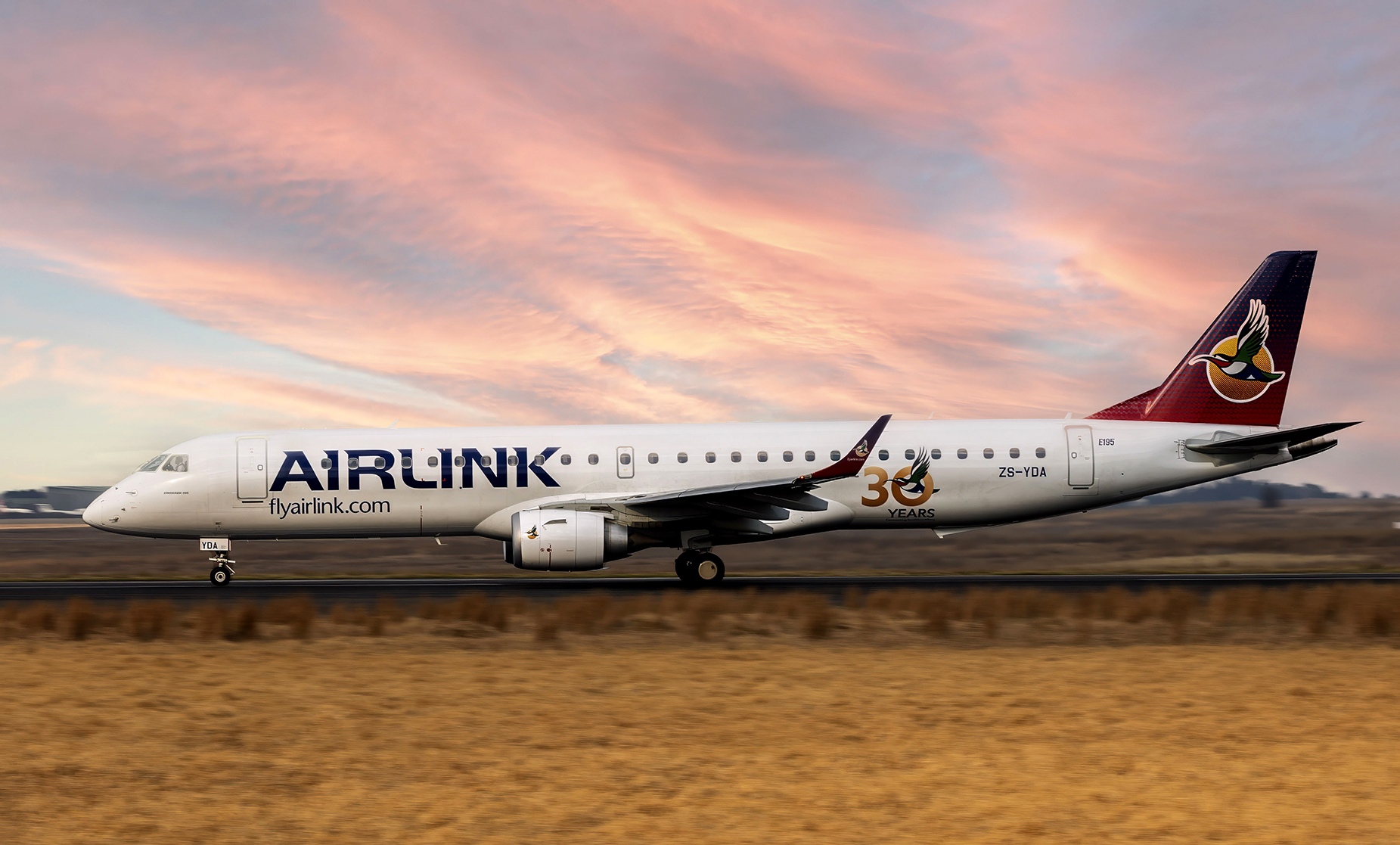
 If the Competition Commission gets its way, Airlink could face a maximum administrative penalty of 10% of its annual turnover. (Photo: AIRLINK)
 Usually, when the term predatory pricing is thrown around, it is because the monopoly was driving up the cost. In this case, it is considered predatory that Airlink first undercut the pricing of new market entrant Fly Blue Crane (FBC) and then bled it dry to maintain a grip on the JNB-UTT route.
Once Fly Blue Crane limped into business administration in 2016, Airlink shot the prices back up for the only ride in town.
This accusation is now being tested in the Competition Tribunal after the Competition Commission found the airline played dirty.
Airlink’s legal counsel had an understandably different view of how it all went down:
“This is an industry where, on anybody’s take, you have a highly, highly contestable industry exit and entry and incumbents that are by no means living happy. No enduring incumbencies.”
For unlearned colleagues in the gallery, the airline is arguing that control of South Africa’s highways in the sky is a volatile game and that FBC failed over its own operational inefficiencies.
Walking contradiction
In its investigation, the Competition Commission used the flight pricing from a five-month period in 2017 to show how far out of pocket Airlink got when FBC was grounded.
The logic? Compare those 2017 prices to the sky-high fares of 2012-2016 to prove Airlink was previously gouging consumers.
But there’s a logical pothole here that Airlink’s counsel drove its argument through. The commission is simultaneously arguing that 2017 was the exact period Airlink was engaged in illegal, below-cost predatory pricing to kill FBC.
It’s just that you can’t use the very period you claim is artificially deflated by predation as your benchmark for a healthy, competitive equilibrium.
“On the one hand you say well, you’ve predated, but the benchmark you’re using to find that you have excessive prices is predation,” Airlink’s legal counsel fired back.
“I think many people will say that this tribunal has lost its marbles... [it is] unprecedented, incoherent, circular, dangerous and unfair.” – Airlink representative counsel, Frank Snyckers.
The Competition Commission’s legal gun attempted to smooth this over, arguing that the alleged predation happened on only two flight pairs over five months (about 15% of the year’s flights). Therefore, the rest of the 2017 data remains a perfectly fine, even conservative, proxy.
The time-travelling capacity dump
The case also leans heavily on the idea that Airlink engineered what was referred to as capacity dump – specifically adding a midday flight pair to flood the market and crowd FBC out.
It’s a cool story, if you don’t actually look at a calendar.
Airlink presented evidence showing this midday flight was already conceptualised and baked into their business plan by May 2016. They (allegedly) didn’t even learn of FBC’s intention to enter the route until July 2016. It is legally tough to argue retaliation against a rival you didn’t know existed.
The flights also weren’t exactly dogfighting for the same passengers. As Airlink pointed out, FBC was gunning for the lucrative peak-time commuters. Airlink’s new flight was smack in the middle of the day.
So much drama in the FBC
But the Competition Commission wasn’t the only one stumbling over its own arguments. Airlink proved it isn’t immune to a little narrative wriggling.
Throughout the hearings, Airlink’s economic experts leaned heavily on that business cycle defence. They argued that those high fares were, simply, a necessary buffer to offset the massive, inevitable revenue drops that are a symptom of aviation’s volatile cycle.
But late in the game, during the expert witness concurrent evidence phase (affectionately known in legal circles as the hot tub), Airlink pulled out a totally new, contradictory defence.
Suddenly, their high profitability wasn’t about surviving the business cycle at all; it was just the natural result of deploying more efficient, larger RJ85 aircraft.
The commission bench pounced on the flip-flop:
“Now we’re hearing, no, it’s not about that at all. It’s not about pricing to make good losses... Now it is the case that there were more efficient planes. The second point to make: it’s inconsistent with this argument on period and business cycle.”
Accounting gymnastics
The final major clash comes down to how you calculate an airline’s assets. Airlink argued that its historical start-up losses on the Mthatha route should be capitalised as customer goodwill, which would theoretically justify charging higher fares to recoup that asset.
But, the Competition Commission held, arguing that this was textbook double-counting. You can’t take standard, day-to-day operational expenses and magically repackage them as a distinct capital investment when it suits the pricing model.
“You can’t have a situation where you are realising an asset... where that opex is necessarily being incurred every year,” the commission argued.
As the Tribunal prepares to chew on these closing arguments, the stakes are actually quite crazy. If the commission gets its way, Airlink could face a maximum administrative penalty of 10% of its annual turnover for allegedly costing Mthatha consumers more than R100-million.
More importantly, the final ruling will draw a definitive line in the South African sky between aggressive, volatile airline pricing and illegal monopoly abuse. DM