




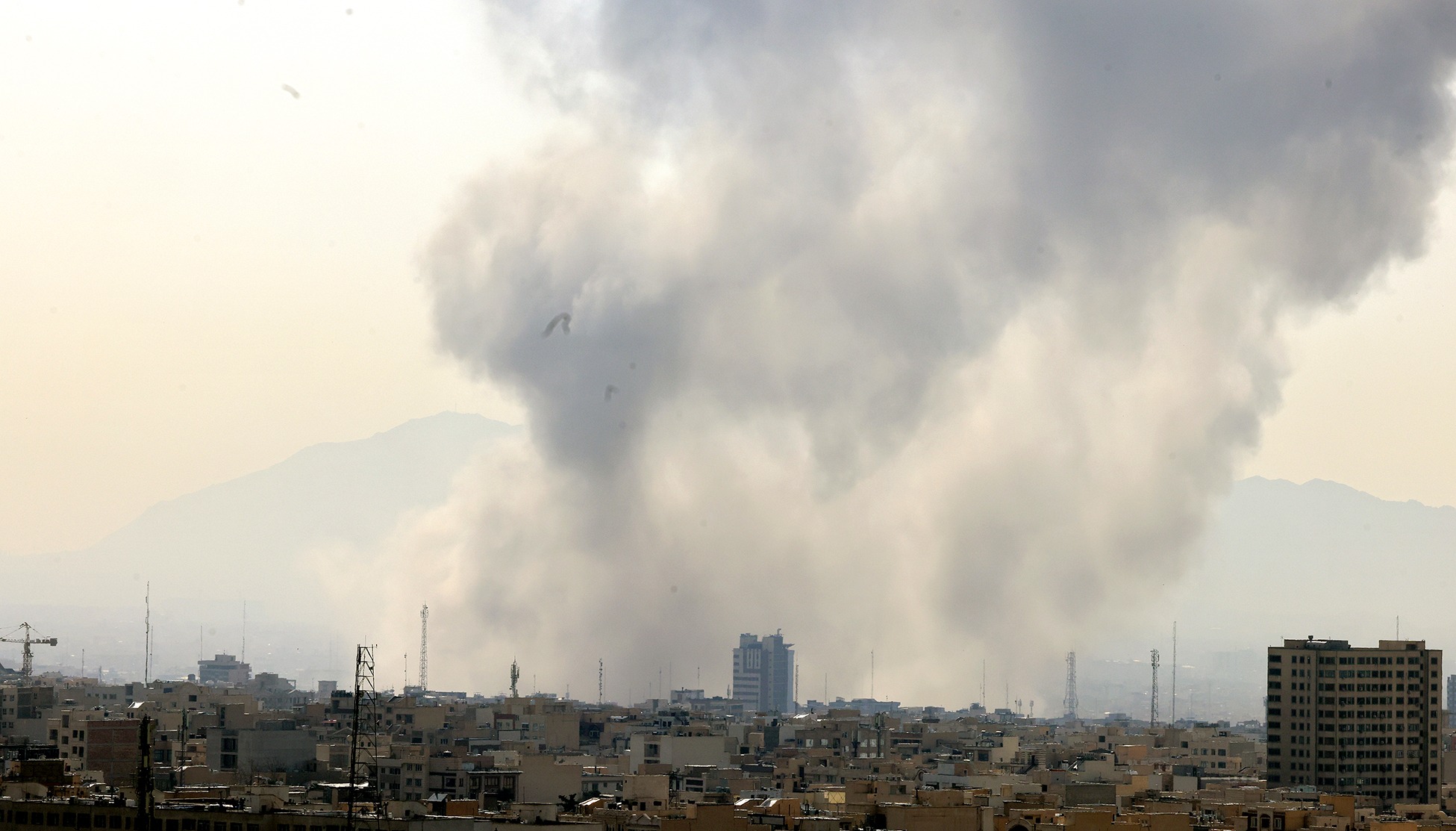
 Smoke rises in central Tehran after Israel attack, 28 February 2026. Israel launched an attack on Iran on 28 February 2026, described as a "preemptive strike" by Israeli Defence Minister Israel Katz. (Photo: EPA / ABEDIN TAHERKENAREH)
Israel and the United States launched strikes on Iran on Saturday, plunging the Middle East into a renewed military confrontation as President Donald Trump vowed to destroy Tehran's missile arsenal and prevent it from developing a nuclear weapon.
Below is international reaction to the attacks:
Dmitry Medvedev, Deputy Chariman of Russia's Security Council
"The peacemaker once again showed his face," Medvedev, a former Russian president, said. "All negotiations with Iran are a cover operation. No one doubted it. No one really wanted to negotiate anything.
"The question is who has more patience to wait for the inglorious end of their enemy. The USA is only 249 years old. The Persian Empire was founded more than 2,500 years ago. Let's see in 100 years…"
French President, Emmanuel Macron
Macron called for an urgent meeting of the United Nations Security Council, saying the outbreak of a war between the United States, Israel and Iran has "serious consequences" for international peace and security.
/file/attachments/2987/13661304_543988.jpg "French President Emmanuel Macron. (Photo: EPA/GIAN EHRENZELLER)")
"The current escalation is dangerous for everyone. It must stop. The Iranian regime must understand that it now has no other option but to engage in good-faith negotiations to end its nuclear and ballistic missile programs, as well as its actions to destabilise the region," Macron said on X.
"This is absolutely essential for the security of everyone in the Middle East."
UN Human Rights Chief, Volker Turk
"I deplore the military strikes across Iran this morning by Israel and the United States of America, and the subsequent retaliatory strikes by Iran. As always, in any armed conflict, it is civilians who end up paying the ultimate price.
"Bombs and missiles are not the way to resolve differences but only result in death, destruction and human misery.
/file/dailymaverick/wp-content/uploads/2024/09/12332358.jpg "Reuters-Middle-East-Update10/9")
"To avert these terrible consequences for civilians, I call for restraint and implore all parties To see reason, to de-escalate, and for a return to the ‘negotiating table’ where they had been actively seeking a solution only hours earlier.
" I have already warned that failing to do so risks an even wider conflict, that will inevitably lead to further senseless civilian deaths and destruction on a potentially unimaginable scale, not just in Iran but across the Middle East region."
Canadian Prime Minister, Mark Carney
Canadian Prime Minister Mark Carney said that Canada supports the U.S. "acting to prevent Iran from obtaining a nuclear weapon and to prevent its regime from further threatening international peace and security."
Spanish Prime Minister, Pedro Sanchez
"We demand immediate de-escalation and full respect for international law," Sanchez said in a statement posted on social media platform X.
Spanish Foreign Minister Albares later said on X that Madrid demanded respect for international law, de-escalation and dialogue, showing support and solidarity with those who are receiving the strikes.
"The attacks must stop," he added.
Oman
Oman's Foreign Minister Badr Albusaidi said that active and serious negotiations mediated by his country between Iran and the U.S. were "yet again undermined" amid the ongoing escalation.
"Neither the interests of the United States nor the cause of global peace are well served by this...I urge the United States not to get sucked in further. This is not your war," he said on X.
Lebanese Prime Minister, Nawaf Salam
"I reiterate that we will not accept anyone dragging the country into adventures that threaten its security and unity."
Norwegian Foreign Minister, Espen Barth Eide
"The attack is described by Israel as a preventive strike, but it is not in line with international law. Preventive attacks require an immediately imminent threat."
Ukraine's Foreign Ministry
"The cause of the current events is precisely the violence and impunity of the Iranian regime, in particular the killings and repression of peaceful protesters, which have become particularly widespread in recent months," the foreign ministry said.
/file/attachments/orphans/GettyImages-2263410440_280365.jpg "A plume of smoke rises after an explosion on February 28, 2026 in Tehran, Iran. After explosions were seen in the Iranian capital, the office of the Israeli Defense Minister issued a statement saying it had launched a preemptive strike against the country. (Photo: Getty Images)")
Airspace closed
Meanwhile, Airspace over Iran, Iraq, Kuwait, Israel and Bahrain was virtually empty on Saturday, maps by flight-tracking service Flightradar24 showed. The European Union's aviation regulator recommended that its airlines stay out of the airspace affected by the military intervention.
Below is the latest on flights listed by airline in alphabetical order:
Aegean Airlines
Greece's largest carrier AGNr.AT suspended flights to and from Tel Aviv in Israel, Beirut in Lebanon and Erbil in Iraq until March 2.
Air Astana
The group AIRA.KZ cancelled all flights to the Middle East through March 3.
Air Europa
The Spanish airline cancelled its flights to Tel Aviv on Sunday and Monday and is monitoring the situation to assess operations from Tuesday.
Air France KLM
Air France AIRF.PA cancelled flights to and from Tel Aviv in Israel and Beirut in Lebanon for Saturday.
KLM brought forward the suspension of its Amsterdam – Tel Aviv service, cancelling the flight scheduled for Saturday. The Dutch arm of Air France‑KLM had announced on Wednesday that flights would be halted from Sunday, but has now advanced that date. Only one flight to Tel Aviv had been scheduled for Saturday.
Azerbaijan Airlines
The airline has suspended flights to and from Dubai, Doha, Jeddah and Tel Aviv.
British Airways
ICAG-owned British Airways ICAG.L said it has cancelled flights to Tel Aviv and Bahrain until March 3 and its flight to Amman on Saturday.
Emirates
Emirates said in a post on X it has temporarily suspended operations to and from Dubai.
Etihad
Etihad said flights scheduled to depart Abu Dhabi were suspended until 2 p.m. local time on Sunday.
Flydubai
The airline said flights were affected by the closure of Iraqi, Iranian and Israeli airspace.
Iberia Express
The Spanish airline owned by Iberia Group IBLA.MC cancelled a flight to Tel Aviv scheduled for Saturday at 5 p.m. local time.
Indigo
The airline said it cancelled flights to and from the Middle East on Saturday.
ITA Airways
ITA Airways has suspended flights to and from Tel Aviv and would not use the airspace of Israel, Lebanon, Jordan, Iraq and Iran until March 7. Flights to and from Dubai were suspended until March 1.
Japan Airlines
Japan Airlines 9201.T cancelled a flight on Saturday from Tokyo Haneda to Doha as well as a return flight on March 1, Nikkei said.
Lot Polish Airlines
LOT Polish Airlines returned its flight LO121 from Warsaw to Dubai to Warsaw.
Lufthansa
The German airline LHAG.DE suspended flights to and from Tel Aviv in Israel, Beirut in Lebanon, and Oman until March 7 and flights to and from Dubai on Saturday and Sunday.
They also said they would not fly through Israeli, Lebanese, Jordanian, Iraqi and Iranian airspace until March 7.
Norwegian Air
The Nordic airline NAS.OL suspended all flights to and from Dubai until March 4, a company spokesperson said. The carrier did not suspend flights to Tel Aviv in Israel or Beirut in Lebanon as these destinations are only active in summer, he added.
Scandinavian Airlines
The airline told Reuters it had suspended its flight to Tel Aviv from Copenhagen on Saturday. No decision had been made regarding flights on later dates.
Turkish Airlines
The airline THYAO.IS cancelled flights to Qatar, Kuwait, Bahrain, the United Arab Emirates and Oman on Saturday and flights to Lebanon, Syria, Iraq, Iran and Jordan until March 2.
Virgin Atlantic
Virgin Atlantic said it will temporarily avoid Iraqi airspace, resulting in some pre-planned rerouting of its flights and has cancelled its VS400 service from London Heathrow to Dubai on Saturday.
Qatar Airways
The airline said it has temporarily suspended flights to and from Doha due to the closure of Qatari airspace.
Wizz Air
The airline WIZZ.Lhalted flights to and from Israel, Dubai, Abu Dhabi and Amman with immediate effect until March 7.
It added that operational decisions would continue to be reviewed, and the flight schedule could be adjusted as the situation evolves.
(Reporting by Reuters bureaux; Writing by Michael Georgy; Editing by Barbara Lewis, Sam Holmes and Timothy Heritage)
Comments
Scroll down to load comments...