




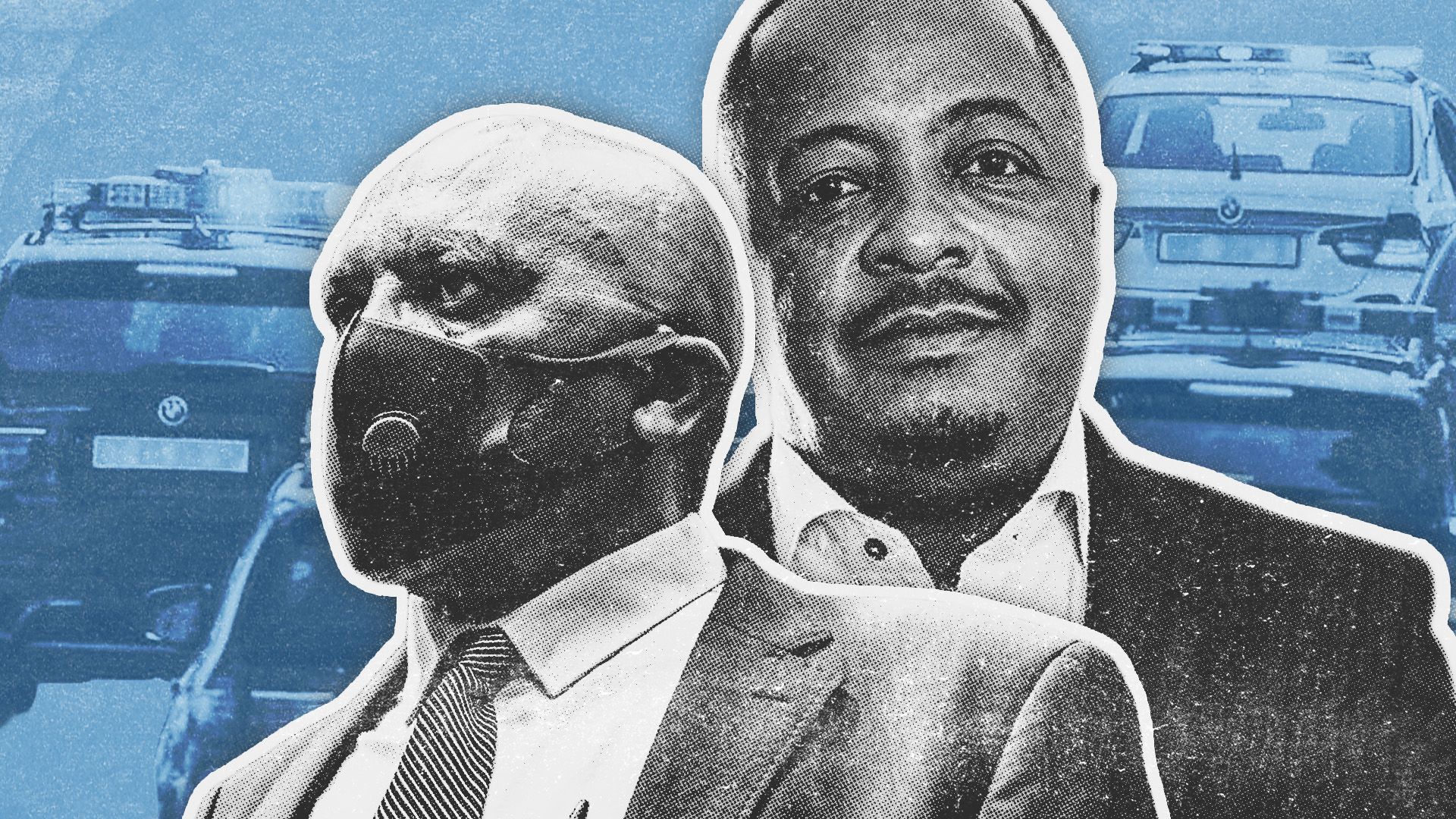
 Illustrative image: Former parliamentarian Vincent Smith. (Photo: Gallo Images / OJ Koloti) | Former African Back CEO Kennedy Bungane. (Photo: African Bank) | A VIP blue light convoy in traffic. (Photo: X @kg007man)
 It’s so interesting sometimes to sit back a little from all of the hurly burly that is our public life and ponder a slightly different question: how are we doing in the quest for accountability?
I’m sure that, like me, you find it very difficult sometimes to try to teach your children that accountability is so important, when all of the public figures around them seem to be focused on avoiding exactly that.
And the thing about accountability, as we all know, is that without it, no institution, business, government or society can ever progress.
Two things happened late last week that made me wonder a little about this.
The first was Vincent Smith agreeing to a plea bargain and going to jail.
While he’s been sentenced to seven years in jail, he’ll probably be in a cell for about a year. I have no insight or special knowledge about the plea deal, but I wouldn’t be surprised if part of the negotiation was which prison and what kind of cell he would be placed in.
The second incident was the decision by the board of African Bank to part ways with their CEO Kennedy Bungane.
We haven’t heard the full story yet, but Business Day carried a clearly well-informed report this morning, suggesting there had been problems with the way it reported to the Prudential Authority.
In banking, boards have a very very low tolerance for a lack of accountability, so when I look at incidents like that I think, well, there are places and areas where perhaps we are making progress.
But that feeling ran into the thought equivalent of a brick wall when I read Anna Cox in Daily Maverick’s Joburg newsletter this morning.
She reminded us that Paul Mashatile’s convoy is still, virtually daily, terrorising people trying to drive in the Midrand area at particular times.
As Anna reminds us, it is obvious that no one in the SAPS gives a fig about anyone else when the national police spokesperson says simply: “I believe they are following security protocols.” (there may be a more appropriate word than “fig” but it was a whole letter longer).
I sometimes think that everything wrong with Mashatile’s presidential campaign is captured in this.
Like so many other ANC leaders, he is still thinking internally. It’s one of the biggest things that’s changed over the past five years. Politics is no longer just about the ANC.
If you are looking for a good example of people trying to avoid – sorry, evade – accountability, you can point your teenager in the direction of any television showing the Madlanga Commission.
There you will see people, used to being powerful in their own fiefdoms, suddenly coming face-to-face with accountability.
Today’s witness at the commission, Suleiman Carrim, tried everything to avoid testifying. Applications and requests seem to flow in a torrent, but eventually the commission saw through it all and put him on the stand.
And suddenly you saw the image of a person who now had to explain how he had lied to Vusimuzi “Cat” Matlala about his relationship with Police Minister Senzo Mchunu, and claimed to be able to influence his behaviour.
It was all a lie, of course.
And while the people testifying at the commissions have a lot to fear, including the loss of any reputation they may have had, I think their biggest fear is the people who are also involved in this.
I’m a big fan of the way the Madlanga Commission does things; it’s been able to really get to the truth, or at least close to it.
There is nothing quite like watching a skilled advocate, a person who is really neutral, like an evidence leader, just following the trail to the truth.
It’s completely different to the parliamentary ad hoc committee, which is supposed to be doing the same thing but gets completely sidetracked by narrow political interests.
I know that banks get a bad rap.
But I can also see that they are not scared to act when things are going in the wrong direction.
Sure, you could say that Bungane might still get a big payout after some disagreement about the future direction of African Bank, or some failure on his part.
However, the board has acted. And they have worked out what they’re going to do and how things will go from here.
This must be one of the reasons some financial institutions have been able to grow and prosper over the years. They’ve been able to ensure, instil or entrench a culture of accountability (at least to each other – perhaps not to everyone else).
And maybe, just maybe, my advice to my children is that they sometimes, just sometimes, need to be a bit like bankers. DM