



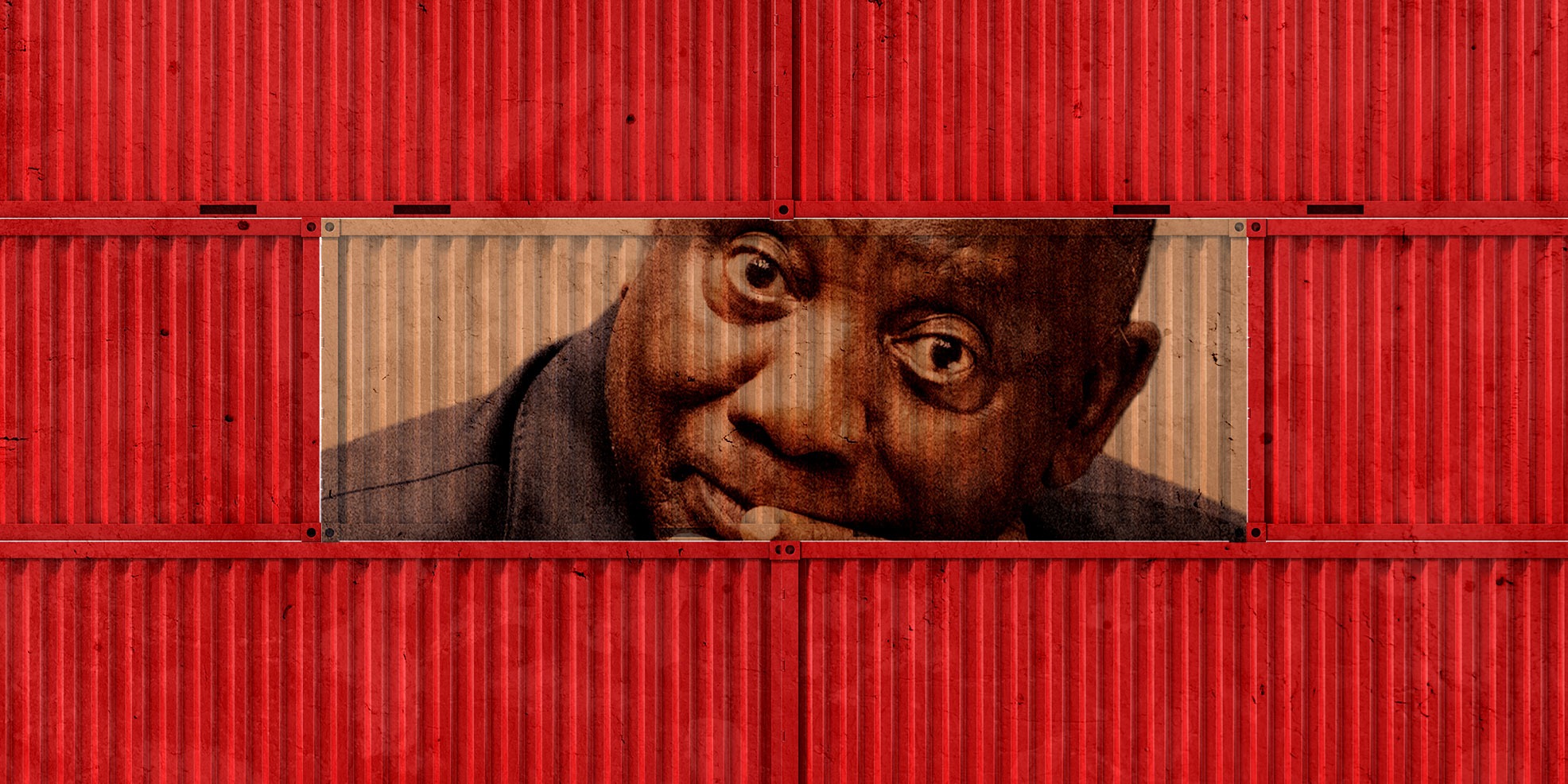
 Illustrative Image: President Cyril Ramaphosa. (Photo: Gallo Images / Misha Jordaan) | Shipping container. (Photo: Freepik) | (By Daniella Lee Ming Yesca)
 I often find it quite difficult to place events that happen in our time in a sort of historic context.
I always get very nervous when people say some event is the “worst/biggest/hardest flood/recession/storm” in history.
Most things that happen have happened before in some way, shape or form.
That said, it is becoming so much clearer that Donald Trump’s disruption of the global trading system is going to have an impact that reverberates for a very long time, and may put nations and the relationships between them on a completely different path.
I don’t think Canadian Prime Minister Mark Carney ever saw himself flying to Beijing to sign a trade deal there. But given the way the world works now, and the fact that his country’s biggest customer is behaving like a spoilt brat, it is the rational thing to do.
One of the major problems with Trump’s tariffs is their sheer uncertainty. Companies wanting to export to the US have no idea whether to plan for a 10% tariff, a 50% tariff or no tariff at all.
What I think does matter is that nations need to make choices for themselves. They need to decide what to do and choose their own direction. I would seriously urge people not to just go with the flow.
I was not at all surprised to see some of the quotes in an important piece by News24’s Carol Paton this morning about how the Department of Trade, Industry and Competition (DTIC) has done so little to deal with this new reality.
Part of this is because our trade policy seems to be hobbled by the Southern African Customs Union and various agreements that prevent us from entering into new trade agreements on our own.
One of the problems in dealing with trade is that you always get consequences in many different directions.
You might want to open Chinese markets to your products, but in return Beijing is going to demand, quite reasonably, that you do the same.
That might really help our farmers, since they get to sell their goods to a huge market, but it makes our car industry unsustainable.
That said, I can’t avoid feeling that perhaps people at the DTIC are just trying to avoid making decisions.
It may be that they’re all working furiously behind the scenes. But, in politics, if people get the impression that you’re doing nothing, if they can’t see what you’re doing, well, there will be consequences.
One of the more interesting aspects of Paton’s piece is that several senior people complain that officials are “set in their ways” and have an “ideological mindset from the 1980s”.
One of the biggest under-appreciated changes in our society since the start of the pandemic has been how the people who currently lead the ANC have ditched so much of their previous ideology.
Essentially, the private sector is being invited, welcomed and encouraged to move into spaces that were previously reserved for the government.
In many democracies one of the biggest long-running arguments is about the size of government. Should the government own an iron-maker? How about a company that produces electricity? Or one that runs trains and ports?
This debate is not even being heard at the moment. Instead, simply because of a lack of capacity, because of State Capture and because, frankly, the government has messed up so many things, there is no other option.
Something similar might be happening in trade.
While Carney might not really feel any kind of ideological or political kinship with his opposite numbers in Beijing, he doesn’t care. He needs a friend who is big enough to deal with his former friend.
Perhaps, if you work at the DTIC, ideology matters more than it would if you worked in other departments.
I suspect that in Home Affairs you just have to apply all of the rules and deal with applications although, as the SIU found this week, some officials are making a fortune selling illegal permits.
But at the DTIC decisions and policy are about ideology. It’s about who you believe we should trade with, and how big you think the government’s role in the economy should be.
It might make sense in some way then that this department is finding itself paralysed. It doesn’t really know what to do.
And it’s probably hard to bring in new people. You can imagine the endless emails between two different camps when it comes to trade policy.
I have some sympathy with all of this. But not a lot.
Because, frankly, I think that in one way, trade policy has become a lot simpler.
As uncomfortable as this is for me to say, the era of multilateralism is ending. We probably have no choice but to go it alone.
We need to find new markets, while protecting our own industries as much as we can.
And we need to move now.
Because Trump’s trade policies really are rewiring the world.
And for the moment, we’re out of the loop. DM