



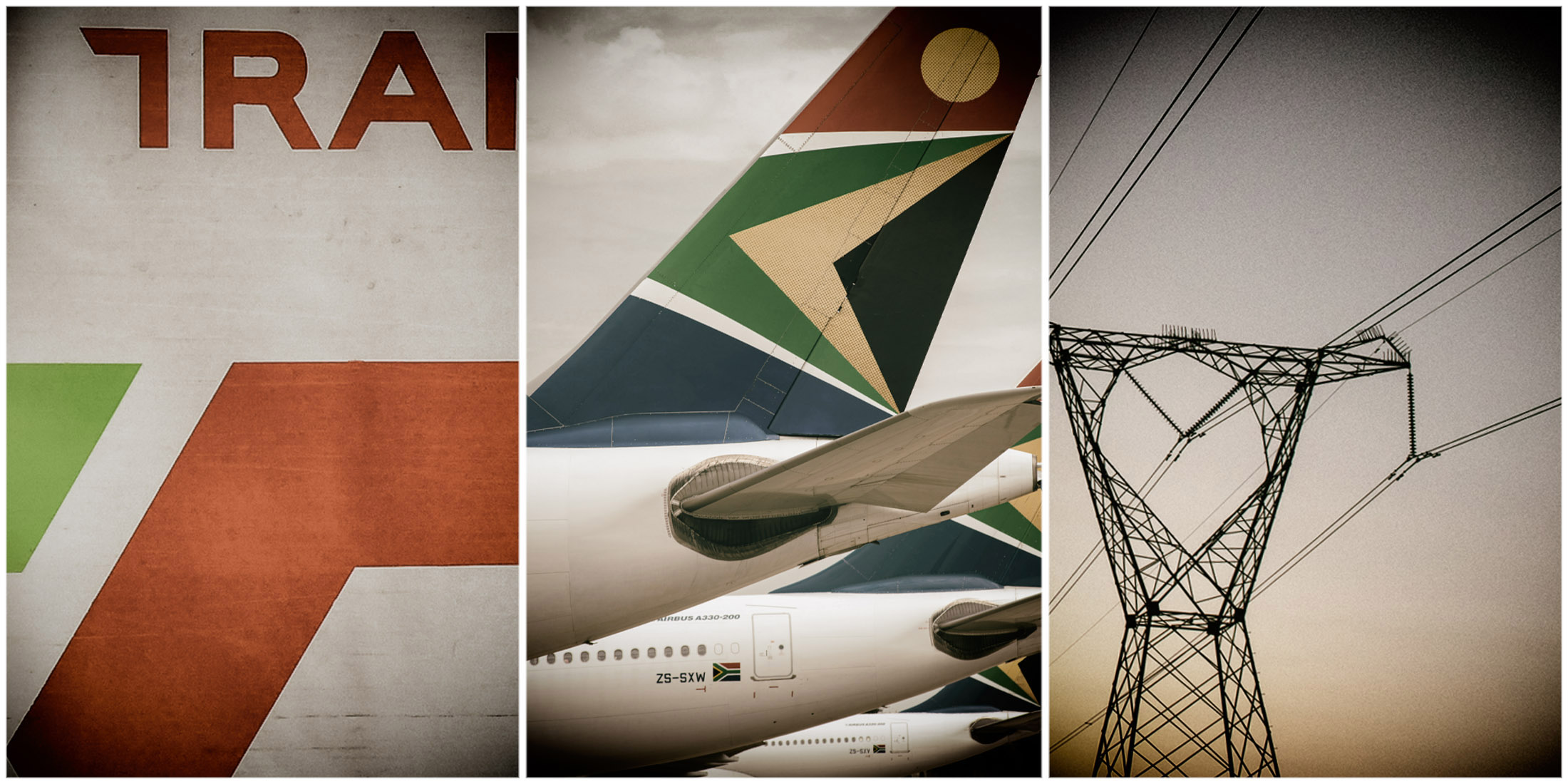
 Transnet logo. (Photo: Gallo Images / Darren Stewart) | South African Airways aircraft at OR Tambo International Airport, Johannesburg. (Photo: Waldo Swiegers / Bloomberg via Getty Images) | Eskom power lines. (Photo: EPA-EFE / Kim Ludbrook)
 I can’t imagine how our President feels when he looks at the state he is supposed to lead and wonders how it is all going to end.
I would also love to know how he really feels about the state of our state-owned entities.
It is so obvious that these companies are still in a very dire state.
When I spoke to Gloria Serobe on The Money Show recently I asked about her experience of being Transnet’s chief financial officer in the 1990s.
She said one of the difficulties was that many of the SOEs then were still establishing themselves – they had been government departments before and were trying to work out their identities as SOEs.
I was also interested whether, as someone who has been on many boards of SOEs as well as private companies, there were any differences between what she experienced in the private sector and in government.
I had half-thought that she might say that the coffee machines in Sandton were slightly better than in central Pretoria.
Instead she said that SOE boards were more fun because the work they did was more meaningful and complicated.
Over the past few months we have all been, correctly I think, cheering the apparent improvements in SOEs.
Who can forget where Eskom was and where it is now, or not see the very real progress at Transnet?
I had that coming-down-to-Earth bump you used to get on old SAA planes when I was pointed to the part of the Budget Review that looks at the debt position of our SOEs.
Obviously the story at Eskom is both improving and well known.
But the review’s commentary on Transnet is stark: “Transnet’s financial position remains fragile, characterised by rising debt levels and and insufficient cash. The company remains unprofitable, although it narrowed its net loss from R7.3-billion in 2023/24 to R1.9-billion in 2024/25.”
There are obviously different ways to see this. To be fragile, have rising debt levels and not enough cash is scary. But to narrow a net loss by such a large amount is also very impressive and a sign of progress.
I think the key thing to learn from Transnet and Eskom is that when you do make major changes, you can often expect positive results.
Only if you do the right thing, of course.
Denel is a good example of what happens when you don’t make major changes.
Treasury points out that it “faces stagnant revenues, a cost base that requires further restructuring, and constrained funding. The Auditor-General did not express an opinion on its financials due to insufficient audit evidence”.
I have to say, if our President were to redesign our state from scratch, I’m not sure that he would include a Denel.
Yes, it makes arms and weapons, but do we, hand-on-heart, really need it?
I get the idea that we need to be responsible for our own defence. But it may surprise you to know that we already have at least one private company making weapons and ammunition here.
Despite the Zuma administration’s insistence on keeping the list of National Key Points secret, when it was finally published we learnt that indeed the Germany company Rheinmetall has an ammunition factory in Boksburg (a special shout-out to whoever put the list on Wikipedia – it was the perfect response to the stupidity of Zuma’s people telling us some places were so important that they were National Key Points but were so secret we couldn’t know about them).
And I know someone will argue that Denel could sell weapons to other countries, but we can’t claim to have a moral voice in international affairs and then sell weapons to other people (there have been reports that some of the weapons made here by Rheinmetall are sold to Israel, making this doubly confusing).
The point of this is that I think there is probably a good case to keep an SOE as an SOE if it serves a particular purpose.
The roles of Eskom and Transnet are clear.
The role of Alexkor, a state-owned entity that mines diamonds, not so much.
I also noticed that this particular part of the Budget did not say too much about the Road Accident Fund. While commenting on its long-term provisions and expected future spending, it obviously makes no mention of changing the RAF model.
As has been said many times, the current model, in which the RAF is funded through a tax on fuel, simply isn’t working.
And, its recent history shows how easy it is to loot.
As Deputy Transport Minister Mkhuleko Hlengwa put it nicely, the RAF “had become a playground of ulterior motives”.
It is his ministry and Transport Minister Barbara Creecy who are going to have to make the real changes here.
But there is no point going on with the RAF as we currently are.
In the end, the problem facing SOEs is the same as it’s always been. Real reform requires real political will. And often it takes a proper crisis to get that political will. Hence Eskom and Transnet.
That means, until Denel or the RAF or Alexkor face a huge crisis, Budget Reviews will remind us how much in the state still needs to change. DM