




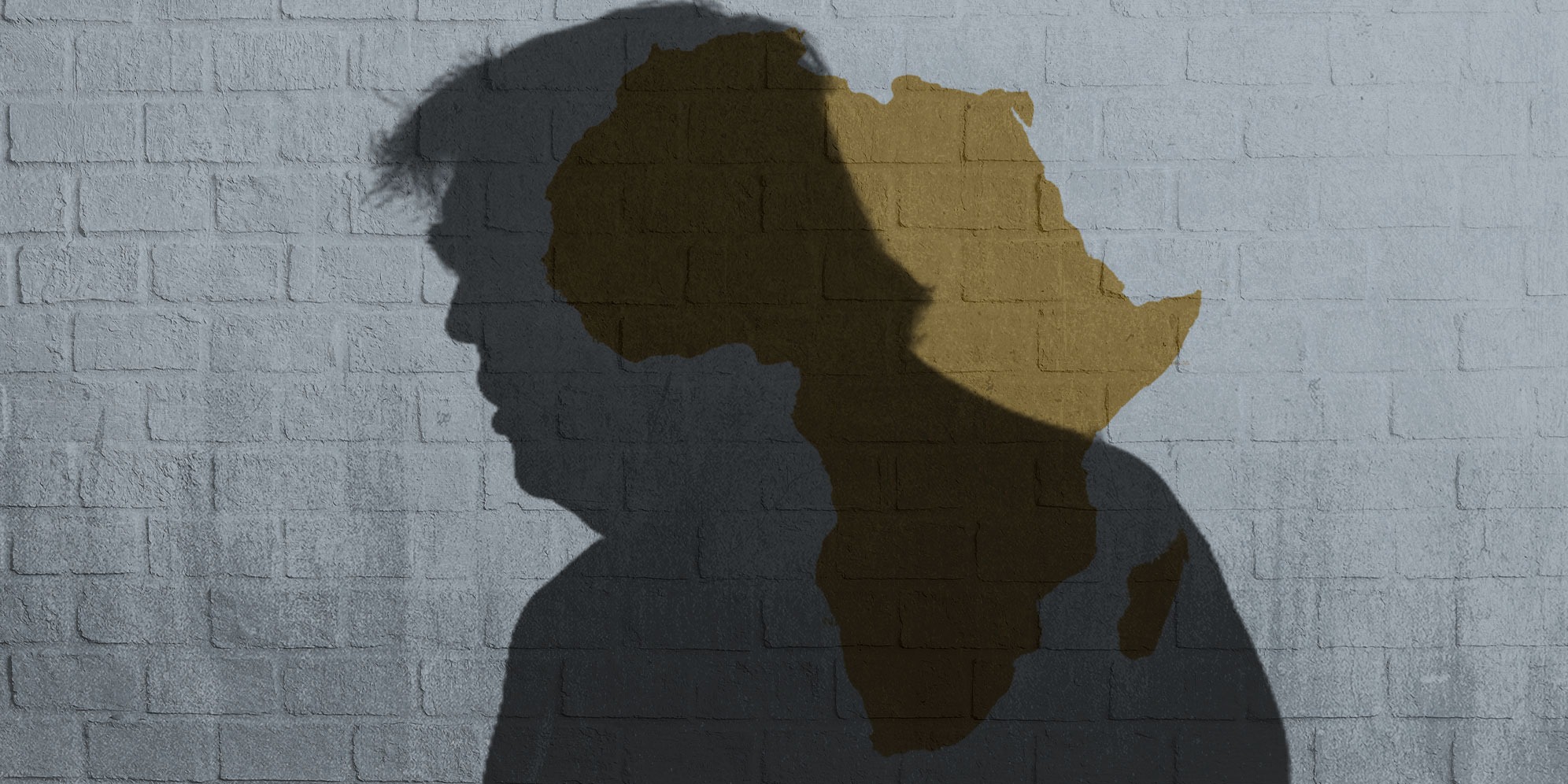
 Illustrative Image: Trump shadow. (Photo: EPA / Nicole Combeau / Pool) | African continent. (Image: Freepik) | Wall. (Image: Freepik) | (By Daniella Lee Ming Yesca)
 /file/dailymaverick/wp-content/uploads/2025/10/label-Op-Ed.jpg)
I’ve spent 30 years hauling cameras through the mud of Rwanda’s hills and the suffocating heat of Baghdad. I’ve seen empires stumble into Africa and retreat just as quickly, usually leaving a mess behind. But a year into Donald Trump’s second term, the “America First” doctrine has morphed into something I didn’t quite expect. It isn’t the cold, hard “Art of the Deal” realism some of us hoped for. It’s a wrecking ball.
When Trump took the oath again in January 2025, there was a cynical hope in some corners of Pretoria and Nairobi: at least he’s honest about what he wants. We thought the era of Western “human rights” lectures was over, replaced by a ledger. We were wrong. What we got instead was a cocktail of punitive 30% tariffs and a return to the kind of racial vitriol I thought we’d left in the 20th century.
Take the April 2025 tariff spikes. While most of the world was braced for a 10% “universal” tax, South Africa got hit with triple that. Why? The White House pointed at trade surpluses, but everyone in the room knew the truth: it was a shakedown. It was punishment for sitting at the BRICS table and refusing to toe the line on Ukraine.
It’s working, but not in the way Washington thinks. The Reserve Bank is staring down the barrel of 100,000 lost jobs. In the Eastern Cape, the auto plants are going quiet – exports to the US didn’t just dip, they cratered by 80% in a single month. It’s not trade policy. It’s a siege.
Then there’s the rhetoric. In December, the mask didn’t just slip – it was incinerated. During a cabinet meeting, Trump spent two minutes trashing Somali immigrants, spitting out the word “garbage” four times in seven seconds like he was clearing his throat. “Their country stinks,” he told a room full of nodding suits.
It’s a tired script. I’ve heard it in a dozen different languages from a dozen different strongmen. He called Somalia “hell” and took a personal swipe at Ilhan Omar, a woman who actually knows what a civil war looks like, unlike the people applauding in that room. It wasn’t just a hot-mic moment; he took the show to Pennsylvania a few days later, doubling down on the “shithole” comments he used to have the decency to deny. Now? He wears the slur like a badge of honour.
The fallout was predictable. ICE raids in Minneapolis, frozen visas and a clear message to the continent: we don’t want your people, and we don’t value your soil.
The diplomatic collapse in Pretoria was just as ugly, if a bit more “refined”. When Marco Rubio declared ambassador Ebrahim Rasool persona non grata in March, it felt like a schoolyard spat. Rasool’s crime? Pointing out the “supremacist instinct” at play during a private call. Instead of a conversation, Washington chose an expulsion. By April, 30 years of military cooperation – something that survived through three different US presidencies – was binned.
The kicker? Trump’s executive order in February offering fast-track visas for Afrikaners. It was a blatant dog whistle, a nostalgic nod to an era South Africa spent decades trying to bury. It wasn’t about human rights; it was about interference.
While Washington was busy burning bridges, Beijing was handing out bricks. In September 2025, the African Growth and Opportunity Act (Agoa) – the trade deal that kept the lights on for a lot of African exporters – looked like it had finally breathed its last. However, on 4 February 2026, EWN reported that Agoa “has been given Senate approval for one year after extensive deliberations by lawmakers in the United States”. This was after Trump met a few leaders in July, gave them a “we’ll see” and then did nothing. The one-year extension still needs to be ratified by Trump, I believe.
Meanwhile, China swept the board, dropping tariffs for 53 nations in June.
It’s almost funny, in a dark way. Trump claims he wants to “stop” China, but he’s become its best recruiter. Every time he throws a tantrum or slaps a 30% tariff on a BRICS partner, he’s just driving another nail into the coffin of American influence. As one analyst in Johannesburg put it, with a weariness I recognise, the tariffs aren’t breaking African resolve; they’re just forcing everyone to find better friends.
What’s truly exhausting is the incoherence of it all. He wants the minerals. He wants the leverage. But he’s traded strategy for ego. He thinks he’s “the dealmaker”, but you can’t make a deal with someone you’ve already called garbage. That isn’t negotiation. It’s a protection racket run by someone who doesn’t understand that the neighbourhood has changed.
I’ve spent my life in the rubble of “great power” strategies. I know the smell of an empire overreaching. Trump thinks Africa is a collection of “weak” states with no choice but to beg. He’s wrong. The world in 2026 isn’t the world of 1990. There are other markets. Other banks. Other partners who at least have the manners to hide their exploitation behind a handshake rather than a tweet.
The human cost? That’s where the cynicism hits a wall. It’s the families in Port Elizabeth looking at empty factory floors because of a trade war they didn’t ask for. It’s the kids in Mogadishu realising the “shining city on a hill” is closed for repairs. These aren’t just data points for a Financial Times column; they’re the casualties of a presidential tantrum.
The G20 debacle in November was the final act – a historic moment turned into a farce. South Africa hosted the summit in Johannesburg, the first time the G20 touched African soil. It should have been a victory lap for the continent. Instead, Trump boycotted the whole thing, chasing ghosts of “white genocide” and dismissing the entire agenda as “DEI” nonsense. He didn’t just skip the meeting; he spat on it. He called the summit a “disgrace” and wouldn’t even send a proper delegation. When the time came to hand over the G20 presidency to the US, there was no one there to take the gavel. It was a tantrum dressed in a suit. Three days later, he barred South Africa from the 2026 summit at his Doral golf club and threatened to pull every cent of US aid.
It wasn’t diplomacy; it was a shakedown by a man who realised he wasn’t the centre of attention. But here is the exquisite irony: while Trump was sulking at Mar-a-Lago, the rest of the world showed up. China, Russia, Germany, Japan – everyone who matters was in Johannesburg. They signed the declaration without him. As Canada’s Mark Carney put it, the world has realised it can move on without Washington. The summit didn’t just succeed despite Trump’s absence; it succeeded because of it. The vacuum he left was filled within hours, mostly by Beijing.
For African leaders, the lesson is cold but clear. Trump thinks poverty equals powerlessness. He’s making the oldest mistake in the book: confusing economic pressure with actual strategic leverage.
He thinks he can starve the continent into submission, but Africa has options now.
The “opportunity” I once saw in his transactional world isn’t about making deals with him – it’s about realising that we don’t need his permission to survive.
As we sit here in February 2026, the air is thick with a new kind of uncertainty. Trump has already spent the first weeks of the year walking back fresh tariff threats against Europe over Greenland, but for Africa, the damage of 2025 is already in the bones of the economy. We’re waiting on a US Supreme Court decision that might – just might – pull the rug out from under the legal authority of these “reciprocal” tariffs. But I’m not holding my breath. I’ve seen enough “legal” overreaches to know that power rarely gives back what it’s already taken.
Africa’s path forward isn’t through Washington; it’s through the new alliances being built while America throws its toys out of the pram. The world is changing, and for the first time in 30 years of covering this beat, I think Africa might finally be ready to leave the “Great Powers” behind in the dust. The “opportunity” wasn’t a seat at Trump’s table – it was the realisation that we can build our own. DM
Danie Nortjé is a Fellow of the Royal Geographical Society and an award-winning documentary filmmaker who has spent more than 40 years in print, broadcast, news and documentary production, specialising in current affairs, investigative journalism, conflict zones and natural disasters.