



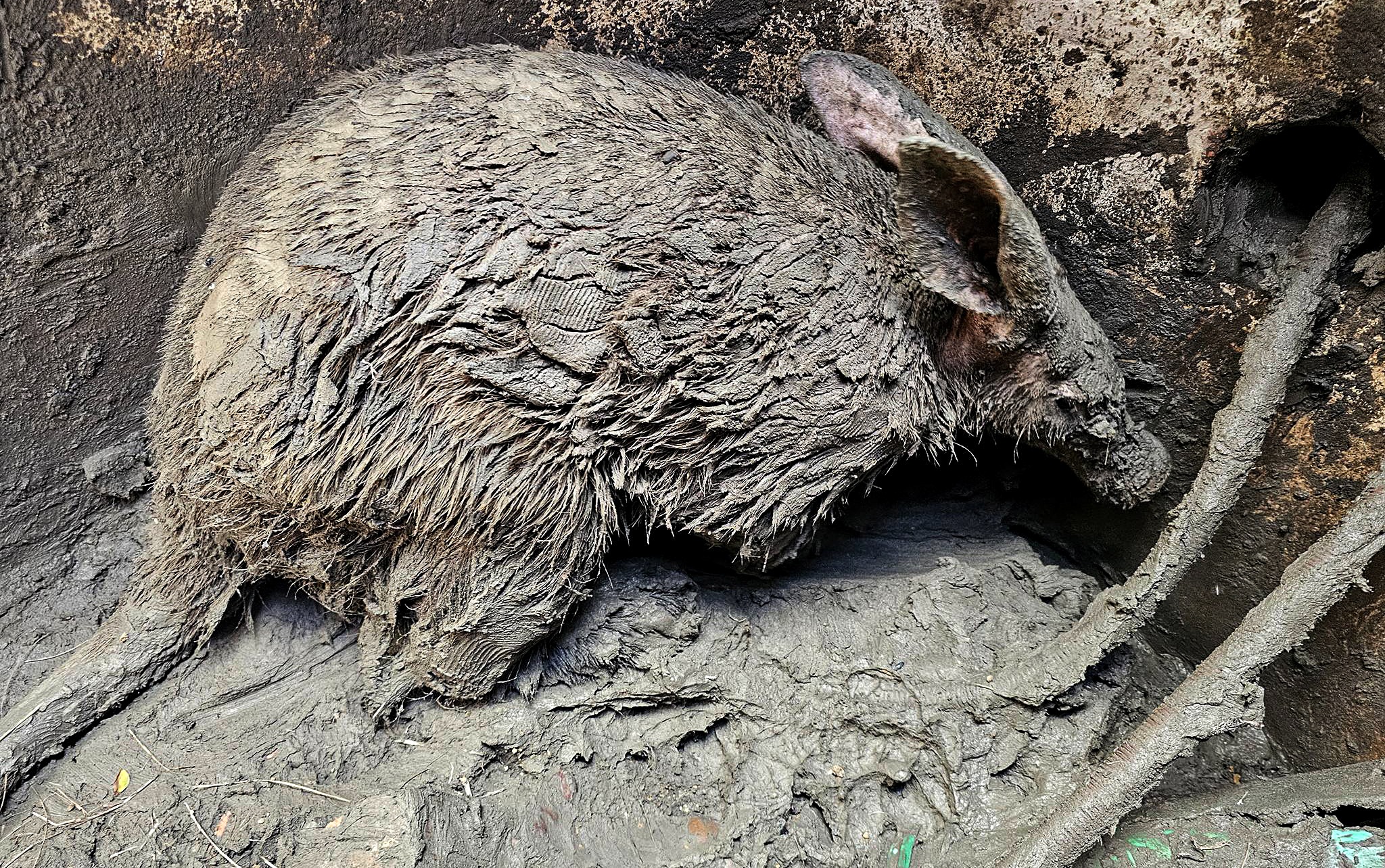
 On Tuesday, Arnold Slabbert pulled an aardvark out of a telecommunications company’s manhole along the N2 in the Van Stadens area outside Gqeberha, Eastern Cape. He had to climb inside the manhole to free the animal, which was covered in mud. (Photo: Facebook / Arnold Slabbert)
What do you do when all you can see in a dark, deep hole is an ear and an eye? If you’re Arnold Slabbert, you simply climb in to rescue whatever is in there.
On Tuesday, 10 February 2026, Slabbert, an urban conservationist with Wildline, pulled a female aardvark out of a telecommunications manhole along the N2 in the Van Stadens area outside Gqeberha.
The aardvark was first spotted by technicians who thought a small antelope was peering out of the vandalised manhole.
Caked in mud, with only an ear and an eye visible above the sludge, the stranded animal was in fact a female aardvark. Her rescue has since become a small but significant reminder of the unintended victims of South Africa’s infrastructure theft crisis.
“It’s a very sad story,” Slabbert said this week. “It’s symptomatic of the breakdown of law and order in our country. Everywhere you go, manhole covers are getting stolen because they’re metal. And when they’re not replaced, the manholes become deadly traps.”
The manhole in question had reportedly been left exposed after vandalism at the site. With recent heavy rains in the area, the concrete shaft had filled with water and thick mud. Any animal passing through the area at night could have fallen in.
“I’ve had to rescue quite a few species out of these manholes,” Slabbert said. “A lot of snakes, and even small antelope. Once they fall in, they can’t climb out. It’s concrete. They remain trapped there until they die.”
/file/attachments/orphans/Photo1630196456_25567143172984389_1159015721991265960_n_155077.jpg "Staff at Mount Croix Animal Clinic clean the rescued aardvark, which was covered in mud. (Photo: Facebook / Arnold Slabbert)")
When he received the call on Tuesday, Slabbert was told a “buck” had been spotted in the hole, and that his help was needed. When he arrived, Slabbert climbed into the manhole and, after assessing the animal more closely, he realised it was an aardvark – a nocturnal, protected species that is becoming increasingly scarce in parts of the Eastern Cape.
These wild animals with their long snout and perky ears are also often referred to as “ecosystem engineers”.
“Aardvarks are heavily persecuted,” he said. “In our region in particular, they are very much persecuted by people hunting with dogs, and often shot by livestock farmers because they make holes along fences that allow lynx and jackals through,” Slabbert said.
“Another reason they are heavily persecuted is that they like making burrows in damn walls. And the farmers, they blamed them for the collapse of the walls.”
Slabbert recalls arresting a man during his conservation days who had shot five aardvarks in a single evening.
“All of these factors contribute to their decline.”
Rescuing this particular animal was no simple task as aardvarks are powerfully built and surprisingly heavy.
“If you just put a rope around it and pull, you can break its ribs,” Slabbert said. “You have to be careful.”
Inside the manhole was about 50cm of mud. The aardvark had wedged herself beneath cabling in an apparent attempt to hide. “It’s like trying to pull a tank out of mud,” Slabbert said. “They just won’t move.”
Climbing into the manhole himself, he began digging away rocks and sludge with his bare hands to manoeuvre a harness under the animal. A farmer at the scene suggested using a broad cattle-lifting belt, which ultimately proved effective.
/file/attachments/orphans/Photo2633085788_25565908963107810_720150887736462852_n_382193.jpg "Slabbert and a team had to hoist the aardvark out of the manhole. (Photo: Facebook / Arnold Slabbert)")
“Sitting in that hole with her, I just felt incredibly sorry for her,” Slabbert said. He suspects she had been trapped for several days. Because the manhole does not drain, she probably had to swim at times to keep her head above water during the recent rains.
Once extracted, with the help of a farmer and the technicians, the aardvark was transported to Mount Croix Animal Clinic in Gqeberha, where veterinarian Dr Matthijs Ravensberg assessed her condition. It took nearly half an hour to wash off the thick mud that had hardened across her body.
Only then was it confirmed that she was female – identifiable by the white tip of her tail. Remarkably, there were no broken bones, though she was stiff and exhausted after days confined in the narrow space.
/file/attachments/orphans/Photo6630578006_25565907923107914_6070619661947841732_n_649592.jpg "The aardvark became trapped after falling into the manhole, whose cover had been stolen. Slabbert says he often sees animals that are stuck in open manholes. (Photo: Facebook / Arnold Slabbert)")
Ravensberg said it was unusual to receive an aardvark as a patient.
“It’s a rare experience for us to get an aardvark at the hospital,” he said.
The animal arrived confined in a transport crate and was initially difficult to examine because of the thick layer of mud and debris coating her body.
“At first it was difficult to assess her because she was just covered with mud and whatever else was in that manhole,” Ravensberg said. “But once we cleaned her up, she was actually in good general condition.”
After being washed, the aardvark was found to be alert, well nourished and in relatively good physical shape, with no obvious major injuries.
/file/attachments/orphans/Photo4631002888_25565909339774439_2190943483668407772_n_731920.jpg "After the rescue, the aardvark was washed clean. (Photo: Facebook / Arnold Slabbert)")
Ravensberg said it was impossible to determine precisely how long the animal had been trapped, but he believed the ordeal was probably shorter than initially feared.
“It’s very difficult to say how long she was in the manhole,” he said. “I don’t think she would have been in there for longer than 48 to 72 hours.”
Ravensberg warned that vandalised infrastructure posed a serious threat to wildlife, with open manholes and damaged sites acting as hidden, often deadly traps.
/file/attachments/orphans/Photo7630812843_25567143716317668_1610690923303664376_n_775281.jpg "After it was cleaned the aardvark was released on a property next to the N2. (Photo: Facebook / Arnold Slabbert)")
Later that day, Slabbert returned the aardvark to the Van Stadens area and released her on private property away from the N2.
For Slabbert, the rescue was a relief – but also a warning.
“It is sad that this has happened. If you think about it, it happened because there is a collapse of law and order. The theft of infrastructure is just horrendous. This is not the only situation that I deal with where infrastructure theft puts wildlife at serious risk, and kills lots of wildlife too,” he said. DM