




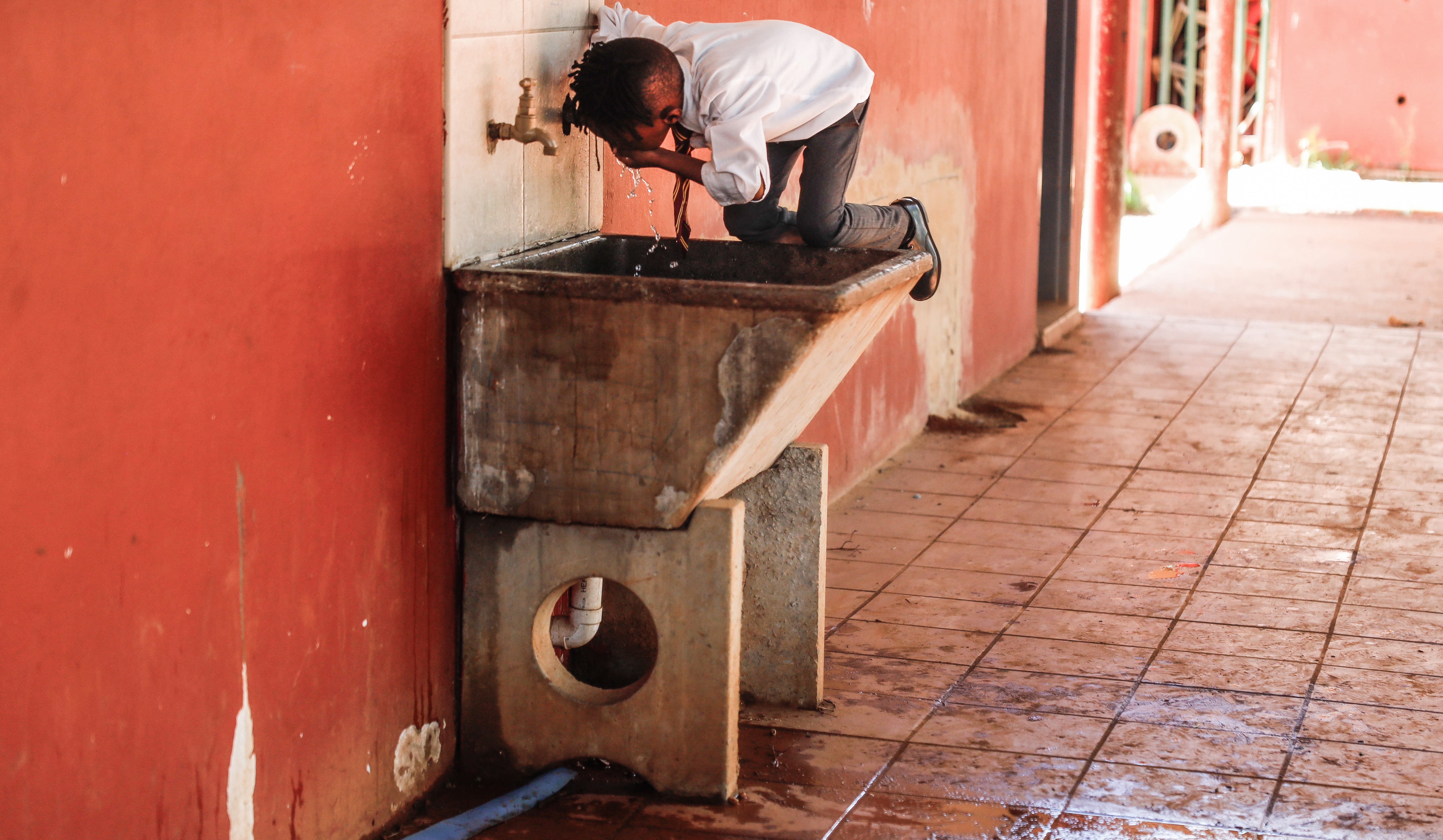
 As the taps run dry across Gauteng, the divide between the province’s poor and wealthy schools only deepens. (Photo: Gallo Images/Sharon Seretlo)
In the shadow of Johannesburg’s water crisis, Noordwyk Primary School has become a casualty. The school starkly illustrates how municipal failures ripple into lost learning time.
Midrand became the epicentre of a severe water crisis in Gauteng, where ageing infrastructure and repeated power failures at the Palmiet Pump Station left the area’s reservoirs critically low for extended periods. This instability reached breaking point, causing outages that lasted nearly a week, severely disrupting the local education system.
Schools in the area, including Noordwyk Primary, have been forced into a chaotic rhythm of operational uncertainty. Without running water, sanitation becomes an immediate health hazard, compelling principals to issue early dismissal notices and shorten the academic day. This has shifted the burden on to families, who must scramble to collect children at midday and ensure learners arrive with their own water supplies, ultimately turning basic hydration into a logistical hurdle that detracts from classroom time.
Elias Lentsoane, the school’s deputy principal, detailed the scramble during a recent outage. With 1,634 students relying on the facility, the absence of running water turned routines upside down.
“We woke up without it,” Lentsoane explained, noting that there were no warnings from the municipality.
A JoJo tank, installed as a Varsity College student project and connected to the main pipes, provided a brief morning reprieve.
“Every morning, we have a little bit of water, but the pressure was not powerful,” he said. Staff instructed learners to fill their water bottles from it, but the supply dwindled fast, forcing early knock-off times when the tank ran dry.
Parents’ frustration boiled over as repeated early dismissals upended family routines and children’s education, with many voicing anger over the unpredictability.
“The parents, they were angry, but there’s nothing we can do, and there’s nothing they can do because it’s a municipality issue,” he said.
No municipal water tankers arrived to deliver emergency supplies, leaving the school to ration its lone JoJo tank.
“When the school knocks off at 10 o’clock, that’s a lot of learning time lost,” Lentsoane noted. To claw back hours, he outlined a catch-up strategy which includes extending each school day by 45 minutes once water stabilises.
Looking ahead, the school is pursuing self-reliant solutions, as government support remains elusive. A local garage has pledged a borehole, and the school seeks five more JoJo tanks.
“We have to build our own resilience. If we want consistent schooling for our children, we have to secure the water ourselves,” he said.
Sanitation breakdown forces early closures
The struggle at Noordwyk is not an anomaly. A teacher of a local high school in Johannesburg South, who spoke on condition of anonymity for fear of reprisal, described a collapse in basic sanitation that forced their hand during the recent outages.
/file/attachments/orphans/0000239701_870761.jpeg "Taps are dry at the Ormonde Primary School in Johannesburg. (Photo: Gallo Images / Beeld / Mary-Ann Palmer)")
“We arrived to no water. By 11am, toilets were spilling over, which is a health hazard with raw sewage risks. We had no choice but to dismiss learners early,” she said.
In the days that followed, absenteeism soared with the teacher noting that student attendance often hinged on functioning taps at home.
“No water means no clean uniforms, and we’re strict on dress codes,” she said.
For this teacher, the suggestion of “self-reliance” rings hollow.
“Alternative water supply sounds good, but it’s unrealistic for underfunded schools. Not all public schools can fund boreholes or JoJo tanks,” she said.
Read more: Despite protests and promises, taps are still dry in Johannesburg
Engineering water independence
While self-reliance is a distant dream for many schools, at Gauteng’s elite schools, it is already a sophisticated reality.
St Stithians College, a private school on a 105-hectare campus, has effectively purchased immunity from the crisis. In a joint statement, Thando Bili, Head of Operations, and Rector Celeste Gilardi confirmed that the school’s strategic investment in infrastructure has completely shielded it from municipal failures.
“We have had no potable water outage for any of our campus activities for the past four years,” they said.
This stability is the result of a massive pivot toward self-sustainability. Since 2021, the college has operated its own water treatment plant, licensed by the Department of Water and Sanitation, which filters groundwater to SANS 241 potable standards. The scale of this operation is immense: as far back as 2022, the school’s Water Security Programme reported that the plant was already supplying more than 70% of the campus’s total water needs.
/file/attachments/orphans/Lessons-GIrlsCollge1_317021.jpg "St Stithians describes its treatment plant as a ‘living classroom’ where students from Grades 1 to 12 engage directly with the science of sustainability. (Photo: Supplied / St Stithians)")
The water crisis disrupts curricula differently across schools. At Noordwyk, dry taps simply mean lost learning time; at St Stithians, water infrastructure becomes the lesson itself.
The college describes its treatment plant as a “living classroom” where students from grades 1 to 12 engage directly with the science of sustainability.
“In several instances, teachers have incorporated the water treatment plant into classroom teaching across subjects such as natural sciences, geography, environmental studies, and life sciences,” said Bili and Gilardi.
A similar water fortress strategy is visible at St John’s College. In May 2024, the school officially launched a dedicated Water Treatment Plant, partnering with filtration specialists Pure Care to treat borehole water to drinkable standards. St John’s has also installed two colossal 50,000-litre storage tanks, creating a massive buffer against supply cuts.
/file/attachments/orphans/ED_220078_193055.jpeg "St John’s College in Johannesburg. (Photo: Gallo Images/Sydney Seshibedi)")
The school’s water system is backed up by solar power and generators, ensuring that even when the electricity grid fails, its pumps do not. Its public documents reveal a goal that effectively reverses the normal order of operations: it aims to use municipal water only as a backup, having engineered its way out of reliance on the state.
Resilience running dry
Contrary to perceptions of a sluggish education system, South African schools are proving remarkably adaptive, according to Dr Jaco Deacon, CEO of The Federation of Governing Bodies of South African Schools (Fedsas).
Deacon detailed how school principals and governing bodies (SGBs) are deploying practical strategies to keep bathrooms functional and doors open, even as municipal supplies falter for weeks.
Federation members have rolled out three main storage solutions, refined over the years:
- JoJo Tanks: Municipal lines feed 10,000–20,000-litre tanks on school grounds. Water is then piped to toilets and taps. Deacon explained that if supply cuts out, reserves buy time, but prolonged outages deplete this reserve rapidly.
- Boreholes: Schools with groundwater access drill boreholes. Quality varies, with some using it to flush toilets or irrigate gardens, while filtered water reaches taps.
- Rainwater harvesting: Vast school roofs channel runoff into JoJo tanks. Deacon said this was mainly for gardens, but in desperate times, it was used for flushing.
However, Deacon describes a system operating in survival mode. He admits that students are often asked to bring personal bottles to contribute to handwashing and flushing. a strategy he calls a “short-term patch” because, ultimately, “you can’t run a school without flushable toilets”.
This places immense pressure on SGBs. While short disruptions are manageable, extended outages force difficult financial decisions. SGBs typically tap into school fees first, but Deacon admits the situation is dire for cash-strapped institutions. These schools are forced to seek business sponsorships or community donations just to keep the taps running.
Daily Maverick sent questions to the Gauteng Department of Education on the impact of the Gauteng water crisis on schools. At the time of publication, the department had not responded.
The hidden hazards of going off grid
Roger Diamond, Director of the Biogeochemistry Research Infrastructure Platform (Biogrip), warns that the regulatory landscape is often a bureaucratic maze. Obtaining a Water Use Licence from the Department of Water and Sanitation can take months or even years, leading to a scenario where desperate schools may bypass necessary scientific oversight.
Diamond points out that without the guidance of a hydrogeologist, the specific geology of an area is often ignored; even in wetter climates, water over rocks with poor water retention can be rapidly depleted if usage isn’t managed.
“Common sense dictates that if enough people use enough water, the resource will become depleted,” he noted, adding that accurate data on usage is scarce across the board.
Beyond depletion, there is the critical issue of safety. Diamond emphasised that drilling a hole in the ground does not guarantee clean water, particularly in urban environments riddled with leaking sewer pipes, septic tanks and pit latrines.
The water quality depends heavily on local pollution risks, and while groundwater might be perfectly safe for flushing toilets, it is not automatically safe for thirsty learners.
“There is no absolute when it comes to water quality,” Diamond explains.
He warns that schools failing to budget for ongoing testing risk exposing students to contamination, potentially turning a solution for water scarcity into a new public health hazard.
As the taps run dry across Gauteng, the divide between the province’s schools only deepens. While wealthy institutions fortify their campuses to ensure the curriculum never stops, public schools are left navigating a maze of daily health risks and lost hours. DM
Comments
Scroll down to load comments...