



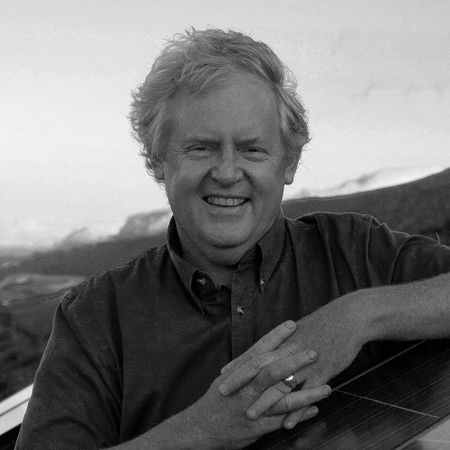
 In this richly researched biography, Tim Cohen explores the life and ideas of Leon Louw, the firebrand libertarian who championed freedom and enterprise during South Africa’s transition to democracy. (Publisher: Maverick 451)
 In this richly researched account, Tim Cohen draws on conversations with Leon Louw to present a portrait of a firebrand libertarian who championed freedom and enterprise during South Africa’s transition to democracy, and beyond. From fighting apartheid-era property laws to advocating economic freedom globally, together they examine what worked, what didn’t, and what still could. Here is an excerpt.
***
This book has an odd history. Following Leon Louw’s exit in July 2022 from the Free Market Foundation, the organisation he founded in 1973 and ran for five decades, his friends gathered and resolved that if nothing else, the record should be set straight about the events that led to his departure. One of the ideas suggested was to entice an unsuspecting journalist to pen a biography of Louw’s life, and in the process, this strange and upsetting story could be told in detail.
When this group of avid supporters and members of the FMF started looking around for writers who might take on the job, my name came up, partly because I had actually covered some of the breakup of the FMF as a journalist, and Louw and I were somewhat acquainted.
I knew then that Louw had led and continues to lead an astonishing life. He became and remains one of the world’s best-known advocates of individual liberty, and a proponent of free markets. He is an internationally celebrated expert on government policies, laws and economics, and back home he is credited with having made significant contributions to more than a hundred reforms, including vital clauses in the South African Constitution, such as the Property Rights and Administrative Justice clauses. He was one of four featured speakers at the historic 1987 Dakar Conference, where he led the debate on the Constitution.
As South Africa stood on the brink of democracy in the early 1990s, Louw played a significant role in shaping the country’s future. He fought to ensure property rights were enshrined in the post-apartheid Constitution, not just as legal technicalities but as the cornerstone of real, enduring economic freedom. He is the author of hundreds of published articles and papers; he has been a speaker in more than 50 countries; and he has addressed the United Nations and United States Congressional committees, sharing platforms with many luminaries, including a dozen Nobel laureates.
His best-selling books, South Africa: The Solution (Amagi, 1986) and Let the People Govern (Amagi, 1989), both co-authored with his wife, Frances Kendall, laid out a radical yet practical vision for a decentralised democracy with entrenched checks and balances. The books sparked national debate.
/file/attachments/orphans/LeonLouwandFrancesKendallwithSouthAfricaTheSolutionin1987Thebookwentontosellmorethan75000copies_TimeLive_271523.jpg "Leon Louw and Frances Kendall with South Africa: The Solution in 1987. The book went on to sell more than 75,000 copies. (Photo: Time Live)")
Many of the ideas he championed – once considered impossible – are now woven into the fabric of South African governance. Louw started the movement towards true freehold land titling for landless black South Africans more than 40 years ago. Titling has been a game-changer in the lives of hundreds of thousands of township dwellers.
His work with informal traders, which extended to amending the law and a Constitutional Court judgment against the Johannesburg City Council, was trailblazing. He remains a celebrated figure in this community.
But perhaps his greatest achievement was his creation of the Free Market Foundation in 1973, from which, with great sadness, he resigned after 50 years at the helm. There were many reasons for it, but the watershed came over how to manage and distribute the windfall of the Johann Rupert and Remgro millions donated for titling.
There were other reasons for the cleavage. One was the increasing political orientation of Louw’s colleagues in 2020 as they moved away from the organisation’s apolitical position, a position that had become a firm article of faith and was a hallowed tradition for almost the entire duration of the Foundation’s existence up till that point. But this was the period when the presidency of Jacob Zuma had permitted, deliberately and through neglect, increasing levels of corruption. The “political” element in the FMF was keen to “take a stand” and wanted to be more openly critical of the ANC government at the time.
To become a political entity aligned with, or opposed to, a political party or movement wasn’t just a bad idea tactically; there was the history of the organisation to consider. The FMF had played a crucial role in the political settlement in 1994, and an even more crucial role in promoting some of the stipulations and ideas which form part of the Constitution.
It’s worth setting history straight on this point too. With the passage of time, the efficacy of these ideas, as well as the orientation and contents of the Constitution as a whole, are worth re-examining. What worked and what didn’t? The more Louw and I talked, the more that issue came up.
We met online once a week over the course of almost a year to tell the story of the history and breakup of the organisation, and of Louw’s life. Our weekly discussions ultimately suggested the final structure and contents of the book. We wanted to tell the story of the breakup of the FMF, and we wanted to indulge in a bit of a biographic journey. We also wanted to record, discuss and dissect the role and battles the FMF took on in the post-transition period.
In many respects, the work of Louw and the FMF is the missing chapter in South Africa’s transformation story.
Which brings us to the final section of the book: the future. The more we spoke about history, the more the future loomed large. And given that Louw’s first book, The Solution, had been such a pivotal and consequential contribution, we began toying with the idea of including a section of what South Africa could do next. At the time of The Solution’s publication in 1986, people were crying out for a way forward in what seemed a political and economic cul-de-sac.
There is an obvious historical analogy to be made: South Africa once again stands at a political and economic impasse.
The section in this book is really quite different from the original. The Solution was concerned primarily with putting forward some proposals for a political and constitutional state that could balance the nationalistic instincts of the large “black” political parties, which were banned then and still provide security for the enfranchised and richer white South Africans today. The core concept proposed in The Solution, in the broadest terms, was a kind of canton system, similar to the one in Switzerland, along with constitutional safeguards and economic freedom. It was a heady mix, which gained broad support across political boundaries.
What the politicians in the banned organisations liked about The Solution was that even though the political and economic suggestions might not have been entirely to their taste, it at least foretold a possible way out of the political impasse, which was driving the country deeper and deeper into the morass. What the politicians in the apartheid government liked about the book was that it suggested concrete ways they could dismount the tiger without being eaten. What business liked about the book was that it proposed solutions that would enhance free trade and wealth creation. That idea of expanding rather than contracting businesses was frantically necessary as South Africa defaulted on its international debt obligations and the economy ran out of steam in the early 1990s.
But the emotional appeal of the book was, I suspect, so much greater: At last someone was putting specific, concrete suggestions on the table to form the basis of a future, which at the time seemed very far off. Ultimately, the political process took its own direction. But based on the book and its ideas, Louw took part in the early ice-breaking meetings between South African political figures and the then still-banned ANC in Dakar (Senegal) and elsewhere. And these meetings had their own hope-building function, which ultimately – and dramatically – culminated in the unbanning of the “black” political parties, the constitutional negotiations, and South Africa’s reconstituted future.
It’s eye-opening to look closely at how many of the ideas proposed in The Solution made it all the way into the final Constitution beyond the normal prescripts of Western democracy, particularly those rooted in the idea of meaningful freedom and popular democracy, ideas that had cross-sectional appeal and were particularly important for the ANC. The party itself was going through massive changes during this period, with many of its key players wedded to a kind of Soviet approach to politics and development. Yet, international changes and the collapse of the Soviet Union gave ANC members, and others, pause. It was a time ripe for alternative ways of thinking. The final Constitution of the Republic of South Africa of 1996 is effectively a stew of ideas, some seemingly and some actually in contradiction.
The Solution’s views about market-led reforms held up one end of the political spectrum, pulling the centre of political gravity towards this different set of ideas. The result was a middle course, something akin to Scandinavian social progressivism. Our section called “The Solution Continued” tries to take some of these concepts a bit further.
South Africa, of course, does not now face the same intense political impasse as it did in the late 1980s. For one thing, huge strides have been made in human development, many of which are now taken for granted. But there is no question that a kind of stultification has set in, partly broken recently by the advent of the Government of National Unity; however, the jury is out.
Although the stakes are different, we are once again at a moment that requires fertile debate. Some of the ideas Louw puts forward are very similar to those suggested almost a generation ago. Some are simply expanded because of the new environment. But some are novel ideas stimulated by the current moment, and personally, I trust they go much, much “too far”.
Hence, this book is presented in four sections. The first, “The Solution”, deals with Leon’s own philosophical development, and the arguments and ideas leading up to the creation of South Africa’s new Constitution, including the writing of The Solution and its aftermath. The second, “Democracy Arrives”, examines some of the programmes and campaigns in which Louw participated through the FMF during the first years of democracy. This is a long period for which we have picked a few events – some local and some foreign – that we thought were worth recording. Some are momentous, some are philosophical, and some are just plain fun. Then we turn to the tragic breakup of the Free Market Foundation.
And finally, we come to “The Solution Continued” and its ideas for the future, intended to help once again in the process of dragging the obstreperous schoolkid that is South Africa towards a more prosperous tomorrow.
Each of these sections, we hope, can be read in isolation or in any order. If you consider the history to be boring (which would be poor judgement, by the way), please page ahead and focus on the future. If you think the future is variable and inchoate, by all means, track some of the important battles and campaigns of the modern era. And if “Who is Leon Louw, the man?” is not of interest, just pass this chapter along to someone who disagrees!
One note on the breakup of the FMF: What appears here is Louw’s perspective on the separation, and the remaining members will presumably have their own view. Much of it is part of public record, and I’ve included the position of the new organisation where I thought appropriate. I should make my position clear: I think what the organisation did to Louw was disgraceful, as a judge of the High Court ultimately found, and that is partly why I accepted the commission to write this book.
Louw is adamant that the ideas encompassed by the libertarian movement should be attractive to all parties, because they are useful to the citizenry generally, and not just to sections of it. As Louw says, a policy institute’s job is to influence government policy, i.e. the government of the day. What most political institutes and organisations do is preach to the converted. Louw says, “It is like a preacher in church every Sunday soliciting more for the same collection plate they filled last week. It converts no one, wins no one over. But preaching to the ‘savages’ in the metaphorical jungle will often get you nothing into the collection plate. Missionaries of this type often get boiled and eaten… but they do also win converts.”
So, off to the jungle then. DM
Leon Louw: A Legacy of Solutions by Tim Cohen is published by Maverick 451. It is available for pre-order on the Daily Maverick Shop. Click here to reserve your copy; nationwide delivery will start from 5 January 2026.