




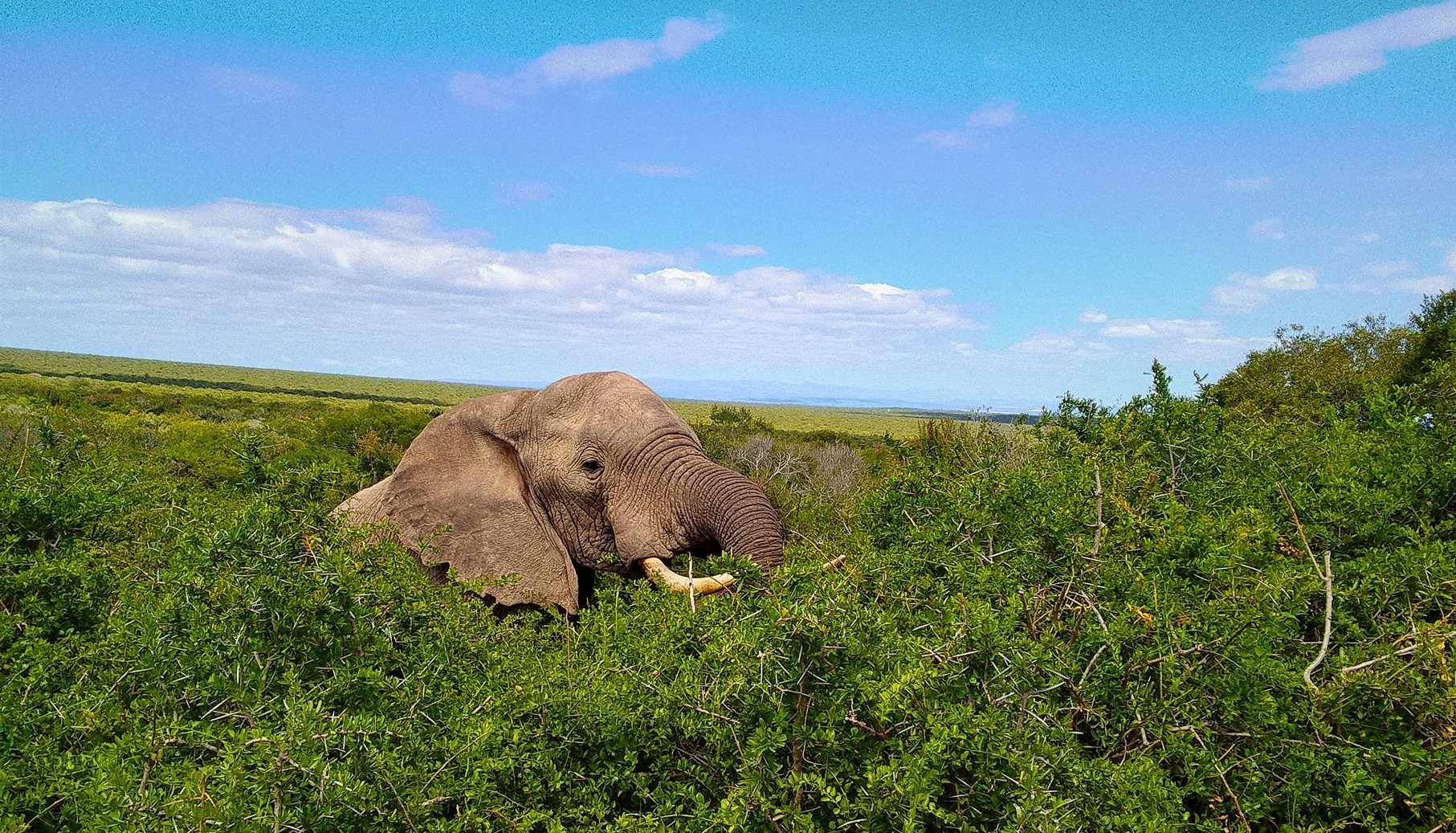
 An elephant peeps over some trees at Addo Elephant National Park. (Photo: Mafungwase Media)
 The sun announced itself pretty early in Cookhouse on a Thursday in late February with the mercury flirting near 20⁰C as early as 6am. Further south, beachgoers must be chuffed, the ocean is about 100km as the crow flies.
The N10 to Addo is replete with crawling trucks, slowing early morning traffic. The road is flanked by farms, some of which are mothers to SA’s newish type of farms: wind farms. There’s more on these roads: elephants and aloes aplenty. Just look.
/file/attachments/orphans/SAroads3ECN10sunset-Mafungwase_528902.jpg "Sunrises in the Eastern Cape are a sight to be seen. (Photo: Mafungwase Media)")
Less dramatically, images of that animal and plant grace the Eastern Cape’s vehicle registration plates.
Our road trip leads to the Addo Elephant National Park, home to the Big Seven if you include southern right whales and great white sharks. The park’s endless expanse and variety of inhabitants, from dung beetles to the savannah elephant, is a story that photos could only try to tell.
I later learn from Nceba Nogaya, a ranger at Addo, that most of the routes we use in Africa today were started by elephants as their pathways long, long ago.
I thus imagined those beasts covering long distances, frolicking and gambolling as they crossed the Zambezi on their walk to, say, Conakry or Mombasa.
My mind turns to the N10, an artery bisecting Sarah Baartman district, leading to Gqeberha. Alas, some road signs refer to Port Elizabeth. Anyway, there’s also the N1, the southernmost part of the continental network that links North Africa and //Hui !Gaeb, the name that the Mother City answered to ages ago.
Added to aloes and tusked mammals, the park’s inhabitants include thousands of warthogs and countless birds belonging to north of 400 species. Each morning, thousands of sopranos turn the park into a sonorous paradise soundscape that would make even hyenas and lions melt.
/file/attachments/orphans/IMG_0834_833476.jpg "Addo has thousands of warthogs. (Photo: Pernille Ørnsø)")
Imagine a jungle the size of Maputo or Johannesburg (from Midrand to Orange Farm and Walkerville). In fact, each of those cities is slightly smaller than Addo – a park of 180,000 hectares. The riot of colour makes photographers and birders swoon.
Spotting a couple of the revered indwe or mohololi (blue crane), the national bird, lifts my spirit high. Sadly, the bird’s population is declining.
In addition to the elephants are hordes of other animals: baboons, eland, kudu, zebra and more. Add to the list the remaining Big Five – eight lions, about 400 Cape buffalo, and rhinos and leopards. Unsurprisingly, not even one leopard is in sight, but another kind of leopard shows up crawling.
It’s a decades-old leopard tortoise. The park is home to almost 100 mammal species but the population sizes of some aren’t disclosed for security reasons.
/file/attachments/orphans/IMG_08852_706569.jpg "A leopard tortoise in Addo enjoys the sun. (Photo: Pernille Ørnsø)")
The trip to Addo is meditative. However, given the Eastern Cape’s bland inland terrain, there isn’t much to write about the landscape of farms, parcels of vacant land, some valleys and hills. Still, the land is rich in history and etymology, encompassing all sorts of tales.
The jury is out on “Cookhouse” but “Addo” is Khoekhoegowab for ravine, which is interesting given the dearth of water bodies. Then there’s Olifantskop Pass – a nod to the tusked beasts. The craggy Zuurberg, playing sentry, speaks of the area’s export: lemons. Back to the district’s eponym later.
In economic terms, construction’s input to the local GDP is rising due to wind farm-related activities. Cue the abundance of trucks plying the N10. A long line of rotating turbines now dwarfs short vegetation.
/file/attachments/orphans/IMG_09203_506039.jpg "Wind farms are popping up in the Eastern Cape, sometimes dwarfing nature. (Photo: Pernille Ørnsø)")
Law enforcers are nowhere to be seen on the roads scything the Eastern Cape. Day or night. No police officers. No highway patrollers.
After navigating Olifantskop we turn right onto the R342, veering from the Gqeberha-bound N10. Members of the welcoming committee, all in grey, bask in the early morning sun.
Dozens of primates beckon at the main gate to the national park. Some older ones stroll, run or stare at passing cars. An odd member randomly scuds across the road as if to ask “What are you going to do about it?”
Addo’s stupefying expanse makes your soul sing. Add to that today’s nice weather after days of heavy rain. A brief breeze has a calming effect as the blistering sun, temporarily taking refuge behind a cloud, creeps a degree higher.
Also, a moment here is akin to taking refuge from court proceedings (dressed as news). The landscape in these climes, even in its blandness, is soothing. People in Addo, the citrus-producing town that lent its name to this park, are slugging to satiate the subcontinent’s appetite for lemons, and as far as Italy and Sri Lanka.
Our two-hour game drive barely covers a fraction of the park but brings to sight flora and fauna to satiate my quota. A photogenic Cape weaver is perched on a tree. Over there are what look like two or so woodpeckers, and then there’s a bushbuck.
A springbok, the national animal, saunters. A range of birds, reptiles and other mammals come in and out of frame. We’ve spotted about 15 elephants, from a distance, by now. Nogaya, the ranger, had warned when we took off that we might see a limited number of creatures due to the recent rains. At any rate, the animals inhabit swathes of this park – the country’s fourth-largest, including trans-frontier parks, after Kruger, Kgalagadi and |Ai-|Ais/Richtersveld.
“Look, it’s usually tricky to see animals after the rain… they have enough water and food wherever and don’t need to come to drinking holes. But let’s hope for the best,” Nogaya had said coolly as we took off, a group of nine mostly middle-aged locals.
Somewhere along the way he pointed out some plants, including the tall poisonous snake head, signalling that there had been a lot of rain, and then discussed aloes which are conspicuous in their absence as you penetrate the park, further and further from the reception area where a cool interpretive centre stands out like a cherry on top.
/file/attachments/orphans/IMG_09143_739547.jpg "The Addo Elephant National Park features an interpretive centre at the main rest camp that houses a striking, full-sized elephant skeleton. (Photo: Pernille Ørnsø)")
The reason is that elephants consume the plant for its medicinal properties. Now united on car plates, the fortunes of the plant and the animal have been linked for eternity.
“That’s the elephants’ work. They find roots very nourishing,” noted Nogaya, tongue in cheek, as he spotted an uprooted tree. He then discussed gestation for herbivores and carnivores. The narration was fluid, drawing vivid images.
Over there a queue of vehicles has formed. Something in the bushes has turned the park’s dirt road into a kind of M1-M2 route you would expect to see in Joburg. About a dozen vehicles, carrying some hundred souls, inch forward at two centimetres per minute.
Lo and behold! It’s a lone lioness under a shadow, about five meters away. It gave birth days ago but there is no break for the animal: the lioness fends for the cubs, nurtures them and protects them from predators. All by itself. Its gestation lasts four months, while elephants, renowned for their intellect, take 22.
/file/attachments/orphans/Addo1-crossingShoksMnisiMzolo_110718.jpg "A car skirts a feeding elephant in Addo National Elephant Park in the Eastern Cape. (Photo: Shoks Mnisi Mzolo)")
Nogaya’s knowledge of the Addo family and easygoing nature match his storytelling skills. Prompted by a swooping cattle egret, he returns to birds. The views are Instagrammable. But it’s a balancing act – take photos or sample the moment? It's a no-brainer. Indeed, a few photos will do. Luckily there are no obstructive selfie-stick types here.
As if on cue, the last half hour brings a big event. A male elephant materialises, noshing branches, seven or eight metres from our open-air truck. The ranger pulls over and turns off the ignition. There’s something majestic about this 20-something beast and its trunk acrobatics, feeding and moving slowly towards our truck. Boom. It’s at arm’s length. A moment to cherish.
Unlike the lioness moment, now there’s just one other car, a red sedan, nearby. After chomping for a while, the elephant waltzes across the road, but with more attitude than the primates. Poised and regal. That memory lingers. Next, it’s the N10 again – probably a pathway begun by the ancestors of Addo’s tusked citizens. Back to the beginning? DM