




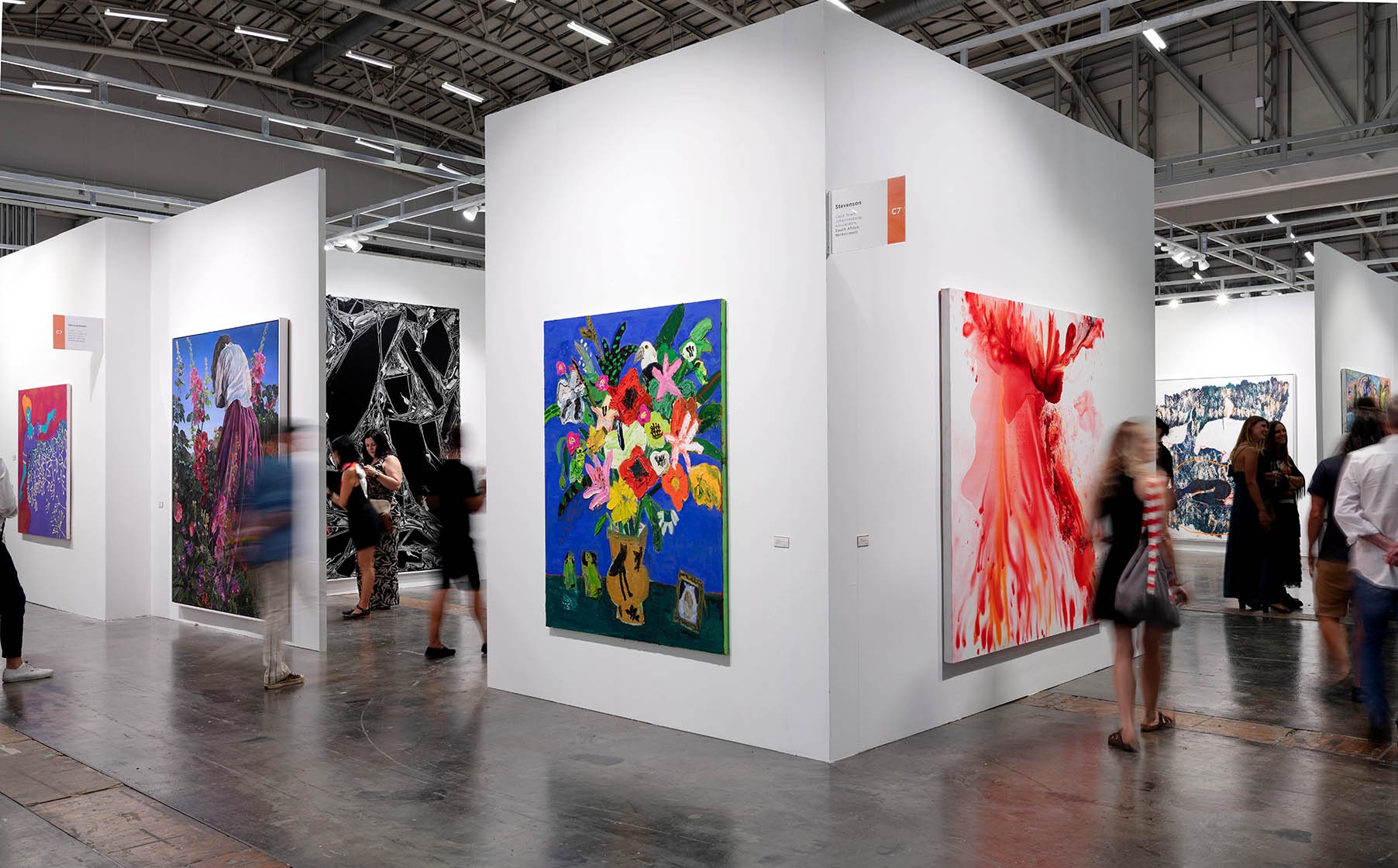
 Guests view art from Stevenson at the Investec Cape Town Art Fair 2025. (Photo: Mia Thom)
 With 126 exhibitors showcasing the work of more than 490 artists from across the globe, it comes as no surprise that the Investec Cape Town Art Fair (ICTAF) is one of the highlights of the art world’s calendar.
Although art fairs are commercially driven marketplaces, they aren’t exclusively for the seasoned art collectors and industry professionals. Art fairs also offer an opportunity for the everyday person to deepen their appreciation for contemporary art.
To better understand how we can make the most of ICTAF, whether as a connoisseur or a newcomer, Daily Maverick spoke to one of the fair’s curators, Tandazani Dhlakama, to get her insights and advice.
/file/attachments/orphans/QhamanandeMaswanaSoftandsilkythorns2024_99LoopGallery_861857.jpg "Soft and silky thorns, 2024. (Image: Qhamanande Maswana / Courtesy of 99 Loop Gallery)")
Why should you attend an art fair?
Visiting an art fair isn’t like visiting a museum. Dhlakama explains that while museum exhibitions typically take you on a narrative journey, ICTAF is a chance to get a “lay of the land” when it comes to regional and international art.
“You can literally see 100 artworks in one weekend,” she says. “And the nice thing about a fair is that there will always be surprises.”
Another unique aspect of a fair is that you’re able to interact with the gallerists representing the artists or the artists themselves. “So you can ask questions,” Dhlakama says, “and it’s almost like it’s an instant way of understanding the art.”
How should you navigate an art fair?
The Cape Town Art Fair is credited as the largest art fair in Africa for a reason, which means that it could be an overwhelming experience at first. So, how do you figure out where to begin exploring?
Dhlakama recommends starting with the curated sections, because they follow a narrative or thematic thread that ties the artworks together.
“There’s already kind of like a narrative or a journey that the curator has created to help viewers look at specific things within the artwork,” she says.
This year’s ICTAF features 10 distinct sections, including four curated by international figures of the art world – Tomorrows/Today (curated by Dr Mariella Franzoni), SOLO (curated by Céline Seror), Generations (curated by Dhlakama) and Cabinet/Record (curated by Beata America) – each speaking in their own way to the fair’s overarching theme of “Listen”.
But, for those who lean more towards spontaneity, there is another approach to getting around the fair, and that is to simply walk through the venue, row by row.
Dhlakama describes how she uses this method herself when attending a fair for the first time: “I take a picture of the things that I find interesting. Then I do a second round where I do a slower walk-through of just the things that caught my attention.”
/file/attachments/orphans/TotemicHarmony2024150x150cmoiloilsticksacryliccollagespraybombcoffeewalnutinkburlaponcanvas_MedericTuray_776669.jpg "Totemic Harmony, 2024, 150 x 150cm oil, oil sticks, acrylic, collage, spray bomb, coffee, walnut ink, burlap on canvas. (Image: Mederic Turay)")
/file/attachments/orphans/OceanPlasticBottlewithFlowers202475x60cmacryliconcanvas_ThirzaSchaap_352041.jpg "Ocean Plastic Bottle with Flowers, 2024, 75 x 60cm acrylic on canvas. (Image: Thirza Schaap)")
Learning to ‘Listen’ to art
Needless to say, art is subjective, so there’s no better time to let your own curiosities lead the way in this setting, while still keeping an open mind for engaging with works outside your taste or interests. ICTAF’s theme for 2026 is a perfect reminder of this.
The art fair’s team defines this year’s theme of “Listen” as “an increasingly radical act” in a world that is “saturated with noise, urgency and individualistic self-expression” – an invitation for slow contemplation.
In her curated section called Generations, Dhlakama speaks to this process of active listening. By pairing two artists – one younger and one more senior — a conversation is created between them, evoking the idea of a “call-and-response” between galleries and artists.
/file/attachments/orphans/LesDfisdelaVieterracottaclayhand-builtcarvedandfired_OkitosongoKadimaJunior_903623.jpeg "Les Défis de la Vie, terracotta clay, hand-built, carved and fired. (Image: Okitosongo Kadima Junior / Courtesy of Art Formes)")
/file/attachments/orphans/SeatedSpirits2025175x146cmmixedmediaacryliconburlap_IbrahimBembaKebe_931932.jpg "Seated Spirits, 2025, 175 x 146cm mixed media acrylic on burlap. (Image: Ibrahim Bemba Kébé)")
Supporting artists through collecting
Even though ICTAF is welcoming to everyone, no matter your level of art knowledge, it is still a commercial event where art collectors can scope out the market and acquire new works.
Dhlakama highlights that ICTAF is particularly special for its range of galleries on exhibition, from the “big, powerful galleries” all the way down to the smaller ones. “I like Cape Town Art Fair because it feels more democratic,” she says. “It’s not like one of those fairs where only blue chip galleries are invited.”
Whether you’re a museum curator, a collector of African art or just starting out your collection, there is something for you to discover at the fair. “Every time you buy a work, you’re actually changing a life,” Dhlakama adds.
Once you’ve done your rounds at the fair and taken it all in, you might be leaving with a new acquisition for your collection or simply a newfound appreciation for what the contemporary art world has to offer.
As a curator, Dhlakama hopes that visitors will leave the fair with a broader perception of African art: “I want them to understand that there’s so much diversity and an endless amount of talent that they can access through the fair. And I know that, whatever notions they had of African art, they’re going to be stretched and challenged”. DM
Investec Cape Town Art Fair takes place from 20 to 22 February at the Cape Town International Convention Centre.
Comments
Scroll down to load comments...