



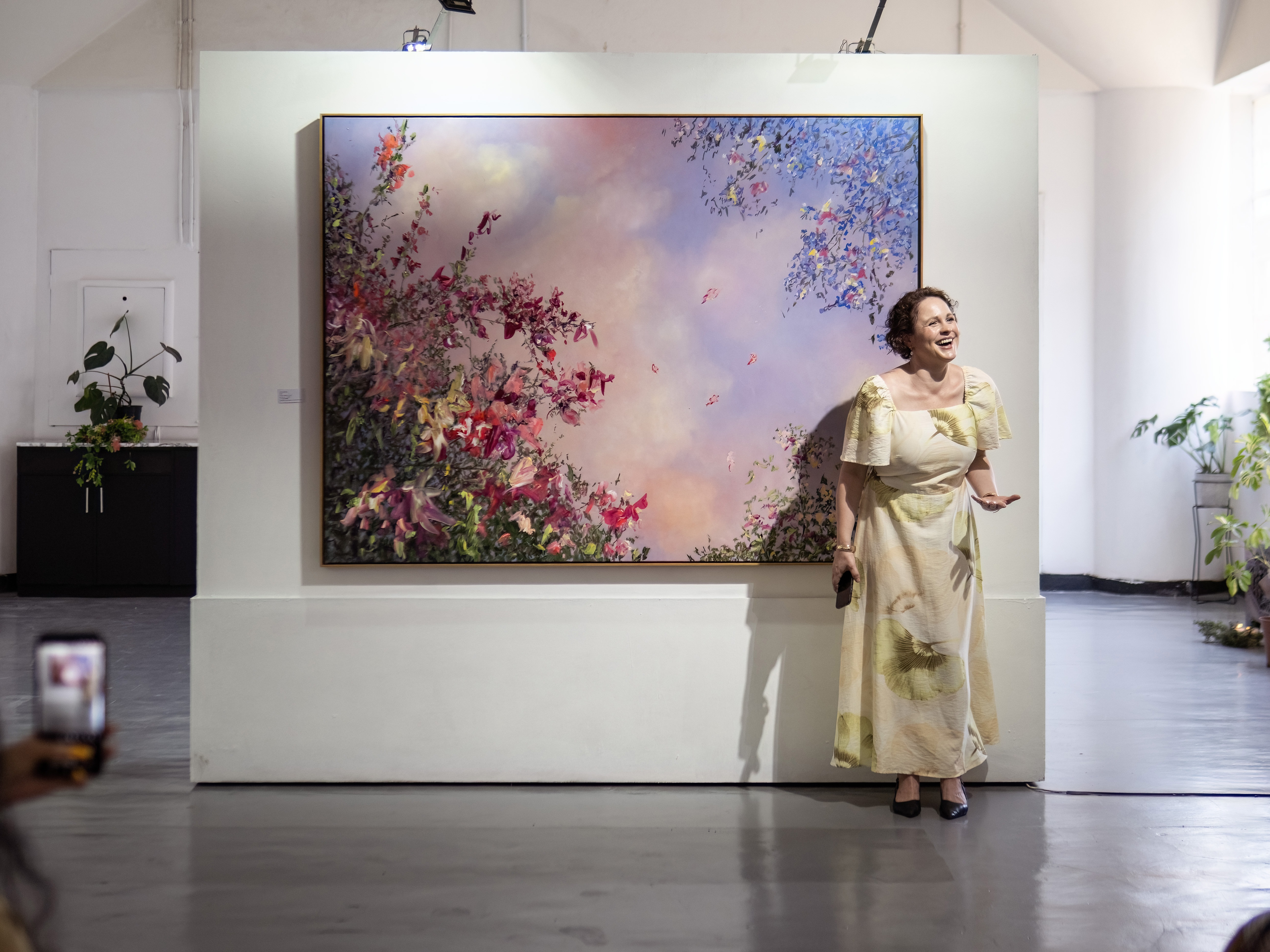
 Melissa Haiden alongside After School, whose evocative skies stirred in the author memories of childhood freedom and Johannesburg’s fleeting light. (Photo: Ryan Enslin)
I almost miss the window.
At the opening of Holywild, Melissa Haiden’s first solo exhibition, at the August House Art Building in Johannesburg, it is Architects and Invaders: Holywild II that immediately draws me in; a tall, narrow canvas filled with saturated pink flowers.
My eye travels through the colour before settling on the steel window frame behind it. The abundance feels familiar from my visit to Haiden’s studio in August, when I interviewed her about her participation in Contra.Joburg, the city-wide arts festival. She showed me some of the works she was still painting for this exhibition. The city was there, but nature had begun to claim the foreground.
I have returned to look at her flowers.
The window frame could have come from my Johannesburg apartment. I look through steel divisions like these every day, scarcely noticing them. On her canvas, the blooms spread around the frame rather than hiding it. What holds me is the way they inhabit the same space as that stubborn geometry. I love the colour, of course, but the window is what makes me recognise a city I have spent years trying to understand.
Around the corner from my apartment, the Ferreira Deep War Memorial stands beneath a magnificent jacaranda tree. A somewhat forgotten granite monument along Booysens Road, it commemorates employees of the former mine who died in World War 1.
Its purple flowering has come to mark time in my private world. For years I tried to photograph the scene, returning convinced that the next frame might finally capture what held me there. None did. A while back I put the camera away. When the jacaranda blooms now, I simply indulge in the fleeting beauty before me.
I think of that corner when I look at Haiden’s canvas. The city I love has never fitted comfortably into a single image. Its neglected buildings and the sight of a jacaranda in bloom do not cancel one another. There are days when Johannesburg makes me angry and others when I would not trade its light for anywhere else. Sometimes, I experience both on the same street as I walk by.
Haiden once wondered whether painting beauty was enough. During our August conversation she recalled looking at what other artists in Johannesburg were making and feeling that she ought to address politics and hardship too. She painted rubbish and cracks, finding decay almost romantic, but she knew the discomfort of calling a damaged place beautiful while children were unsafe walking those same streets.
Eventually the city began to feel claustrophobic. She turned towards what made her feel alive, finding it increasingly in nature and light. The city stayed in the work, though it no longer dictated the subject.
The title Architects and Invaders invites an uneasy question. Who has shaped this space, those who constructed the window or the flowers growing across it? And which is the invader? I cannot decide, and I find that I do not want to. Why should a cracked pavement be more truthful about Johannesburg than the flowers growing beside it?
The freedom to paint what drew her eye took Haiden time to claim. For years she painted privately while working as an actor, uncertain whether she could call herself an artist. She remembered painting at night to her father’s Joni Mitchell records, when nobody was around to assess what she made.
Motherhood made that private space harder to find. Saturday evenings at August House became her time. After the other artists had left, she could lose herself in colour and music once again, returning to a part of herself that had become harder to reach.
Elsewhere in the exhibition, After School draws my gaze upwards, through flowering branches into a sky still carrying the last light of day. Orange and gold give way to lavender, then to a deep blue I know intimately from evenings after the sun has disappeared beneath the horizon.
I have spent years photographing that fleeting passage between sunset and night, trying to hold on to colours that seem to change almost as I notice them. Yet standing before Haiden’s work, another part of my life unexpectedly returns to me, those hours after school, before my parents arrived home.
There were entire imaginary worlds in those afternoons. I could move between them without having to explain myself, until a car arrived or a door opened and the ordinary routines resumed.
Looking at After School, I understand why Haiden spoke about wanting her paintings to recall the intensity with which we first felt things. Her late nights with music and my hours before my parents returned are different memories. In the painting, I find a place for mine, without needing hers to be the same.
In August, Haiden told me she hoped she would always be an emerging artist. We had been discussing career labels, but she meant something more restless. The permission to change.
She was also unsure whether the works for her first solo exhibition needed to tell one coherent story. I think of that uncertainty now, having followed two of her works into quite different parts of my own life. Before leaving, I return once more to Architects and Invaders. This time, I notice the window first. DM
Holywild, curated by Sara Hallatt of the Meta Foundation, runs at the August House Art Building in Johannesburg until 5 December 2026.
Comments
Scroll down to load comments...