




 Image: Supplied
Policymakers acknowledge that play matters for development, early learning centres advertise play-based learning, and parents are urged to play with their children. In all these examples, play (and the importance of play) is given value for its function and outcome. Decades of developmental research has shown that play leads to improved emotional regulation, social competence, and problem-solving. While these are valuable outcomes, something important shifts when play is valued primarily for what it produces.
In November 1989 the United Nations adopted the the Convention on the Rights of the Child (CRC), and each year on 20 November World Children’s Day marks the adoption of the CRC to highlight ongoing efforts to promote children’s welfare and securing Child Rights. Article 31 of the CRC governs ‘children’s right to play’, and is considered ‘the forgotten right’. The widespread inaction in fulfilling we believe is partly due to uncertainty about how to define play. In this article we attempt such a definition.
We love Alison Gopnik’s definition of play as something you do when not working and that is fundamentally useless, something done for pure enjoyment and pleasure rather than with an end goal in mind. For Gopnik play needs to be “purposeless” on purpose.
In 2004, Justine Howard and her colleagues showed pre-school children pictures of a fun activity. Most children, while ‘seeing the fun’ in the activity, described it as play only when there were no adults in the picture. For the children, the simple presence of adults meant adults were controlling the activity, and therefore it was not play. A study by Natasha Goodhall and Cathy Atkinson supports this showing that children play was something “that took place with other children with little or no involvement from adults”.
We are researchers who have had the privilege of working across Africa, with amazing implementers, communities, and families. We have been in the field long enough to have seen countless changes in the approach to how we should deliver interventions to children and their families, and what should be in those interventions. One of the key shifts in the last 10-15 years has been in the use of toys as a mechanism of engaging young children in play.
Of course, improving the engagement with and cognitive stimulation of young children is a good thing. But a few things happened with this renewed focus. The first was that play became an activity that required adult involvement. As a result, play has routinely become something that caregivers ‘do with children’, or ‘do for children’. Much of the focus of current interventions has become about ‘teaching children to play’, parents getting involved in and overseeing the ‘play of children’.
This misses something fundamental. No child in history has ever needed an adult to teach them how to play.
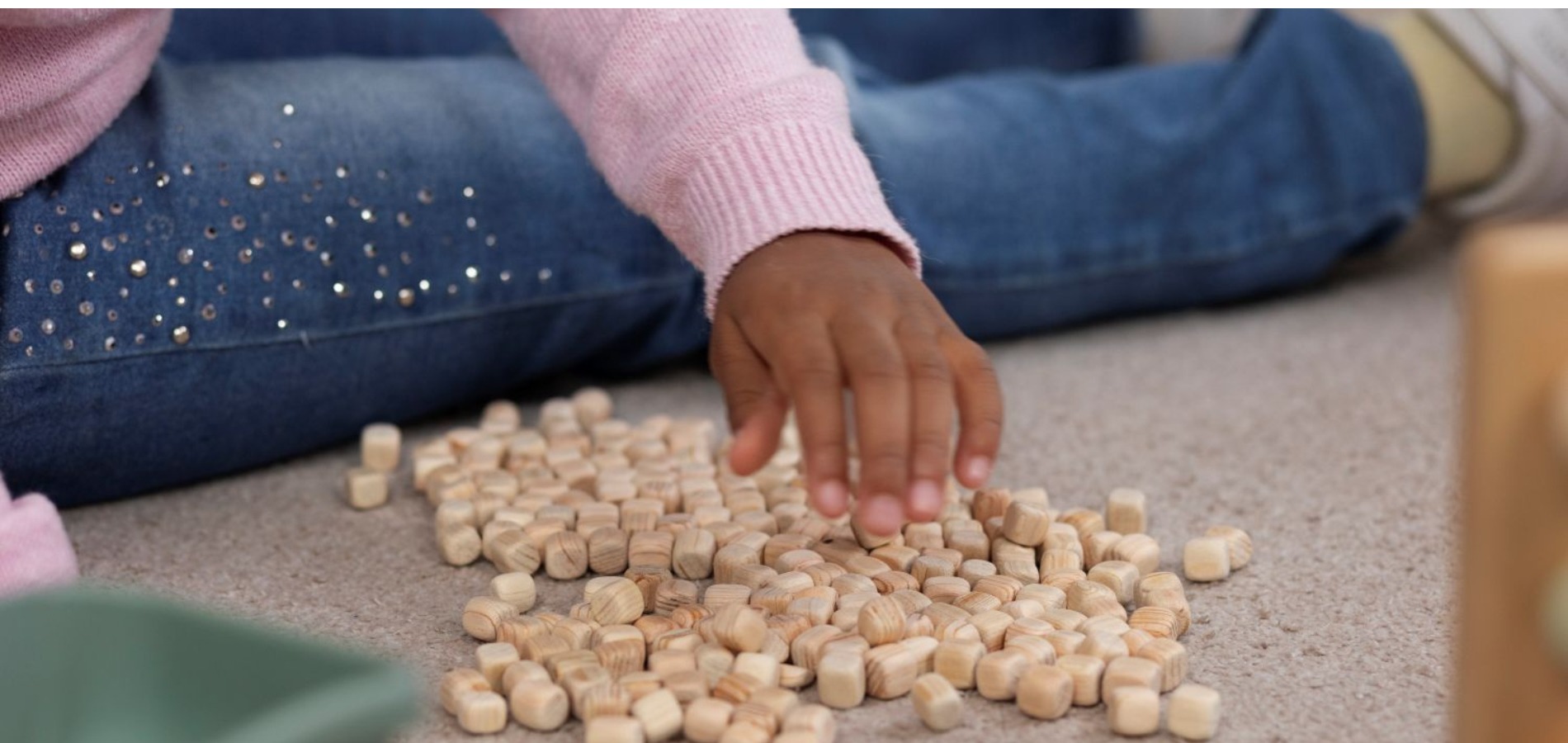
The second thing that happened has been the increased importance assigned to the availability of toys and play materials for children’s learning and development. Part of this stems from the extreme inequalities across the world in terms of access to toys and play materials. Children in rich countries drown in toys, some have entire rooms simply to house their toys. The toy industry in the United States is worth $42 billion – more than the combined GDP of 36 African countries. Of course, all children should have access to toys.
But access and inequality aside, we believe that the focus on toys has perhaps done a disservice to what play should be about.
Some years ago, we had the privilege of observing a community health worker home visit to a family with their two-year old in rural Kenya. The child sat on the floor in front of his parents for the duration of the visit playing happily with some sticks. The community health worker, who, of course, was extremely nervous being observed by the ‘foreign technical experts’, had a checklist that she was going through. At one point she asked the mother if she and her son had made the toy that they had spoken about during the last visit. The mother said yes, got up, walked to the other side of the room and took the toy down from the highest shelf. She showed the toy to the community health worker, who made a tick on her checklist, and the mother then placed the toy back on the shelf.
Should children everywhere have access to toys? Of course. Can they form part of the play of children? Absolutely. Should toys be the centerpiece of interventions to improve child development and parent-child engagement? Absolutely not. When toys are valued primarily for their educational return, play risks becoming another site of performance and productivity. Parents, understandably wanting to support their child’s development, may feel pressure to curate play environments filled with supposedly enriching materials.
Play is not about a toy that must be made, an activity that should be guided by a parent, or a task that should be scheduled. Play must have the form of being useless, purposeless, and without the function of a product or a goal. When play becomes primarily about toys, we are witnessing the victory of function over form.
Play should always be “the ultimate expression of freedom for its own sake”. DM
Authors: Mark Tomlinson and Marguerite Marlow

Prof Mark Tomlinson is co-director of the Institute for Life Course Health Development in the Department of Global Health at Stellenbosch University (SU). Dr Marguerite Marlow is a senior researcher in the Institute for Life Course Health Development in the Department of Global Health at SU.