




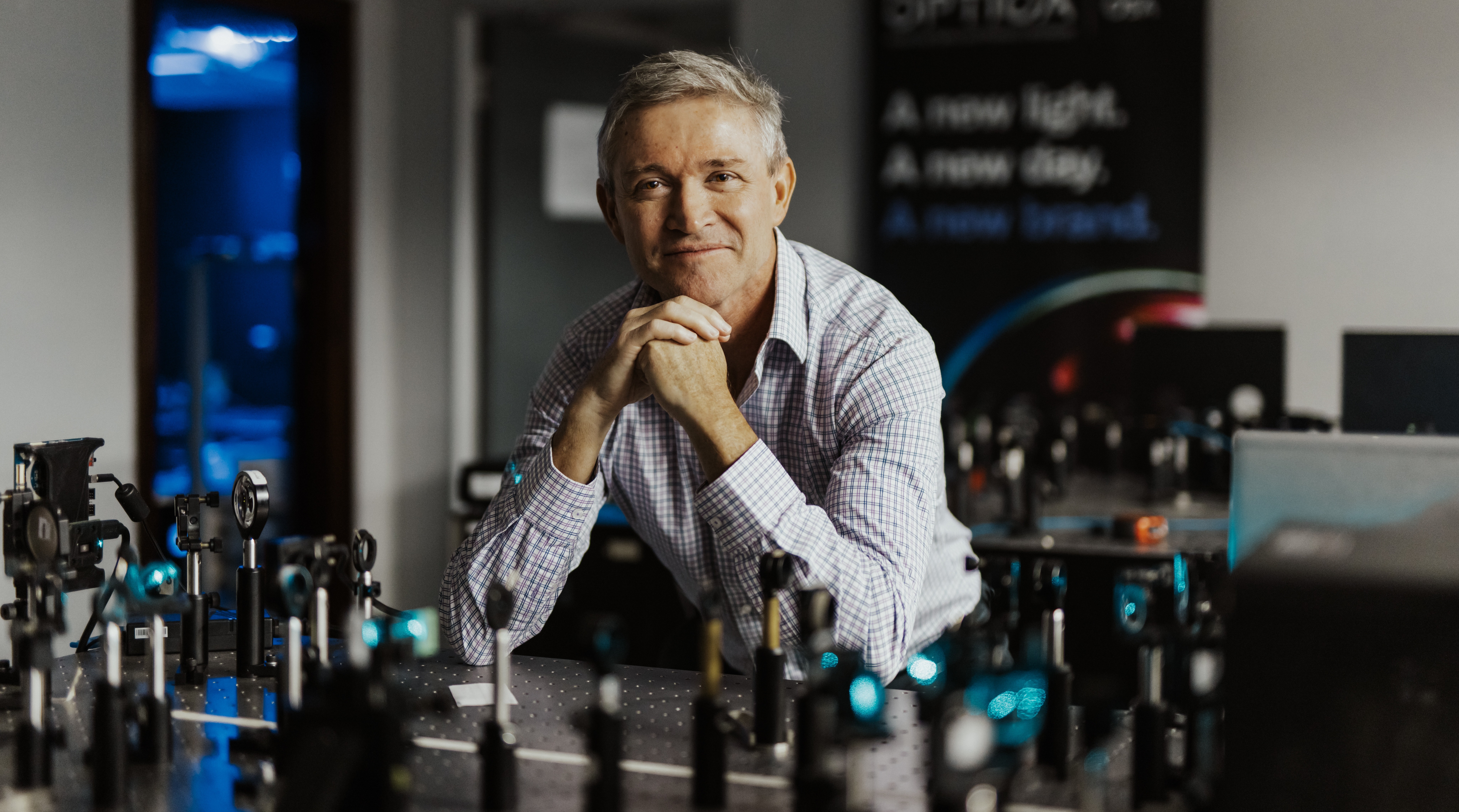
 Professor Andrew Forbes.
Scientists at the University of the Witwatersrand (Wits) have launched a photonics company to turn their research into the extraordinary properties of light into technologies for industries ranging from telecommunications and manufacturing to medicine.
Button Optics, a spin-out from the Wits Structured Light Laboratory, builds on a decade of research led by Distinguished Professor Andrew Forbes into how light can be shaped, manipulated and controlled for different purposes.
The company enters a major international industry. Photonics, the science and technology of light, serves as the foundation of everything from fibre-optic communications and smartphones to solar power, laser manufacturing and medical imaging.
Light-based technologies enable an estimated US$16 trillion in global economic activity, illustrating the scale of an industry in which Forbes believes African scientists should play a greater role.
Pushing the boundaries of light
The Structured Light Laboratory at Wits has become internationally recognised for its work investigating properties of light that extend far beyond the familiar characteristics of colour and brightness.
Its scientists have developed techniques to twist and shape light, transmit information securely through optical networks, overcome distortions that interfere with communications, and manipulate light to investigate quantum physics.
Structured light involves controlling properties such as the shape, polarisation and spatial pattern of a light beam. This gives you the ability to tailor light in any way. A tightly focused beam, for example, can improve the precision of laser manufacturing, while twisted light can carry additional information through communication networks. Other forms of structured light can detect chemical properties important in pharmaceutical production.
Forbes says the laboratory's scientific advances revealed an important problem: many potential applications remained confined to specialist laboratories because the equipment and expertise needed to use them were not commercially accessible.
“Structured light has exploded over the past decade and has opened up exciting physics as well as real-world applications, from communications to manufacturing. The many requests for help and advice we get identified a gap – everyone should be using structured light, but only the experts understand how to do so.”

From science to technology
Button Optics aims to close that gap by making sophisticated optical technologies accessible to researchers and industries without requiring them to become structured-light specialists.
Its first product, Lightweaver I, combines optical hardware and digital software into a system that creates different forms of structured light on demand.
The device allows researchers to generate specialised light beams, manipulate their properties and simulate conditions such as atmospheric turbulence.
Turning the laboratory's research into a commercial product took three years, with challenges including limited access to specialist engineering expertise, manufacturing infrastructure and supply chains in South Africa.
The development was funded by the University Technology Fund. Button Optics has already made its first international sales, even before formally entering the market.
“Invention is easy – we are trained to come up with new ideas – but turning ideas into tangible products or socio-economic impact takes time and dedication,” says Forbes.
Building an African photonics business
Lightweaver I is the first step in a broader commercial strategy that aims to turn the laboratory's continuing scientific discoveries into technologies for global markets.
The company is developing further products for laser diagnostics and photonics education, while its longer-term ambitions include ophthalmology, pharmaceutical production and advanced optical communications.
Its technology roadmap also draws on Wits research into transmitting information securely through light, overcoming distortion in optical networks and developing light-based approaches to artificial intelligence and quantum technologies.
These capabilities could eventually have applications in cybersecurity, banking, telecommunications and energy-efficient data centres.
Button Optics and its Wits advisory board are engaging potential investors and strategic partners to secure the capital and commercial expertise needed to develop these technologies.
“We have the underlying technology for these lucrative sectors, we have the expertise and we just need the right partners to roll out the technology development and business plan,” says Forbes.
“The transition from world-class science to economic and societal impact is very much part of the Wits innovation vision,” says Professor Lynn Morris, Deputy Vice-Chancellor: Research and Innovation at Wits. “This speaks to Wits being ranked first for innovation in sub-Saharan Africa.”
For Forbes, the ambition is to establish an African technology company capable of bringing advanced scientific research into international markets.
“In 2027 we will take Button Optics out on the world stage, where our science has been for decades, and showcase what can be done in Africa.” DM