




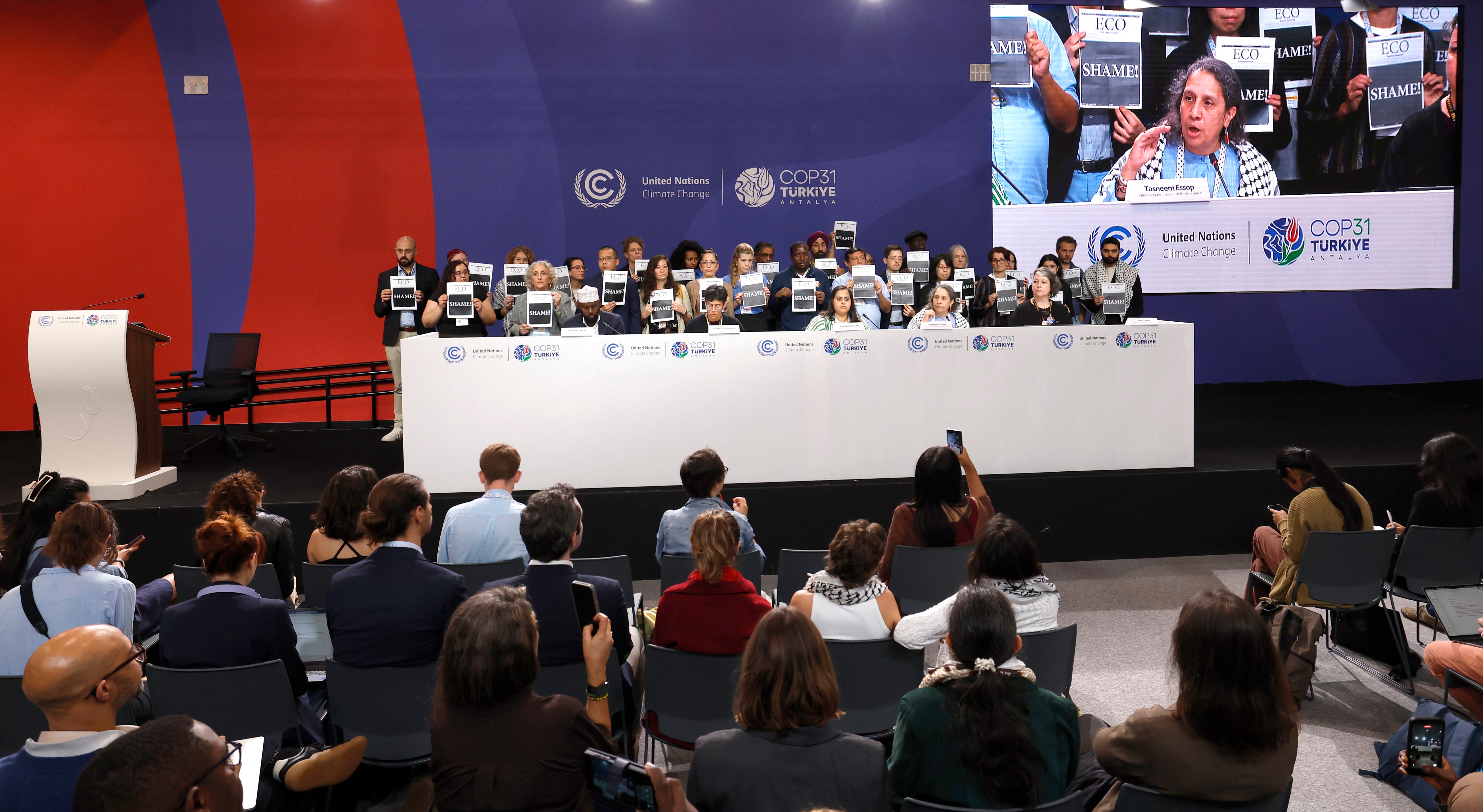
 Activists with the Climate Action Network – International stage a protest during a press conference on the last day of the COP31 summit in Antalya, Turkey, on 20 November 2026. (Photo: EPA / Antonio Bat)
And that’s all, folks. When the world’s most important climate talks collapsed in Antalya over the weekend, the most terrifying thing was not that almost 200 countries could not agree on a text.
It was that almost nobody seems to care. The collapse of the marathon talks barely registered as a surprise. It was met with a shrug of resignation.
COP31 ended without a final agreement after an irretrievable rift opened between a bloc of nations led by Saudi Arabia, and a coalition of countries including the EU, UK, Norway, Panama, Vanuatu and a group of least developed countries.
They refused to accept the text as it made no mention of fossil fuels – the principal cause of the problem the conference exists to solve.
Such an outcome would have been equivalent to a Nuremberg Trials where no one mentioned the Nazis.
This is the first COP since Copenhagen in 2009 to end without a final agreement. And it was not for want of effort; after a fortnight, the talks ran two days into overtime, making these the longest session the UN has convened in its 31 years of trying.
“It is unconscionable that we would have a climate pact that makes no reference to fossil fuels – and no reference to transition away from fossil fuel either,” said Darragh O’Brien, climate minister for Ireland, which holds the rotating EU presidency, to applause in the final plenary.
Across the room, the case was made with indifference. Saudi Arabia, speaking for the 22-nation Arab group, defended carbon capture as a concrete solution. Its chief virtue, of course, is that it allows petrostates to keep pumping the oil and gas their economies depend on. Qatar, Iran and Russia lined up behind it.
“We cannot agree to any wording on fossil fuels,” said Russia’s representative, which was at least honest. China, the world’s largest emitter, fell into line behind its polluting peers, as did India.
Fossil fuels were not the only reef the Antalya accord ran aground on. There were long-running disputes over finance for countries coping with climate change, and even disputes over the scientific reports themselves. When negotiators cannot even agree on what the science says, it is generous to call what follows a negotiation.
The context of this failure makes it worse. This was the first summit since a UN report found that global warming is set to overshoot the 1.5°C threshold that had been agreed in Paris more than a decade ago, beyond which extreme weather intensifies. It also followed months of catastrophic floods in Nepal and the hottest summer in European history.
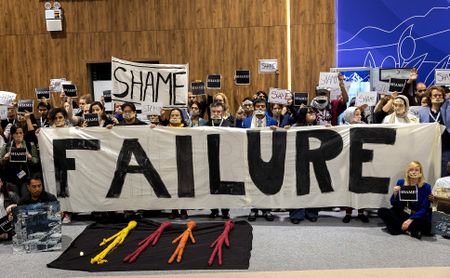
A symptom, not cause
Yet the fossil feud wording fracas is a symptom, not the disease. The reason Antalya failed is the same reason why trying to stop climate change increasingly looks like a lost cause.
Years ago, I walked out of an environmental economics lecture at the University of Edinburgh feeling utterly despondent. The professor had laid out the fundamental problem with the economics of climate change; it is a prisoner’s dilemma playing out on a global scale.
Every country is better off if we all cooperate and cut emissions. But each is individually better off carrying on polluting, while others bear the cost of cutting. Absent an enforcer, the rational strategy is to defect. Countries will not cooperate to save humanity because they know their neighbours will not either.

Antalya played out precisely as he predicted.
The petrostates defected openly. China and India defected quietly, accepting a text that asked nothing of them. And the one actor strong enough to change the payoffs for all was not even in the room.
The US skipped the talks for the second year running. Under President Donald Trump, climate change has not so much been argued away as dropped from the agenda entirely, dismissed as “politicised” and filed as further evidence of the “woke mind virus”.

Who wins?
It is worth asking who benefits. Fossil fuel producers, obviously, who are printing record profits on the back of rocketing energy prices. But this will also be a relief for the tech and AI lobby, if they even deign to care. Data centres need every electron they can get their hands on.
There have even been reports of US data centres running on their own gas turbines.
As ever with politics in the US, the pendulum is swinging back. After a crushing midterm election victory, the Democrats are favourites for the White House in 2028, and a Democrat president would be far more amenable to the COP process and the green agenda. But is this enough? The damage is done.
A country that joins the Paris accord, leaves, rejoins and leaves again cannot expect anyone to treat its commitments as durable. In a prisoner’s dilemma, the only thing that rescues the protagonists and ensures cooperation is trust that the other side will still be cooperating tomorrow. That trust is precisely what Washington has squandered.
Which is why, when China and India decline to sign up to the language on fossil fuels, their argument is hard to dismiss.
Why should they bind themselves, as developing countries, when the world’s largest economy and biggest historical emitter does not even bother to turn up? Whatever sacrifices are made by India and China, the dilemma cannot be solved without the US at the table.
Previous generations were defined by the fall of the Berlin Wall or the Enlightenment. We got Facebook and a dying planet.
History is unlikely to be kind. DM
Comments
Scroll down to load comments...